



 Chat with AI
Exam 3: Interdependence and the Gains From Trade

Exam 1: Ten Principles of Economics455 Questions
Exam 2: Thinking Like an Economist643 Questions
Exam 3: Interdependence and the Gains From Trade547 Questions
Exam 4: The Market Forces of Supply and Demand693 Questions
Exam 5: Elasticity and Its Application626 Questions
Exam 6: Supply, Demand, and Government Policies668 Questions
Exam 7: Consumers, Producers, and the Efficiency of Markets547 Questions
Exam 8: Applications: the Costs of Taxation509 Questions
Exam 9: Application: International Trade521 Questions
Exam 10: Externalities543 Questions
Exam 11: Public Goods and Common Resources452 Questions
Exam 12: The Design of the Tax System664 Questions
Exam 13: The Costs of Production649 Questions
Exam 14: Firms in Competitive Markets604 Questions
Exam 15: Monopoly662 Questions
Exam 16: Monopolistic Competition649 Questions
Exam 17: Oligopoly522 Questions
Exam 18: The Markets for the Factors of Production592 Questions
Exam 19: Earnings and Discrimination511 Questions
Exam 20: Income Inequality and Poverty478 Questions
Exam 21: The Theory of Consumer Choice570 Questions
Exam 22: Frontiers in Microeconomics461 Questions
Exam 23: Measuring a Nation S Income547 Questions
Exam 24: Measuring the Cost of Living565 Questions
Exam 25: Production and Growth527 Questions
Exam 26: Saving, Investment, and the Financial System637 Questions
Exam 27: Tools of Finance534 Questions
Exam 28: Unemployment and Its Natural Rate701 Questions
Exam 29: The Monetary System540 Questions
Exam 30: Money Growth and Inflation504 Questions
Exam 31: Open-Economy Macroeconomics: Basic Concepts540 Questions
Exam 32: A Macroeconomic Theory of the Open Economy511 Questions
Exam 33: Aggregate Demand and Aggregate Supply572 Questions
Exam 34: The Influence of Monetary and Fiscal Policy on Aggregate Demand523 Questions
Exam 35: The Short-Run Tradeoff Between Inflation and Unemployment536 Questions
Exam 36: Six Debates Over Macroeconomic Policy354 Questions
Select questions type


Table 3-24
Assume that England and Spain can switch between producing cheese and producing bread at a constant rate.

-Refer to Table 3-24. The opportunity cost of 1 unit of bread for Spain is
-Refer to Table 3-24. The opportunity cost of 1 unit of bread for Spain is (Multiple Choice)
4.7/5  (85)
(85) Figure 3-2
Brazil's Production Possibilities Frontier  -Refer to Figure 3-2. If the production possibilities frontier shown is for 24 hours of production, then how long does it take Brazil to make one cashew?
 (Multiple Choice)
4.7/5 (76)
(76) Table 3-30
Assume that Falda and Varick can switch between producing wheat and producing cloth at a constant rate.  -Refer to Table 3-30. Falda has a comparative advantage in the production of
 (Multiple Choice)
4.8/5 (84)
(84) Figure 3-17
Maxine's Production Possibilities Frontier
Daisy's Production Possibilities Frontier 
 -Refer to Figure 3-17. If Maxine and Daisy switch from each person dividing her time equally between the production of pies and tarts to each person spending all of her time producing the good in which she has a comparative advantage, then total production of tarts will increase by
 (Multiple Choice)
4.9/5 (73)
(73) Olivia bakes cakes and Andrew grows corn. Olivia and Andrew both like to eat cake and eat corn. In which of the following cases is it impossible for both Olivia and Andrew to benefit from trade?
(Multiple Choice)
4.9/5 (81)
(81) Figure 3-20
Canada's Production Possibilities Frontier
Mexico's Production Possibilities Frontier 
 -Refer to Figure 3-20. Canada would incur an opportunity cost of 6 units of Good X if it increased its production of Good Y by
 (Multiple Choice)
4.8/5 (80)
(80) Figure 3-13
Peru's Production Possibilities Frontier  -Refer to Figure 3-13. Suppose Madagascar is willing to trade 40 rubies to Peru for each emerald that Peru produces and sends to Madagascar. Which of the following combinations of emeralds and rubies could Peru then consume, assuming Peru specializes in emerald production?
 (Multiple Choice)
4.8/5 (69)
(69) Figure 3-15
Perry's Production Possibilities Frontier
Jordan's Production Possibilities Frontier 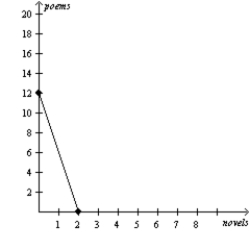
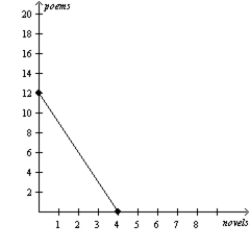 -Refer to Figure 3-15. Perry should specialize in the production of
 (Multiple Choice)
4.9/5 (65)
(65) Table 3-27
Assume that Huang and Min can switch between producing parasols and producing porcelain plates at a constant rate.
 -Refer to Table 3-27. The opportunity cost of 1 plate for Huang is
 (Multiple Choice)
4.9/5 (79)
(79) Suppose that the country of Xenophobia chose to isolate itself from the rest of the world. Its ruler proclaimed that Xenophobia should become self-sufficient, so it would not engage in foreign trade. From an economic perspective, this idea would
(Multiple Choice)
4.9/5 (74)
(74) Table 3-27
Assume that Huang and Min can switch between producing parasols and producing porcelain plates at a constant rate.
-Refer to Table 3-27. The opportunity cost of 1 parasol for Huang is
-Refer to Table 3-27. The opportunity cost of 1 parasol for Huang is (Multiple Choice)
4.9/5 (81)
(81) Table 3-11
Assume that Max and Min can switch between producing mittens and producing hats at a constant rate.
 -Refer to Table 3-11. Which of the following points would be on Min's production possibilities frontier, based on a 36-hour production period?
 (Multiple Choice)
4.9/5 (81)
(81) Table 3-26
Assume that Japan and Korea can switch between producing cars and producing airplanes at a constant rate.
 -Refer to Table 3-26. Japan has an absolute advantage in the production of
 (Multiple Choice)
4.9/5 (86)
(86) Figure 3-18
Bintu's Production Possibilities Frontier
Juba's Production Possibilities Frontier 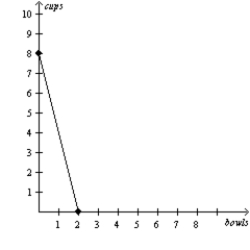
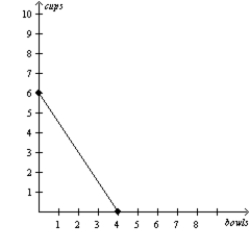 -Refer to Figure 3-18. The opportunity cost of 1 cup for Bintu is
 (Multiple Choice)
4.8/5 (79)
(79) Table 3-20
Assume that Brad and Theresa can switch between producing wheat and producing beef at a constant rate.  -Refer to Table 3-20. What is Brad's opportunity cost of producing one bushel of wheat?
 (Multiple Choice)
5.0/5 (79)
(79) Serena Williams should pay someone else to mow her lawn instead of mowing it herself, unless
(Multiple Choice)
4.9/5 (89)
(89) Consider two individuals - Howard and Mai - each of whom would like to wear sweaters and eat tasty food. The gains from trade between Howard and Mai are least obvious in which of the following cases?
(Multiple Choice)
4.8/5 (87)
(87) Figure 3-13
Peru's Production Possibilities Frontier
-Refer to Figure 3-13. Suppose Peru decides to increase its production of rubies by 30. What is the opportunity cost of this decision?
-Refer to Figure 3-13. Suppose Peru decides to increase its production of rubies by 30. What is the opportunity cost of this decision? (Multiple Choice)
4.9/5 (76)
(76) Table 3-33
Chris and Tony's Production Opportunities  -Refer to Table 3-33 Chris and Tony both produce tomatoes and pasta sauce. The table shows their possible production per month if both work the same number of 8 hour days. Given this information, Chris's opportunity cost of 1 lb. of tomatoes is
 (Multiple Choice)
4.8/5 (68)
(68) Table 3-37 
-Refer to Table 3-37. Sarah and Charles are both potters and each can switch between the production of vases and mugs at a constant rate. The table shows the total number of vases or decorative mugs that each person can produce in a six-hour session of producing pottery. Suppose that Sarah and Charles produce for two 6-hour sessions and they split this time equally between the production of vases and mugs. If they then produce for two 6-hour sessions and produce only the good that each person has the comparative advantage for, then total production of
-Refer to Table 3-37. Sarah and Charles are both potters and each can switch between the production of vases and mugs at a constant rate. The table shows the total number of vases or decorative mugs that each person can produce in a six-hour session of producing pottery. Suppose that Sarah and Charles produce for two 6-hour sessions and they split this time equally between the production of vases and mugs. If they then produce for two 6-hour sessions and produce only the good that each person has the comparative advantage for, then total production of (Multiple Choice)
4.8/5 (76)
(76) 
Filters
- Essay(0)
- Multiple Choice(0)
- Short Answer(0)
- True False(0)
- Matching(0)