



 Chat with AI
Exam 5: Elasticity and Its Application

Exam 1: Ten Principles of Economics455 Questions
Exam 2: Thinking Like an Economist643 Questions
Exam 3: Interdependence and the Gains From Trade547 Questions
Exam 4: The Market Forces of Supply and Demand693 Questions
Exam 5: Elasticity and Its Application626 Questions
Exam 6: Supply, Demand, and Government Policies668 Questions
Exam 7: Consumers, Producers, and the Efficiency of Markets547 Questions
Exam 8: Applications: the Costs of Taxation509 Questions
Exam 9: Application: International Trade521 Questions
Exam 10: Externalities543 Questions
Exam 11: Public Goods and Common Resources452 Questions
Exam 12: The Design of the Tax System664 Questions
Exam 13: The Costs of Production649 Questions
Exam 14: Firms in Competitive Markets604 Questions
Exam 15: Monopoly662 Questions
Exam 16: Monopolistic Competition649 Questions
Exam 17: Oligopoly522 Questions
Exam 18: The Markets for the Factors of Production592 Questions
Exam 19: Earnings and Discrimination511 Questions
Exam 20: Income Inequality and Poverty478 Questions
Exam 21: The Theory of Consumer Choice570 Questions
Exam 22: Frontiers in Microeconomics461 Questions
Exam 23: Measuring a Nation S Income547 Questions
Exam 24: Measuring the Cost of Living565 Questions
Exam 25: Production and Growth527 Questions
Exam 26: Saving, Investment, and the Financial System637 Questions
Exam 27: Tools of Finance534 Questions
Exam 28: Unemployment and Its Natural Rate701 Questions
Exam 29: The Monetary System540 Questions
Exam 30: Money Growth and Inflation504 Questions
Exam 31: Open-Economy Macroeconomics: Basic Concepts540 Questions
Exam 32: A Macroeconomic Theory of the Open Economy511 Questions
Exam 33: Aggregate Demand and Aggregate Supply572 Questions
Exam 34: The Influence of Monetary and Fiscal Policy on Aggregate Demand523 Questions
Exam 35: The Short-Run Tradeoff Between Inflation and Unemployment536 Questions
Exam 36: Six Debates Over Macroeconomic Policy354 Questions
Select questions type


Figure 5-14  -Refer to Figure 5-14. Using the midpoint method, what is the price elasticity of supply between $16 and $40?
 (Multiple Choice)
4.9/5  (69)
(69) Table 5-2  -Refer to Table 5-2. Using the midpoint method, if the price falls from $150 to $100, the absolute value of the price elasticity of demand is
 (Multiple Choice)
4.9/5 (85)
(85) For which of the following goods is the income elasticity of demand likely highest?
(Multiple Choice)
4.8/5 (76)
(76) OPEC failed to maintain a high price of oil in the long run, partly because both the supply of oil and the demand for oil are more elastic in the long run than in the short run.
(True/False)
4.7/5 (92)
(92) Table 5-9
 -Refer to Table 5-9. Which of the three supply curves represents the least elastic supply?
 (Multiple Choice)
4.8/5 (73)
(73) Even the demand for a necessity such as gasoline will respond to a change in price, especially over a longer time horizon.
(True/False)
4.9/5 (80)
(80) There are fewer farmers in the United States today than 200 years ago because of
(Multiple Choice)
4.9/5 (83)
(83) The discovery of a new hybrid wheat would increase the supply of wheat. As a result, wheat farmers would realize an increase in total revenue if the
(Multiple Choice)
4.9/5 (81)
(81) Measures of elasticity enhance our ability to study the magnitudes of changes in quantities in response to changes in prices or income.
(True/False)
4.8/5 (79)
(79) Suppose the point (Q = 3,400, P = $20) is the midpoint on a certain downward-sloping, linear demand curve. Then
(Multiple Choice)
4.8/5 (67)
(67) For which pairs of goods is the cross-price elasticity most likely to be positive?
(Multiple Choice)
4.9/5 (81)
(81) Figure 5-7  -Refer to Figure 5-7. For prices below $5, demand is price
 (Multiple Choice)
4.7/5 (72)
(72) Which of the following is likely to have the most price elastic demand?
(Multiple Choice)
4.9/5 (82)
(82) Suppose that 300 bottles of soda are demanded at a particular price. If the price of a bottle of soda rises from that price by 6 percent, the number of bottles of soda demanded falls to 275. Using the midpoint approach to calculate the price elasticity of demand, it follows that the
(Multiple Choice)
4.8/5 (76)
(76) Figure 5-9  -Refer to Figure 5-9. If the price rises from point D to point C, total revenue
 (Multiple Choice)
4.9/5 (76)
(76) Figure 5-4 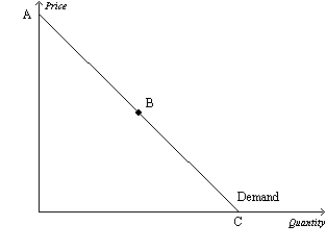 -Refer to Figure 5-4. The section of the demand curve from A to B represents the
 (Multiple Choice)
5.0/5 (87)
(87) If the demand curve is linear and downward sloping, which of the following statements is not correct?
(Multiple Choice)
4.8/5 (62)
(62) 
Filters
- Essay(0)
- Multiple Choice(0)
- Short Answer(0)
- True False(0)
- Matching(0)