



 Chat with AI
Exam 13: Capital Investment Decisions: Appraisal Methods

Exam 1: Introduction to Management Accounting49 Questions
Exam 2: An Introduction to Cost Terms and Concepts64 Questions
Exam 3: Cost Assignment29 Questions
Exam 4: Accounting Entries for a Job Costing System15 Questions
Exam 5: Process Costing29 Questions
Exam 6: Joint and By-Product Costing61 Questions
Exam 7: Income Effects of Alternative Cost Accumulation Systems45 Questions
Exam 8: Cost-Volume-Profit Analysis60 Questions
Exam 9: Measuring Relevant Costs and Revenues for Decision-Making81 Questions
Exam 10: Activity-Based Costing40 Questions
Exam 11: Pricing Decisions and Profitability Analysis59 Questions
Exam 12: Decision-Making Under Conditions of Risk and Uncertainty29 Questions
Exam 13: Capital Investment Decisions: Appraisal Methods77 Questions
Exam 14: Capital Investment Decisions: the Impact of Capital Rationing, Taxation, Inflation and Risk25 Questions
Exam 15: The Budgeting Process86 Questions
Exam 16: Management Control Systems64 Questions
Exam 17: Standard Costing and Variance Analysis 181 Questions
Exam 18: Standard Costing and Variance Analysis 2: Further Aspects12 Questions
Exam 19: Divisional Financial Performance Measures51 Questions
Exam 20: Transfer Pricing in Divisionalized Companies50 Questions
Exam 21: Cost Management95 Questions
Exam 22: Strategic Management Accounting32 Questions
Exam 23: Cost Estimation and Cost Behaviour63 Questions
Exam 24: Quantitative Models for the Planning and Control of Stocks42 Questions
Exam 25: The Application of Linear Programming to Management Accounting30 Questions
Select questions type


The problem with the accounting rate of return is that it fails to consider the:
(Multiple Choice)
4.9/5  (72)
(72) Mitchell, Inc., is considering two mutually exclusive projects. Project 1 requires an investment of £80,000, while Project 2 requires an investment of £90,000.
Cash revenues and cash costs for each project are shown below: 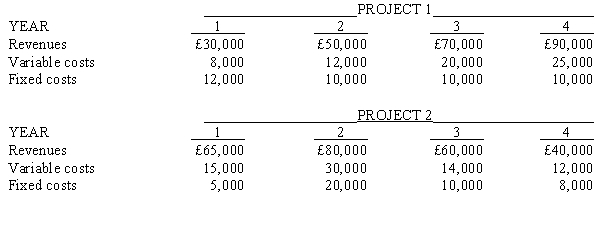 The company estimates that at the end of the fourth year Project 1 would have a salvage value of £10,000 and Project 2 would have a salvage value of £5,000.
Required:
a.
Determine the net present value of EACH project using an 8 per cent discount rate.
b.
Prepare a memorandum for management stating your recommendation. Include supporting calculations in good form.
The company estimates that at the end of the fourth year Project 1 would have a salvage value of £10,000 and Project 2 would have a salvage value of £5,000.
Required:
a.
Determine the net present value of EACH project using an 8 per cent discount rate.
b.
Prepare a memorandum for management stating your recommendation. Include supporting calculations in good form. (Essay)
4.8/5 (75)
(75) A firm is considering a project with annual cash flows of £120,000. The project would have an 8-year life, and the company uses a discount rate of 12 per cent. What is the maximum amount the company could invest in the project and the project still be acceptable?
(Multiple Choice)
4.9/5 (80)
(80) Maxim, Inc., is considering two mutually exclusive projects. Project 1 requires an investment of £40,000, while Project 2 requires an investment of £30,000. Cash revenues and cash costs for each project are shown below. 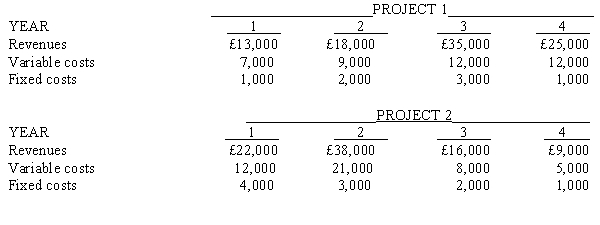 The company estimates that at the end of the fourth year Project 1 would have a salvage value of £3,000 and Project 2 would have a salvage value of £1,000.
Required:
a.
Determine the net present value of EACH project using a 16 per cent discount rate.
b.
Prepare a memorandum for management stating your recommendation. Include supporting calculations in good form.
The company estimates that at the end of the fourth year Project 1 would have a salvage value of £3,000 and Project 2 would have a salvage value of £1,000.
Required:
a.
Determine the net present value of EACH project using a 16 per cent discount rate.
b.
Prepare a memorandum for management stating your recommendation. Include supporting calculations in good form. (Essay)
4.9/5 (77)
(77) Figure 13-3
Glady, Inc., is considering the purchase of production equipment that costs £800,000. The equipment is expected to generate annual cash inflows of £250,000. The equipment is expected to have a useful life of five years with no salvage value. The firm's cost of capital is 14 per cent.
-Refer to Figure 13-3. Excluding the effect of income taxes, Glady's net present value of the project is
(Multiple Choice)
4.9/5 (86)
(86) Projects that, if accepted, preclude the acceptance of competing projects are
(Multiple Choice)
4.7/5 (73)
(73) A capital investment project requires an investment of £145,000 and has an expected life of four years. Annual cash flows at the end of each year are expected to be as follows:  Required:
a.
Compute payback assuming that the cash flows occur evenly throughout the year.
b.
Compute the net present value of the project using an 8 per cent discount rate.
Required:
a.
Compute payback assuming that the cash flows occur evenly throughout the year.
b.
Compute the net present value of the project using an 8 per cent discount rate. (Essay)
4.9/5 (69)
(69) Figure 13-3
Glady, Inc., is considering the purchase of production equipment that costs £800,000. The equipment is expected to generate annual cash inflows of £250,000. The equipment is expected to have a useful life of five years with no salvage value. The firm's cost of capital is 14 per cent.
-Refer to Figure 13-3. The approximate internal rate of return of Glady's project is
(Multiple Choice)
4.9/5 (78)
(78) Which of the following capital investment models would be preferred when choosing among mutually exclusive alternatives?
(Multiple Choice)
4.9/5 (84)
(84) Figure 13-5 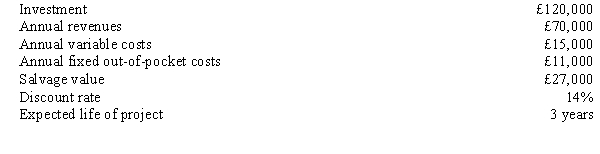 -Refer to Figure 13-5. The present value of the annual net cash inflows from operations is
 (Multiple Choice)
4.8/5 (91)
(91) The present value of £2,000 to be received each year for three years and earning a 10 per cent return is
(Multiple Choice)
4.9/5 (97)
(97) 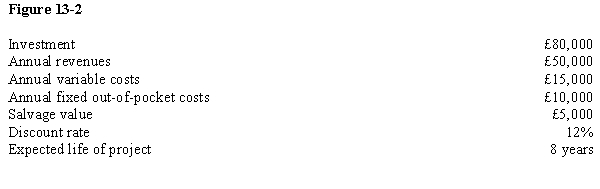 -Refer to Figure 13-2. The net present value of the project is
 (Multiple Choice)
4.8/5 (84)
(84) Lake Kariba Company is considering buying a new boat that would cost £120,000. The accountant determined that the boat promises an internal rate of return of 10 per cent and has a life of four years. The accountant resigned and the president wanted to check her calculations. What were the approximate annual net cash inflows from the project?
(Multiple Choice)
4.8/5 (90)
(90) Figure 13-3
Glady, Inc., is considering the purchase of production equipment that costs £800,000. The equipment is expected to generate annual cash inflows of £250,000. The equipment is expected to have a useful life of five years with no salvage value. The firm's cost of capital is 14 per cent.
-Refer to Figure 13-3. Payback for Glady's project is
(Multiple Choice)
4.9/5 (77)
(77) A firm is evaluating a project that has a net present value of £0 when a discount rate of 8 per cent is used. A discount rate of 6 per cent will result in
(Multiple Choice)
4.9/5 (86)
(86) If a project has a net present value of £0 when a discount rate of 10 per cent is used, what can be concluded about the rate of return of the project?
(Multiple Choice)
4.8/5 (73)
(73) 
Filters
- Essay(0)
- Multiple Choice(0)
- Short Answer(0)
- True False(0)
- Matching(0)