



 Chat with AI
Exam 8: Cost-Volume-Profit Analysis

Exam 1: Introduction to Management Accounting49 Questions
Exam 2: An Introduction to Cost Terms and Concepts64 Questions
Exam 3: Cost Assignment29 Questions
Exam 4: Accounting Entries for a Job Costing System15 Questions
Exam 5: Process Costing29 Questions
Exam 6: Joint and By-Product Costing61 Questions
Exam 7: Income Effects of Alternative Cost Accumulation Systems45 Questions
Exam 8: Cost-Volume-Profit Analysis60 Questions
Exam 9: Measuring Relevant Costs and Revenues for Decision-Making81 Questions
Exam 10: Activity-Based Costing40 Questions
Exam 11: Pricing Decisions and Profitability Analysis59 Questions
Exam 12: Decision-Making Under Conditions of Risk and Uncertainty29 Questions
Exam 13: Capital Investment Decisions: Appraisal Methods77 Questions
Exam 14: Capital Investment Decisions: the Impact of Capital Rationing, Taxation, Inflation and Risk25 Questions
Exam 15: The Budgeting Process86 Questions
Exam 16: Management Control Systems64 Questions
Exam 17: Standard Costing and Variance Analysis 181 Questions
Exam 18: Standard Costing and Variance Analysis 2: Further Aspects12 Questions
Exam 19: Divisional Financial Performance Measures51 Questions
Exam 20: Transfer Pricing in Divisionalized Companies50 Questions
Exam 21: Cost Management95 Questions
Exam 22: Strategic Management Accounting32 Questions
Exam 23: Cost Estimation and Cost Behaviour63 Questions
Exam 24: Quantitative Models for the Planning and Control of Stocks42 Questions
Exam 25: The Application of Linear Programming to Management Accounting30 Questions
Select questions type


Which of the following statements is TRUE?

Free
(Multiple Choice)
4.9/5  (75)
(75) Correct Answer: Verified
A
Information about two products is as follows:  The firm expects 60 per cent of its sales (in units) to be Product C (a sales mix of 6:4). Fixed costs are expected to be £82,000. Break-even in units would be

The firm expects 60 per cent of its sales (in units) to be Product C (a sales mix of 6:4). Fixed costs are expected to be £82,000. Break-even in units would be Free
(Short Answer)
4.8/5 (75)
(75) Correct Answer:Verified
VerifiedD
Figure 8-2
Lewis Production Company had the following projected information for 2011:  -Refer to Figure 8-2. What is the profit when one unit more than the break-even point is sold?
Free
(Multiple Choice)
4.8/5 (72)
(72) Correct Answer:Verified
VerifiedB
Figure 8-6
The following diagram is a cost-volume-profit graph for a manufacturing company: 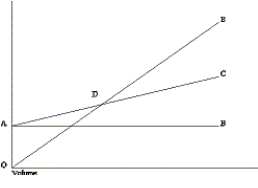 -Refer to Figure 8-6. The difference between line AB and line AC (area BAC) is the
 (Multiple Choice)
4.9/5 (77)
(77) Figure 8-4
Dirth Company sells only one product at a regular price of £7.50 per unit. Variable expenses are 60 per cent of sales and fixed expenses are £30,000. Management has decided to decrease the selling price to £6.00 in hopes of increasing its volume of sales.
-Refer to Figure 8-4. What sales pound level is needed to obtain a before-tax profit of £60,000 when the selling price is £6.00 per unit?
(Multiple Choice)
4.8/5 (73)
(73) The Millennium Company produces two types of products: Quality and Superior. The company expects to sell 1,200 units of Quality and 800 units of Superior.
A projected income statement for the firm as a whole follows:  Required:
a.
Determine the break-even point in terms of sales revenue.
b.
Determine the sales revenue necessary to generate a before-tax profit of £300,000.
c.
Determine the sales revenue necessary to generate an after-tax profit of £270,000 if the tax rate is 40 per cent.
Required:
a.
Determine the break-even point in terms of sales revenue.
b.
Determine the sales revenue necessary to generate a before-tax profit of £300,000.
c.
Determine the sales revenue necessary to generate an after-tax profit of £270,000 if the tax rate is 40 per cent. (Essay)
4.8/5 (95)
(95) Figure 8-7
The income statement for Thomas Manufacturing Company for 2011 is as follows:  -Refer to Figure 8-7. If sales increase by £60,000, what will happen to profit?
 (Multiple Choice)
4.9/5 (72)
(72) The range of operations within which a linear cost function is valid is called:
(Multiple Choice)
4.8/5 (76)
(76) In a cost-volume-profit graph, the slope of the total cost line represents
(Multiple Choice)
4.9/5 (60)
(60) Which of the following assumptions does NOT pertain to cost-profit-volume analysis?
(Multiple Choice)
4.8/5 (73)
(73) Using cost-volume-profit analysis, we can conclude that a 20 per cent reduction in variable costs will
(Multiple Choice)
4.9/5 (68)
(68) Figure 8-4
Dirth Company sells only one product at a regular price of £7.50 per unit. Variable expenses are 60 per cent of sales and fixed expenses are £30,000. Management has decided to decrease the selling price to £6.00 in hopes of increasing its volume of sales.
-Refer to Figure 8-4. What is the monetary sales level required to break even at the old price of £7.50?
(Multiple Choice)
4.8/5 (60)
(60) Which of the following is a TRUE statement about sales mix?
(Multiple Choice)
4.8/5 (88)
(88) Figure 8-8
Urban Company had the following information: 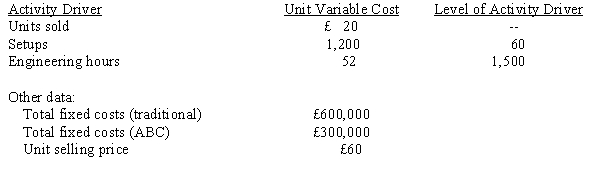 -Refer to Figure 8-8. Suppose Urban could reduce setup costs by £300 per setup and could reduce the number of engineering hours needed to 1,400 hours. How many units must be sold to break even in this case?
 (Multiple Choice)
4.8/5 (98)
(98) In a cost-volume-profit graph, the slope of the total revenue line represents
(Multiple Choice)
4.9/5 (83)
(83) Assuming all other things are equal, fixed costs must have ____ if there was a decrease in the break-even point.
(Multiple Choice)
4.9/5 (70)
(70) Assuming all other things are the same, contribution margin per unit must have ____ if there was an increase in the break-even point.
(Multiple Choice)
4.9/5 (85)
(85) Product 1 has a contribution margin of £6.00 per unit, and Product 2 has a contribution margin of £7.50 per unit. Total fixed costs are £300,000. Sales mix and total volume varies from one period to another. Which of the following is TRUE?
(Multiple Choice)
4.7/5 (74)
(74) 
Filters
- Essay(0)
- Multiple Choice(0)
- Short Answer(0)
- True False(0)
- Matching(0)