



 Chat with AI
Exam 6: Joint and By-Product Costing

Exam 1: Introduction to Management Accounting49 Questions
Exam 2: An Introduction to Cost Terms and Concepts64 Questions
Exam 3: Cost Assignment29 Questions
Exam 4: Accounting Entries for a Job Costing System15 Questions
Exam 5: Process Costing29 Questions
Exam 6: Joint and By-Product Costing61 Questions
Exam 7: Income Effects of Alternative Cost Accumulation Systems45 Questions
Exam 8: Cost-Volume-Profit Analysis60 Questions
Exam 9: Measuring Relevant Costs and Revenues for Decision-Making81 Questions
Exam 10: Activity-Based Costing40 Questions
Exam 11: Pricing Decisions and Profitability Analysis59 Questions
Exam 12: Decision-Making Under Conditions of Risk and Uncertainty29 Questions
Exam 13: Capital Investment Decisions: Appraisal Methods77 Questions
Exam 14: Capital Investment Decisions: the Impact of Capital Rationing, Taxation, Inflation and Risk25 Questions
Exam 15: The Budgeting Process86 Questions
Exam 16: Management Control Systems64 Questions
Exam 17: Standard Costing and Variance Analysis 181 Questions
Exam 18: Standard Costing and Variance Analysis 2: Further Aspects12 Questions
Exam 19: Divisional Financial Performance Measures51 Questions
Exam 20: Transfer Pricing in Divisionalized Companies50 Questions
Exam 21: Cost Management95 Questions
Exam 22: Strategic Management Accounting32 Questions
Exam 23: Cost Estimation and Cost Behaviour63 Questions
Exam 24: Quantitative Models for the Planning and Control of Stocks42 Questions
Exam 25: The Application of Linear Programming to Management Accounting30 Questions
Select questions type


Figure 6-4
Deli Products produces two products, X and Y, in a single process. In 2011, the joint costs of this process were £25,000. In addition, 4,000 units of X and 6,000 units of Y were produced. Separable processing costs beyond the split-off point were: X-£10,000; Y-£20,000. X sells for £10.00 per unit; Y sells for £7.50 per unit.
-Refer to Figure 6-4. What is the gross profit of product Y assuming the physical units method is used?

Free
(Multiple Choice)
4.8/5  (73)
(73) Correct Answer: Verified
C
Figure 6-4
Deli Products produces two products, X and Y, in a single process. In 2011, the joint costs of this process were £25,000. In addition, 4,000 units of X and 6,000 units of Y were produced. Separable processing costs beyond the split-off point were: X-£10,000; Y-£20,000. X sells for £10.00 per unit; Y sells for £7.50 per unit.
-Refer to Figure 6-4. What is the gross profit of product Y assuming the net realizable value method is used?
Free
(Multiple Choice)
4.9/5 (78)
(78) Correct Answer:Verified
VerifiedA
Information about three joint products follows: 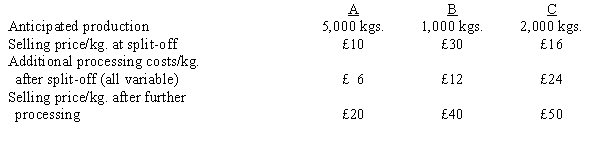 The cost of the joint process is £60,000. Which of the joint products should be sold at split-off?
Free
(Multiple Choice)
4.8/5 (67)
(67) Correct Answer:Verified
VerifiedB
Figure 6-8
James Ltd. produces three products in a joint process: A, B, and C. The joint costs are as follows:  The split-off values for A, B, and C are £80,000, £100,000, and £60,000, respectively. If management processes the three products beyond the split-off point, sales values for A, B, and C would increase to £150,000, £130,000, and £120,000, respectively. In order to process the products further, the company must incur separable costs of £14,000, £12,000, and £10,000 for products A, B, and C, respectively. James uses the sales-value-at-split-off method to allocate joint costs.
-Refer to Figure 6-8. Should James Ltd. process A further?
The split-off values for A, B, and C are £80,000, £100,000, and £60,000, respectively. If management processes the three products beyond the split-off point, sales values for A, B, and C would increase to £150,000, £130,000, and £120,000, respectively. In order to process the products further, the company must incur separable costs of £14,000, £12,000, and £10,000 for products A, B, and C, respectively. James uses the sales-value-at-split-off method to allocate joint costs.
-Refer to Figure 6-8. Should James Ltd. process A further? (Multiple Choice)
4.8/5 (90)
(90) Amos, SA., manufactures products A and B from a joint process. Joint product costs were £40,000 during the month of October. Additional information is as follows: Sales Values at
Product
Units Produced
Split-Off
A
14,000
£110,000
B
6,000
£90,000
Amos uses the physical units method of joint cost allocation. What is the amount of joint product costs to be allocated to products A and B in October, respectively?
(Multiple Choice)
4.8/5 (88)
(88) Figure 6-10
Manning Company uses a joint process to produce products W, X, Y, and Z. Each product may be sold at its split-off point or processed further. Additional processing costs of specific products are entirely variable. Joint processing costs for a single batch of joint products are £120,000. Other relevant data are as follows: 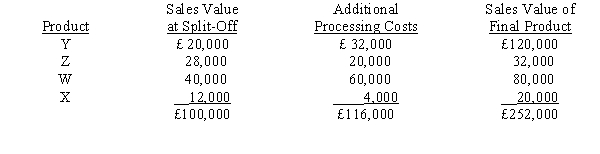 -Refer to Figure 6-10. Processing Y further will cause profits to
 (Multiple Choice)
4.8/5 (68)
(68) Ottawa Ltd. produces two products from a joint process. Information about the two joint products is as follows: 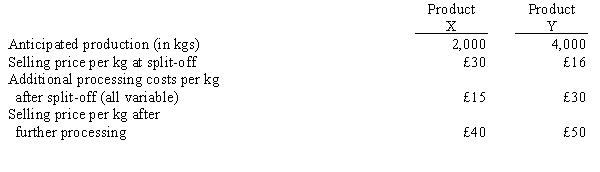 The cost of the joint process is £85,000.
-Refer to Figure 6-12. Which of Ottawa's joint products should be processed further?
The cost of the joint process is £85,000.
-Refer to Figure 6-12. Which of Ottawa's joint products should be processed further? (Multiple Choice)
4.7/5 (86)
(86) Figure 6-8
James Ltd. produces three products in a joint process: A, B, and C. The joint costs are as follows: The split-off values for A, B, and C are £80,000, £100,000, and £60,000, respectively. If management processes the three products beyond the split-off point, sales values for A, B, and C would increase to £150,000, £130,000, and £120,000, respectively. In order to process the products further, the company must incur separable costs of £14,000, £12,000, and £10,000 for products A, B, and C, respectively. James uses the sales-value-at-split-off method to allocate joint costs.
-Refer to Figure 6-8. Should James Ltd. process C further?
The split-off values for A, B, and C are £80,000, £100,000, and £60,000, respectively. If management processes the three products beyond the split-off point, sales values for A, B, and C would increase to £150,000, £130,000, and £120,000, respectively. In order to process the products further, the company must incur separable costs of £14,000, £12,000, and £10,000 for products A, B, and C, respectively. James uses the sales-value-at-split-off method to allocate joint costs.
-Refer to Figure 6-8. Should James Ltd. process C further? (Multiple Choice)
4.8/5 (75)
(75) Figure 6-6
Suppose that a sawmill processes logs into four grades of lumber totaling 500,000 board feet as follows at a joint cost of £300,000:  -Refer to Figure 6-6. What is the gross profit of No. 3 common if the constant gross margin percentage method is used?
 (Multiple Choice)
4.9/5 (82)
(82) Figure 6-6
Suppose that a sawmill processes logs into four grades of lumber totaling 500,000 board feet as follows at a joint cost of £300,000:
-Refer to Figure 6-6. What amount of joint costs will be allocated to No. 2 common using the constant gross margin percentage method?
-Refer to Figure 6-6. What amount of joint costs will be allocated to No. 2 common using the constant gross margin percentage method? (Multiple Choice)
5.0/5 (79)
(79) Figure 6-9
Stars Manufacturing Company produces Products A1, B2, C3, and D4 through a joint process. The joint costs amount to £200,000. 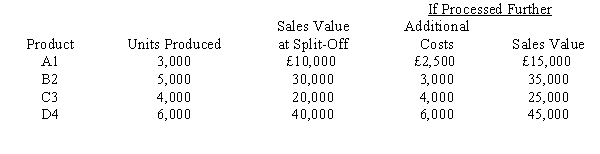 -Refer to Figure 6-9. If Product B2 is processed further, profits will
 (Multiple Choice)
4.9/5 (79)
(79) Figure 6-7
Suppose that a concrete manufacturer produces four grades of concrete totaling 500,000 cubic yards as follows at a joint cost of £2,000,000:  -Refer to Figure 6-7. What is the gross profit of Grade D if the constant gross margin percentage method is used?
 (Multiple Choice)
4.8/5 (72)
(72) Figure 6-5
Eden Company manufactures two products, Brights and Dulls, from a joint process. A production run costs £50,000 and results in 250 units of Brights and 1,000 units of Dulls. Both products must be processed past the split-off point, incurring separable costs for Brights of £60 per unit and £40 per unit for Dulls. The market price is £250 for Brights and £200 for Dulls.
-Refer to Figure 6-5. What is the amount of joint costs allocated to Dulls using the constant gross margin percentage method?
(Multiple Choice)
4.9/5 (92)
(92) Which of the following methods allocates joint production costs based on their proportionate share of eventual revenue less further processing costs?
(Multiple Choice)
4.8/5 (80)
(80) Park Company produces three products in a joint process: A, B, and C. The joint costs are described as follows:  The split-off values for A, B, and C are £100,000, £120,000 and £80,000, respectively. If management processes A beyond the split-off point, the sales value of A would increase to £150,000. In order to process A further, the company must rent another facility for £24,000, as well as incur additional materials and labour costs equal to £15,000.
Required:
a.
What is the amount of joint costs allocated to products A, B, and C if the sales value at split-off value method is used?
b.
Should the division process A further or sell it at split-off? What is the effect of the decision on gross profit?
The split-off values for A, B, and C are £100,000, £120,000 and £80,000, respectively. If management processes A beyond the split-off point, the sales value of A would increase to £150,000. In order to process A further, the company must rent another facility for £24,000, as well as incur additional materials and labour costs equal to £15,000.
Required:
a.
What is the amount of joint costs allocated to products A, B, and C if the sales value at split-off value method is used?
b.
Should the division process A further or sell it at split-off? What is the effect of the decision on gross profit? (Essay)
4.9/5 (79)
(79) Figure 6-7
Suppose that a concrete manufacturer produces four grades of concrete totaling 500,000 cubic yards as follows at a joint cost of £2,000,000:
-Refer to Figure 6-7. Grade C can be made into bricks. The final sales value will increase to £900,000. The additional cost to make the bricks is £250,000. Should the concrete be processed into bricks?
-Refer to Figure 6-7. Grade C can be made into bricks. The final sales value will increase to £900,000. The additional cost to make the bricks is £250,000. Should the concrete be processed into bricks? (Multiple Choice)
4.8/5 (85)
(85) Which of the following is a by-product of agricultural and food Industries?
(Multiple Choice)
4.8/5 (73)
(73) Carey Ltd. manufactures Products X and Y from a joint process. Joint product costs were £60,000 during the month of December. Additional information is as follows:  What is the amount of joint product costs to be allocated to Product X during December using the sales-value-at-split-off method?
 (Multiple Choice)
4.9/5 (82)
(82) Amos, SA., manufactures products A and B from a joint process. Joint product costs were £40,000 during the month of October. Additional information is as follows:  Amos uses the sales-value-at-split-off method of joint cost allocation. What is the amount of joint product costs to be allocated to products A and B in October, respectively?
 (Multiple Choice)
4.9/5 (78)
(78) 
Filters
- Essay(0)
- Multiple Choice(0)
- Short Answer(0)
- True False(0)
- Matching(0)