



 Chat with AI
Exam 13: Capital Investment Decisions: Appraisal Methods

Exam 1: Introduction to Management Accounting49 Questions
Exam 2: An Introduction to Cost Terms and Concepts64 Questions
Exam 3: Cost Assignment29 Questions
Exam 4: Accounting Entries for a Job Costing System15 Questions
Exam 5: Process Costing29 Questions
Exam 6: Joint and By-Product Costing61 Questions
Exam 7: Income Effects of Alternative Cost Accumulation Systems45 Questions
Exam 8: Cost-Volume-Profit Analysis60 Questions
Exam 9: Measuring Relevant Costs and Revenues for Decision-Making81 Questions
Exam 10: Activity-Based Costing40 Questions
Exam 11: Pricing Decisions and Profitability Analysis59 Questions
Exam 12: Decision-Making Under Conditions of Risk and Uncertainty29 Questions
Exam 13: Capital Investment Decisions: Appraisal Methods77 Questions
Exam 14: Capital Investment Decisions: the Impact of Capital Rationing, Taxation, Inflation and Risk25 Questions
Exam 15: The Budgeting Process86 Questions
Exam 16: Management Control Systems64 Questions
Exam 17: Standard Costing and Variance Analysis 181 Questions
Exam 18: Standard Costing and Variance Analysis 2: Further Aspects12 Questions
Exam 19: Divisional Financial Performance Measures51 Questions
Exam 20: Transfer Pricing in Divisionalized Companies50 Questions
Exam 21: Cost Management95 Questions
Exam 22: Strategic Management Accounting32 Questions
Exam 23: Cost Estimation and Cost Behaviour63 Questions
Exam 24: Quantitative Models for the Planning and Control of Stocks42 Questions
Exam 25: The Application of Linear Programming to Management Accounting30 Questions
Select questions type


In computing the net present value of a project, a manager uses a cost of capital number that is too low. This error causes the manager to compute a net present value that:

Free
(Multiple Choice)
4.8/5  (84)
(84) Correct Answer: Verified
B
Dale Davis Company is evaluating a proposal to purchase a new machine that would cost £100,000 and have a salvage value of £10,000 in four years. It would provide annual operating cash savings of £10,000, as follows:  If the new machine is purchased, the old machine will be sold for its current salvage value of £20,000. If the new machine is not purchased, the old machine will be disposed of in four years at a predicted salvage value of £2,000. The old machine's present book value is £40,000. If kept, in one year the old machine will require repairs predicted to cost £35,000.
Dale Davis's cost of capital is 14 per cent.
Required:
Should the new machine be purchased? Why or why not?
If the new machine is purchased, the old machine will be sold for its current salvage value of £20,000. If the new machine is not purchased, the old machine will be disposed of in four years at a predicted salvage value of £2,000. The old machine's present book value is £40,000. If kept, in one year the old machine will require repairs predicted to cost £35,000.
Dale Davis's cost of capital is 14 per cent.
Required:
Should the new machine be purchased? Why or why not?Free
(Essay)
4.9/5 (86)
(86) Correct Answer:Verified
Verified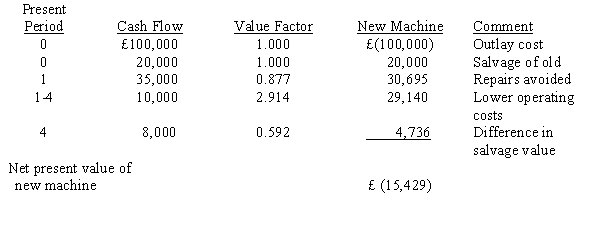 Negative net present value indicates that the new machine returns are less than the company's cost of capital. Do not buy the new machine.
The accounting rate of return is calculated as
Free
(Multiple Choice)
4.9/5 (65)
(65) Correct Answer:Verified
VerifiedC
A firm is evaluating a project that has a net present value of £0 when a discount rate of 8 per cent is used. A discount rate of 10 per cent will result in
(Multiple Choice)
5.0/5 (83)
(83) A firm is considering a project with an annual cash flow of £240,000. The project would have an 8-year life, and the company uses a discount rate of 12 per cent. Ignoring income taxes, what is the maximum amount the company could invest in the project and have the project still be acceptable (rounded)?
(Multiple Choice)
4.9/5 (84)
(84) Figure 13-3
Glady, Inc., is considering the purchase of production equipment that costs £800,000. The equipment is expected to generate annual cash inflows of £250,000. The equipment is expected to have a useful life of five years with no salvage value. The firm's cost of capital is 14 per cent.
-Refer to Figure 13-3. If depreciation is £190,000 per year, Glady's accounting rate of return based on the average investment would be
(Multiple Choice)
5.0/5 (83)
(83) Which of the following methods assumes a reinvestment rate equal to the discount rate?
(Multiple Choice)
4.7/5 (85)
(85) A capital investment project requires an investment of £75,000 and has an expected life of four years. Annual cash flows at the end of each year are expected to be as follows:  Required:
a.
Compute payback assuming that the cash flows occur evenly throughout the year.
b.
Compute the net present value of the project using a 12 per cent discount rate.
Required:
a.
Compute payback assuming that the cash flows occur evenly throughout the year.
b.
Compute the net present value of the project using a 12 per cent discount rate. (Essay)
4.8/5 (72)
(72) A firm is considering a project with an annual cash flow of £200,000. The project would have a 7-year life, and the company uses a discount rate of 10 per cent. Ignoring income taxes, what is the maximum amount the company could invest in the project and have the project still be acceptable?
(Multiple Choice)
4.8/5 (81)
(81) Figure 13-6
JD, Inc., is considering the purchase of production equipment that costs £400,000. The equipment is expected to generate annual cash inflows of £125,000. The equipment is expected to have a useful life of five years with no salvage value. The firm's cost of capital is 12 per cent.
-Refer to Figure 13-6. JD's approximate internal rate of return of the project is
(Multiple Choice)
4.8/5 (79)
(79) The Bradshaw Company is considering purchasing equipment for £78,000. This equipment will save the company £22,000 in operating costs annually. The payback period for this equipment is
(Multiple Choice)
4.8/5 (78)
(78) A firm is considering a project requiring an investment of £14,150. The project would generate annual cash inflows of £3,300 per year for the next seven years. The approximate internal rate of return for the project is
(Multiple Choice)
4.8/5 (79)
(79) ____ are capital budgeting models that identify criteria for accepting or rejecting projects without considering the time value of money.
(Multiple Choice)
4.9/5 (82)
(82) Figure 13-1
A project requires an investment of £90,000 in equipment. Annual cash inflows of £15,000 are expected to occur for the next ten years. No salvage value is expected.
-Refer to Figure 13-1. Using the initial capital investment, the accounting rate of return for the project would be
(Multiple Choice)
5.0/5 (85)
(85) Figure 13-6
JD, Inc., is considering the purchase of production equipment that costs £400,000. The equipment is expected to generate annual cash inflows of £125,000. The equipment is expected to have a useful life of five years with no salvage value. The firm's cost of capital is 12 per cent.
-Refer to Figure 13-6. If depreciation is £90,000 per year, JD's accounting rate of return based on the average investment would be
(Multiple Choice)
4.8/5 (79)
(79) A firm is considering two projects with the following cash flows:  Each project requires an investment of £120,000. Which project will have the higher net present value?
 (Multiple Choice)
4.9/5 (74)
(74) A firm is considering a project requiring an investment of £100,000. The project would generate annual cash inflows of £26,380 per year for the next five years. The approximate internal rate of return for the project is
(Multiple Choice)
4.8/5 (80)
(80) The internal rate of return model assumes that all net cash inflows are reinvested at the:
(Multiple Choice)
4.8/5 (77)
(77) The present value of £10,000 to be received five years from now and earning a 12 per cent return is
(Multiple Choice)
4.9/5 (75)
(75) 
Filters
- Essay(0)
- Multiple Choice(0)
- Short Answer(0)
- True False(0)
- Matching(0)