



 Chat with AI
Exam 13: Capital Investment Decisions: Appraisal Methods

Exam 1: Introduction to Management Accounting49 Questions
Exam 2: An Introduction to Cost Terms and Concepts64 Questions
Exam 3: Cost Assignment29 Questions
Exam 4: Accounting Entries for a Job Costing System15 Questions
Exam 5: Process Costing29 Questions
Exam 6: Joint and By-Product Costing61 Questions
Exam 7: Income Effects of Alternative Cost Accumulation Systems45 Questions
Exam 8: Cost-Volume-Profit Analysis60 Questions
Exam 9: Measuring Relevant Costs and Revenues for Decision-Making81 Questions
Exam 10: Activity-Based Costing40 Questions
Exam 11: Pricing Decisions and Profitability Analysis59 Questions
Exam 12: Decision-Making Under Conditions of Risk and Uncertainty29 Questions
Exam 13: Capital Investment Decisions: Appraisal Methods77 Questions
Exam 14: Capital Investment Decisions: the Impact of Capital Rationing, Taxation, Inflation and Risk25 Questions
Exam 15: The Budgeting Process86 Questions
Exam 16: Management Control Systems64 Questions
Exam 17: Standard Costing and Variance Analysis 181 Questions
Exam 18: Standard Costing and Variance Analysis 2: Further Aspects12 Questions
Exam 19: Divisional Financial Performance Measures51 Questions
Exam 20: Transfer Pricing in Divisionalized Companies50 Questions
Exam 21: Cost Management95 Questions
Exam 22: Strategic Management Accounting32 Questions
Exam 23: Cost Estimation and Cost Behaviour63 Questions
Exam 24: Quantitative Models for the Planning and Control of Stocks42 Questions
Exam 25: The Application of Linear Programming to Management Accounting30 Questions
Select questions type


Which of the following methods uses income instead of cash flows?
(Multiple Choice)
4.9/5  (62)
(62) The present value of £2,000 to be received three years from now and earning a 12 per cent return is
(Multiple Choice)
4.8/5 (82)
(82) 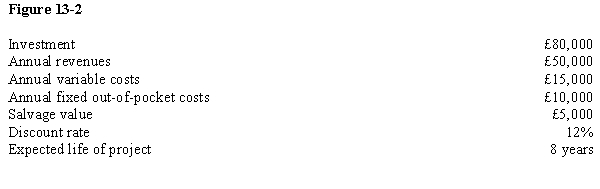 -Refer to Figure 13-2. The present value of the annual net cash inflows from operations is
 (Multiple Choice)
4.9/5 (88)
(88) Which of the following is NOT included in the calculation of net present value of a proposed project? (Ignore income taxes.)
(Multiple Choice)
4.8/5 (94)
(94) Figure 13-6
JD, Inc., is considering the purchase of production equipment that costs £400,000. The equipment is expected to generate annual cash inflows of £125,000. The equipment is expected to have a useful life of five years with no salvage value. The firm's cost of capital is 12 per cent.
-Refer to Figure 13-6. JD's payback for the project is
(Multiple Choice)
4.9/5 (60)
(60) A capital investment project requires an investment of £1,000,000. It has an expected life of five years with annual cash flows of £240,000 received at the end of each year.
Required:
a.
Compute payback for the project.
b.
Compute the internal rate of return for the project.
c.
Compute the net present value of the project using a 12 per cent discount rate. Ignore income taxes.
d.
Would you recommend this project be accepted? Why or why not?
(Essay)
4.9/5 (78)
(78) A capital investment project requires an investment of £450,000. It has an expected life of six years with an annual cash flow of £90,000 received at the end of each year. The company uses the straight-line method of depreciation. Ignore income taxes.
Required:
a.
Compute payback for the project.
b.
Compute the net present value of the project using a 12 per cent discount rate.
c.
Would you recommend this project be accepted? Why or why not?
(Essay)
4.8/5 (79)
(79) If the annual cash flows are an annuity (equal each period), payback is calculated as
(Multiple Choice)
4.8/5 (84)
(84) (Memorandum required)
Simon Enterprises is considering the purchase of a flexible manufacturing system. The savings associated with the system are estimated to be as follows:  The system will cost £400,000 and will last ten years. The system would have a salvage value of £30,000 at the end of ten years. The company's cost of capital is 8 per cent.
Required:
Prepare a memorandum to management with your recommendation regarding whether Simon Enterprises should purchase the flexible manufacturing system. Include a discussion of qualitative factors that might influence management's decision. Include your supporting calculations (including NPV analysis.)
The system will cost £400,000 and will last ten years. The system would have a salvage value of £30,000 at the end of ten years. The company's cost of capital is 8 per cent.
Required:
Prepare a memorandum to management with your recommendation regarding whether Simon Enterprises should purchase the flexible manufacturing system. Include a discussion of qualitative factors that might influence management's decision. Include your supporting calculations (including NPV analysis.) (Essay)
5.0/5 (85)
(85) The time required for a project to return its investment is the
(Multiple Choice)
4.9/5 (86)
(86) Lewis Manufacturing Company is planning to invest in equipment costing £240,000. The estimated cash flows from this equipment are expected to be as follows: 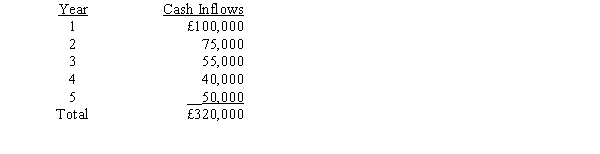 Assume that the cash inflows occur evenly over the year. The payback period for this investment is
 (Multiple Choice)
4.8/5 (75)
(75) Figure 13-6
JD, Inc., is considering the purchase of production equipment that costs £400,000. The equipment is expected to generate annual cash inflows of £125,000. The equipment is expected to have a useful life of five years with no salvage value. The firm's cost of capital is 12 per cent.
-Refer to Figure 13-6. JD's net present value of the project is
(Multiple Choice)
4.9/5 (83)
(83) Figure 13-4
A capital investment project requires an investment of £60,000 and has an expected life of four years. Annual cash flows, which occur evenly throughout the year, are expected to be as follows:  -Refer to Figure 13-4. Payback for the project is
 (Multiple Choice)
4.9/5 (81)
(81) Van Dyke Company is evaluating a capital expenditure proposal that has the following predicted cash flows: 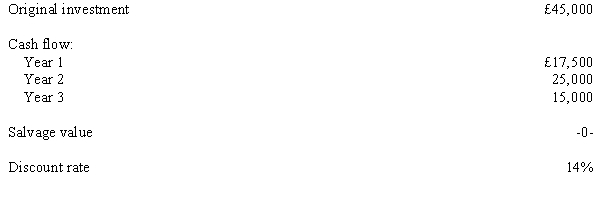 Required:
Determine the following values:
a.
Net present value of the investment
b.
Proposal's internal rate of return
c.
Payback period
Required:
Determine the following values:
a.
Net present value of the investment
b.
Proposal's internal rate of return
c.
Payback period (Essay)
4.8/5 (88)
(88) Figure 13-1
A project requires an investment of £90,000 in equipment. Annual cash inflows of £15,000 are expected to occur for the next ten years. No salvage value is expected.
-Refer to Figure 13-1. If the annual cash inflows occur throughout the year, payback for the project would be
(Multiple Choice)
4.9/5 (65)
(65) A company invests in a project that realizes an internal rate of return equal to its cost of capital. This project should:
(Multiple Choice)
4.9/5 (79)
(79) Kaylin Company purchased a piece of equipment for £100,000 that had a useful life of 5 years. The equipment had no salvage value. It saves the company £40,000 a year and costs the company £5,000 a year to operate. What is the accounting rate of return on the equipment?
(Multiple Choice)
4.9/5 (79)
(79) A firm is considering a project with annual cash flows of £40,000. The project would have a 10-year life, and the company uses a discount rate of 8 per cent. What is the maximum amount the company could invest in the project and the project still be acceptable?
(Multiple Choice)
4.9/5 (73)
(73) How is working capital needed in the operations of investments treated in discounted cash flow analysis?
(Multiple Choice)
4.9/5 (77)
(77) 
Filters
- Essay(0)
- Multiple Choice(0)
- Short Answer(0)
- True False(0)
- Matching(0)