



 Chat with AI
Exam 6: Joint and By-Product Costing

Exam 1: Introduction to Management Accounting49 Questions
Exam 2: An Introduction to Cost Terms and Concepts64 Questions
Exam 3: Cost Assignment29 Questions
Exam 4: Accounting Entries for a Job Costing System15 Questions
Exam 5: Process Costing29 Questions
Exam 6: Joint and By-Product Costing61 Questions
Exam 7: Income Effects of Alternative Cost Accumulation Systems45 Questions
Exam 8: Cost-Volume-Profit Analysis60 Questions
Exam 9: Measuring Relevant Costs and Revenues for Decision-Making81 Questions
Exam 10: Activity-Based Costing40 Questions
Exam 11: Pricing Decisions and Profitability Analysis59 Questions
Exam 12: Decision-Making Under Conditions of Risk and Uncertainty29 Questions
Exam 13: Capital Investment Decisions: Appraisal Methods77 Questions
Exam 14: Capital Investment Decisions: the Impact of Capital Rationing, Taxation, Inflation and Risk25 Questions
Exam 15: The Budgeting Process86 Questions
Exam 16: Management Control Systems64 Questions
Exam 17: Standard Costing and Variance Analysis 181 Questions
Exam 18: Standard Costing and Variance Analysis 2: Further Aspects12 Questions
Exam 19: Divisional Financial Performance Measures51 Questions
Exam 20: Transfer Pricing in Divisionalized Companies50 Questions
Exam 21: Cost Management95 Questions
Exam 22: Strategic Management Accounting32 Questions
Exam 23: Cost Estimation and Cost Behaviour63 Questions
Exam 24: Quantitative Models for the Planning and Control of Stocks42 Questions
Exam 25: The Application of Linear Programming to Management Accounting30 Questions
Select questions type


Figure 6-5
Eden Company manufactures two products, Brights and Dulls, from a joint process. A production run costs £50,000 and results in 250 units of Brights and 1,000 units of Dulls. Both products must be processed past the split-off point, incurring separable costs for Brights of £60 per unit and £40 per unit for Dulls. The market price is £250 for Brights and £200 for Dulls.
-Refer to Figure 6-5. What is the gross profit for Brights assuming the physical units method is used?
(Multiple Choice)
4.8/5  (84)
(84) Maxwell Company manufactures two products from a joint process. Information about the two joint products is as follows: 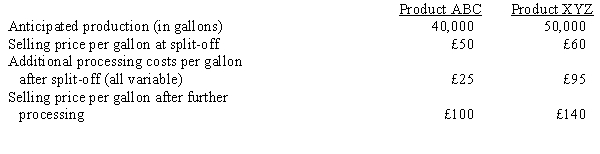 The cost of the joint process is £1,500,000.
Required:
a.
Which of Maxwell's joint products should be processed further?
b.
Assume that Maxwell currently sells both products at the split-off point. What is Maxwell's income?
c.
Assume that Maxwell makes decisions about its joint products that maximize profit. What is Maxwell's income?
The cost of the joint process is £1,500,000.
Required:
a.
Which of Maxwell's joint products should be processed further?
b.
Assume that Maxwell currently sells both products at the split-off point. What is Maxwell's income?
c.
Assume that Maxwell makes decisions about its joint products that maximize profit. What is Maxwell's income? (Essay)
4.8/5 (74)
(74) Arcadia, SA, uses a joint process to produce Products W, X, Y, Z. Each product may be sold at its split-off point or processed further. Additional processing costs of specific products are entirely variable. Joint processing costs for a single batch of joint products are £200,000. Other relevant data are as follows: 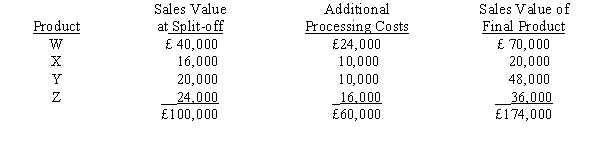 Required:
a.
Determine which products should be processed further.
b.
How will processing each product further affect profits?
Required:
a.
Determine which products should be processed further.
b.
How will processing each product further affect profits? (Essay)
4.8/5 (74)
(74) Figure 6-3
Bond Ltd., which manufactures products W, X, Y, and Z through a joint process costing £18,000, has the following data for 2011: 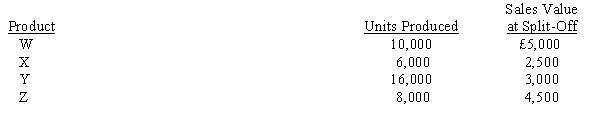 -Refer to Figure 6-3. What is the amount of joint costs assigned to Product Y using the sales-value-at-split-off method?
 (Multiple Choice)
4.9/5 (77)
(77) Figure 6-5
Eden Company manufactures two products, Brights and Dulls, from a joint process. A production run costs £50,000 and results in 250 units of Brights and 1,000 units of Dulls. Both products must be processed past the split-off point, incurring separable costs for Brights of £60 per unit and £40 per unit for Dulls. The market price is £250 for Brights and £200 for Dulls.
-Refer to Figure 6-5. What is the gross profit for Dulls assuming the constant gross margin percentage method is used?
(Multiple Choice)
4.8/5 (67)
(67) Mickey Company manufactures three joint products: X, Y, and Z. The cost of the joint process is £30,000. Information about the three products follows: 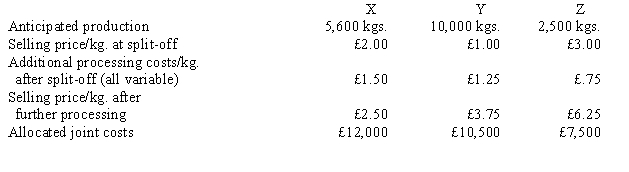 Required:
a.
Determine whether each product should be sold at split-off or processed further. Show all supporting calculations in good form.
b.
Determine the firm's income if the firm processed all three products beyond split-off.
Required:
a.
Determine whether each product should be sold at split-off or processed further. Show all supporting calculations in good form.
b.
Determine the firm's income if the firm processed all three products beyond split-off. (Essay)
4.8/5 (76)
(76) Figure 6-6
Suppose that a sawmill processes logs into four grades of lumber totaling 500,000 board feet as follows at a joint cost of £300,000:  -Refer to Figure 6-6. No. 2 common can be cut into 2 * 4s. The final sales value will increase to £150,000. The cost of cutting No. 2 common is £15,000. Should the No. 2s be cut into 2 * 4s?
 (Multiple Choice)
4.9/5 (84)
(84) Carey Ltd. manufactures products X and Y from a joint process. Joint product costs were £60,000 during the month of December. Additional information is as follows: Sales Values at
Product
Units Produced
Split-Off per Unit
X
10,000
£24
Y
5,000
£8
What is the amount of joint product costs to be allocated to product X during December using the physical units method?
(Multiple Choice)
4.9/5 (69)
(69) Figure 6-9
Stars Manufacturing Company produces Products A1, B2, C3, and D4 through a joint process. The joint costs amount to £200,000. 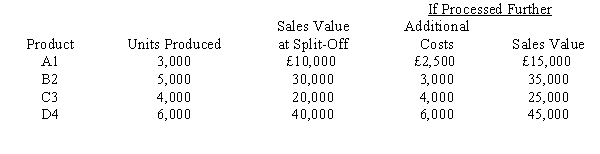 -Refer to Figure 6-9. Which product(s) should be sold at split-off to maximize profits in the short run?
 (Multiple Choice)
4.9/5 (98)
(98) Figure 6-7
Suppose that a concrete manufacturer produces four grades of concrete totaling 500,000 cubic yards as follows at a joint cost of £2,000,000:  -Refer to Figure 6-7. What amount of joint costs will be allocated to Grade C using the constant gross margin percentage method?
 (Multiple Choice)
4.9/5 (94)
(94) Ottawa Ltd. produces two products from a joint process. Information about the two joint products is as follows: 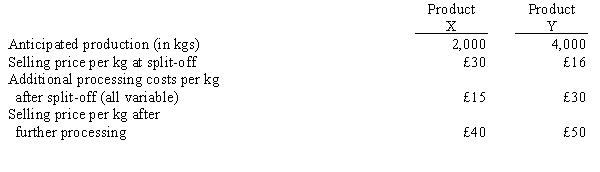 The cost of the joint process is £85,000.
-Refer to Figure 6-12. Which of Ottawa's joint products should be sold at split-off?
The cost of the joint process is £85,000.
-Refer to Figure 6-12. Which of Ottawa's joint products should be sold at split-off? (Multiple Choice)
4.8/5 (78)
(78) The sales-value-at-split-off method allocates joint production costs based on each product's share of
(Multiple Choice)
4.8/5 (78)
(78) The decision of whether or NOT to process joint products beyond their split-off point is
(Multiple Choice)
4.7/5 (73)
(73) Figure 6-11
Information about three joint products follows: 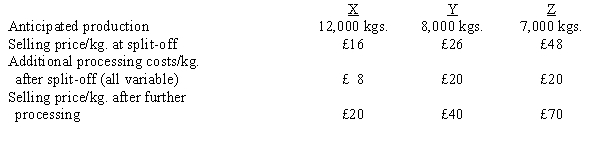 The cost of the joint process is £140,000.
-Refer to Figure 6-11. If the firm is currently processing all three products beyond split-off, the firm's income would be
The cost of the joint process is £140,000.
-Refer to Figure 6-11. If the firm is currently processing all three products beyond split-off, the firm's income would be (Multiple Choice)
4.8/5 (70)
(70) A ____ is a secondary product recovered in the course of manufacturing a primary product during a joint process.
(Multiple Choice)
5.0/5 (91)
(91) Which joint cost allocation method is described by the following statement? Joint cost is backed into. First, overall sales revenue minus overall costs (joint plus further processing costs) is calculated to yield gross profit and the gross profit percentage. Then, each product is assigned the same cost of goods sold percentage.
(Multiple Choice)
4.7/5 (81)
(81) Which of the following costs is NOT relevant to a decision to sell a product at split-off or process the product further and then sell the product?
(Multiple Choice)
4.9/5 (81)
(81) Figure 6-7
Suppose that a concrete manufacturer produces four grades of concrete totaling 500,000 cubic yards as follows at a joint cost of £2,000,000:
-Refer to Figure 6-7. What amount of joint costs will be allocated to Grade B using the final sales value method?
-Refer to Figure 6-7. What amount of joint costs will be allocated to Grade B using the final sales value method? (Multiple Choice)
4.9/5 (85)
(85) A joint producft should be processed beyond split-off if additional revenue from further processing exceeds
(Multiple Choice)
4.9/5 (85)
(85) Figure 6-8
James Ltd. produces three products in a joint process: A, B, and C. The joint costs are as follows:  The split-off values for A, B, and C are £80,000, £100,000, and £60,000, respectively. If management processes the three products beyond the split-off point, sales values for A, B, and C would increase to £150,000, £130,000, and £120,000, respectively. In order to process the products further, the company must incur separable costs of £14,000, £12,000, and £10,000 for products A, B, and C, respectively. James uses the sales-value-at-split-off method to allocate joint costs.
-Refer to Figure 6-8. Should James Ltd. process B further?
The split-off values for A, B, and C are £80,000, £100,000, and £60,000, respectively. If management processes the three products beyond the split-off point, sales values for A, B, and C would increase to £150,000, £130,000, and £120,000, respectively. In order to process the products further, the company must incur separable costs of £14,000, £12,000, and £10,000 for products A, B, and C, respectively. James uses the sales-value-at-split-off method to allocate joint costs.
-Refer to Figure 6-8. Should James Ltd. process B further? (Multiple Choice)
4.9/5 (80)
(80) 
Filters
- Essay(0)
- Multiple Choice(0)
- Short Answer(0)
- True False(0)
- Matching(0)