



 Chat with AI
Exam 12: Accounting for Partnerships

Exam 1: Accounting in Action220 Questions
Exam 2: The Recording Process192 Questions
Exam 3: Adjusting the Accounts216 Questions
Exam 4: Completing the Accounting Cycle203 Questions
Exam 5: Accounting for Merchandising Operations221 Questions
Exam 6: Inventories204 Questions
Exam 7: Accounting Information Systems139 Questions
Exam 8: Fraud, Internal Control, and Cash212 Questions
Exam 9: Accounting for Receivables220 Questions
Exam 10: Plant Assets, Natural Resources, and Intangible Assets293 Questions
Exam 11: Current Liabilities and Payroll Accounting207 Questions
Exam 12: Accounting for Partnerships210 Questions
Exam 13: Corporations: Organization and Capital Stock Transactions195 Questions
Exam 14: Corporations: Dividends, Retained Earnings, and Income Reporting176 Questions
Exam 15: Long-Term Liabilities215 Questions
Exam 16: Investments178 Questions
Exam 17: Statement of Cash Flows203 Questions
Exam 18: Financial Analysis: the Big Picture225 Questions
Exam 19: Managerial Accounting197 Questions
Exam 20: Job Order Costing199 Questions
Exam 21: Process Costing198 Questions
Exam 22: Cost-Volume-Profit217 Questions
Exam 23: Incremental Analysis208 Questions
Exam 24: Budgetary Planning207 Questions
Exam 25: Budgetary Control and Responsibility Accounting207 Questions
Exam 26: Standard Costs and Balanced Scorecard221 Questions
Select questions type


The partnership agreement of Nieto, Keller, and Pickert provides for the following income ratio: (a) Nieto, the managing partner, receives a salary allowance of $36,000, (b) each partner receives 15% interest on average capital investment, and (c) remaining net income or loss is divided equally. The average capital investments for the year were: Nieto $200,000, Keller $400,000, and Pickert $600,000. If partnership net income is $240,000, the amount distributed to Keller should be:
(Multiple Choice)
4.8/5  (67)
(67) Eaton, Korman, and Roland have capital balances of $150,000, $100,000, and $75,000, respectively, and their income ratios are 4:2:4.
Instructions
Record the withdrawal of Roland from the partnership under each of the following assumptions:
1. Roland is paid $75,000 from partnership assets.
2. Roland is paid $90,000 from partnership assets.
3. Roland is paid $55,000 from partnership assets.
(Essay)
4.7/5 (74)
(74) Partnership income or loss need not be closed to partners' capital accounts each period because of the unlimited life characteristic of partnerships.
(True/False)
4.8/5 (95)
(95) Use the following account balance information for Grinotfin Partnership with income ratios of 2:4:4 for Grigsby, Nott, and Fine, respectively.  Assume that, as part of liquidation proceedings, Grinotfin sells its noncash assets for $120,000. As a result, one of the partners has a capital deficiency which that partner decides not to repay. The amount of cash that would ultimately be distributed to Fine would be:
 (Multiple Choice)
4.7/5 (92)
(92) Roper and Walton have partnership capital balances of $320,000 and $240,000, respectively. Walton negotiates to sell his partnership interest to Molle for $280,000. Roper agrees to accept Molle as a new partner. The partnership entry to record this transaction is 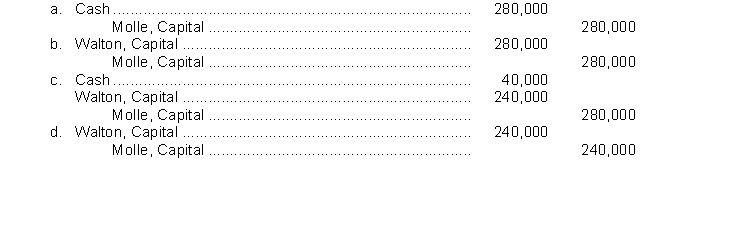
(Short Answer)
4.9/5 (82)
(82) Dauber and Jackson decide to organize a partnership. Dauber invests $25,000 cash, and Jackson contributes $5,000 and equipment having a book value of $3,500 and a fair market value of $10,000.
Instructions
Prepare the entry to record each partner's investment.
(Essay)
4.8/5 (75)
(75) When admitting a new partner by investment, a bonus to old partners
(Multiple Choice)
4.9/5 (90)
(90) In the liquidation of a partnership, any partner who has a capital deficiency
(Multiple Choice)
4.9/5 (82)
(82) Ace, Goran, and Notte are forming The Acgono Partnership. Ace is transferring $45,000 of personal cash and equipment worth $38,000 to the partnership. Goran owns land worth $27,000 and a small building worth $112,000, which he transfers to the partnership. There is a long-term mortgage of $30,000 on the land and building, which the partnership assumes. Notte transfers cash of $10,000, accounts receivable of $54,000, supplies worth $5,000, and equipment worth $33,000 to the partnership. The partnership expects to collect $48,000 of the accounts receivable.
Instructions
Prepare a classified balance sheet for the partnership after the partner's investments on December 31, 2010.
(Essay)
4.9/5 (89)
(89) All of the following are characteristics of partnerships except
(Multiple Choice)
4.9/5 (77)
(77) Mark Bahr and Robert Engler decide to form a partnership. Bahr invests $25,000 cash and accounts receivable of $30,000 less allowance for doubtful accounts of $2,000. Engler contributes $20,000 cash and equipment having a $6,000 book value. It is agreed that the allowance account should be $3,000 and the fair market value of the equipment is $10,000.
Instructions
Prepare the necessary journal entry to record the formation of the partnership.
(Essay)
4.8/5 (75)
(75) A partner invests into a partnership a building with an original cost of $90,000 and accumulated depreciation of $40,000. This building has a $70,000 fair market value. As a result of the investment, the partner's capital account will be credited for
(Multiple Choice)
4.9/5 (71)
(71) The partner in a limited partnership that has unlimited liability is referred to as the
(Multiple Choice)
4.8/5 (65)
(65) If a partner's investment in a partnership consists of equipment that has accumulated depreciation of $8,000, it would not be appropriate for the partnership to record the accumulated depreciation.
(True/False)
5.0/5 (88)
(88) Mary, Jim, and Mike have partnership capital account balances of $225,000, $450,000 and $105,000, respectively. The income sharing ratio is Mary, 50%; Jim, 40%; and Mike, 10%. Mary desires to withdraw from the partnership and it is agreed that partnership assets of $195,000 will be used to pay Mary for her partnership interest. The balances of Jim's and Mike's Capital accounts after Mary's withdrawal would be
(Multiple Choice)
4.9/5 (75)
(75) Which of the following is not an advantage of the partnership form of business?
(Multiple Choice)
4.8/5 (84)
(84) Mary, Ann, and Tina formed a partnership with income-sharing ratios of 50%, 30%, and 20%, respectively. Cash of $300,000 was available after the partnership's assets were liquidated. Prior to the final distribution of cash, Mary's capital balance was $200,000, Ann's capital balance was $150,000, and Tina had a capital deficiency of $50,000. Assuming Tina contributes cash to match her capital deficiency, Mary should receive
(Multiple Choice)
4.9/5 (84)
(84) 
Filters
- Essay(0)
- Multiple Choice(0)
- Short Answer(0)
- True False(0)
- Matching(0)