



 Chat with AI
Exam 16: Investments

Exam 1: Accounting in Action220 Questions
Exam 2: The Recording Process192 Questions
Exam 3: Adjusting the Accounts216 Questions
Exam 4: Completing the Accounting Cycle203 Questions
Exam 5: Accounting for Merchandising Operations221 Questions
Exam 6: Inventories204 Questions
Exam 7: Accounting Information Systems139 Questions
Exam 8: Fraud, Internal Control, and Cash212 Questions
Exam 9: Accounting for Receivables220 Questions
Exam 10: Plant Assets, Natural Resources, and Intangible Assets293 Questions
Exam 11: Current Liabilities and Payroll Accounting207 Questions
Exam 12: Accounting for Partnerships210 Questions
Exam 13: Corporations: Organization and Capital Stock Transactions195 Questions
Exam 14: Corporations: Dividends, Retained Earnings, and Income Reporting176 Questions
Exam 15: Long-Term Liabilities215 Questions
Exam 16: Investments178 Questions
Exam 17: Statement of Cash Flows203 Questions
Exam 18: Financial Analysis: the Big Picture225 Questions
Exam 19: Managerial Accounting197 Questions
Exam 20: Job Order Costing199 Questions
Exam 21: Process Costing198 Questions
Exam 22: Cost-Volume-Profit217 Questions
Exam 23: Incremental Analysis208 Questions
Exam 24: Budgetary Planning207 Questions
Exam 25: Budgetary Control and Responsibility Accounting207 Questions
Exam 26: Standard Costs and Balanced Scorecard221 Questions
Select questions type


"Intent to convert" does not include an investment used as a resource that will be used whenever the need for cash arises.
(True/False)
4.7/5  (73)
(73) Which of the following reasons best explains why a company that experiences seasonal fluctuations in sales may purchase investments in debt or stock securities?
(Multiple Choice)
5.0/5 (91)
(91) Nance Company owns 30% interest in the stock of Finley Corporation. During the year, Finley pays $25,000 in dividends to Nance, and reports $100,000 in net income. Nance Company's investment in Finley will increase by
(Multiple Choice)
4.8/5 (76)
(76) On April 1, Smith Company buys 4,000 shares of Porter common stock for $60,000, plus brokerage fees of $1,200. On October 1, Smith sells 1,000 shares of Porter stock for $20,000, less brokerage fees of $500.
Instructions
Prepare journal entries for the purchase and sale of the Porter common stock.
(Essay)
4.7/5 (61)
(61) Dobson Inc. earns $450,000 and pays cash dividends of $150,000 during 2010. Cornwell Corporation owns 70,000 of the 210,000 outstanding shares of Dobson.
What amount should Cornwell show in the investment account at December 31, 2010 if the beginning of the year balance in the account was $40,000?
(Multiple Choice)
4.8/5 (75)
(75) When an investor owns between 20% and 50% of the common stock of a corporation, it is generally presumed that the investor
(Multiple Choice)
4.8/5 (75)
(75) On January 1, Burkett Company purchased as an investment a $1,000, 7% bond for $1,020. The bond pays interest on January 1 and July 1. What is the entry to record the interest accrual on December 31? 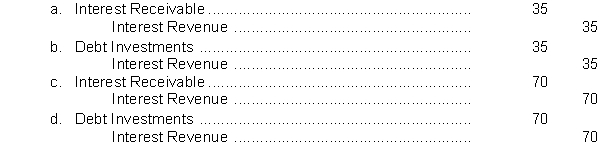
(Short Answer)
4.9/5 (78)
(78) Price Corporation has the following trading portfolio of stock investments as of December 31, 2010.  On January 22, 2011, Price Corporation sold security C for $31,000.
Instructions
(a) Prepare the adjusting entry for Price Corporation on December 31, 2010, to report the portfolio at fair value.
(b) Indicate the balance sheet and income statement presentation of the fair value data for Price Corporation at December 31, 2010.
(c) Prepare the journal entry for the 2011 sale.
On January 22, 2011, Price Corporation sold security C for $31,000.
Instructions
(a) Prepare the adjusting entry for Price Corporation on December 31, 2010, to report the portfolio at fair value.
(b) Indicate the balance sheet and income statement presentation of the fair value data for Price Corporation at December 31, 2010.
(c) Prepare the journal entry for the 2011 sale. (Essay)
4.7/5 (88)
(88) The balance sheet presentation of an unrealized loss on an available-for-sale security is similar to the statement presentation of
(Multiple Choice)
4.9/5 (86)
(86) Market Adjustment is a valuation _______________ account which is _______________ to (from) the cost of the investments.
(Short Answer)
4.7/5 (83)
(83) On January 2, Westies Company purchased 40, 10%, $1,000 Boswell Company bonds for $41,000 cash, plus brokerage fees of $1,000. Interest is payable semiannually on July 1 and January 1. On July 1, the company received a semiannual interest payment on the Boswell Company bonds. Journalize the entries to record the purchase of the bonds and the receipt of the interest payment.
(Essay)
5.0/5 (76)
(76) On February 1, Milo Company purchased 1,000 shares (2% ownership) of Werth Company common stock for $30 per share plus brokerage fees of $400. On March 20, Milo Company sold 200 shares of Werth stock for $5,800, less a $50 brokerage fee. Milo received a dividend of $1.00 per share on April 25. On June 15, Milo sold 300 shares of Werth stock for 9,800 less a $100 brokerage fee.
Instructions
Prepare the journal entries to record the transactions described above.
(Essay)
4.8/5 (88)
(88) Nagen Company had these transactions pertaining to stock investments:
Feb) 1 Purchased 3,000 shares of Horton Company (10%) for $49,800 cash plus brokerage fees of $1,200.
June 1 Received cash dividends of $2 per share on Horton stock.
Oct) 1 Sold 1,200 shares of Horton stock for $24,000 less brokerage fees of $600.
The entry to record the receipt of the dividends on June 1 would include a
(Multiple Choice)
4.8/5 (86)
(86) The Stock Investments account is debited at acquisition under both the equity method and cost method of accounting for investments in common stock.
(True/False)
4.8/5 (93)
(93) Nagen Company had these transactions pertaining to stock investments:
Feb) 1 Purchased 3,000 shares of Horton Company (10%) for $49,800 cash plus brokerage fees of $1,200.
June 1 Received cash dividends of $2 per share on Horton stock.
Oct) 1 Sold 1,200 shares of Horton stock for $24,000 less brokerage fees of $600.
The entry to record the sale of the stock would include a
(Multiple Choice)
4.9/5 (72)
(72) If the cost method is used to account for a long-term investment in common stock,
(Multiple Choice)
4.9/5 (73)
(73) If 10% of the common stock of an investee company is purchased as a long-term investment, the appropriate method of accounting for the investment is
(Multiple Choice)
4.7/5 (58)
(58) 
Filters
- Essay(0)
- Multiple Choice(0)
- Short Answer(0)
- True False(0)
- Matching(0)