



 Chat with AI
Exam 26: Standard Costs and Balanced Scorecard

Exam 1: Accounting in Action220 Questions
Exam 2: The Recording Process192 Questions
Exam 3: Adjusting the Accounts216 Questions
Exam 4: Completing the Accounting Cycle203 Questions
Exam 5: Accounting for Merchandising Operations221 Questions
Exam 6: Inventories204 Questions
Exam 7: Accounting Information Systems139 Questions
Exam 8: Fraud, Internal Control, and Cash212 Questions
Exam 9: Accounting for Receivables220 Questions
Exam 10: Plant Assets, Natural Resources, and Intangible Assets293 Questions
Exam 11: Current Liabilities and Payroll Accounting207 Questions
Exam 12: Accounting for Partnerships210 Questions
Exam 13: Corporations: Organization and Capital Stock Transactions195 Questions
Exam 14: Corporations: Dividends, Retained Earnings, and Income Reporting176 Questions
Exam 15: Long-Term Liabilities215 Questions
Exam 16: Investments178 Questions
Exam 17: Statement of Cash Flows203 Questions
Exam 18: Financial Analysis: the Big Picture225 Questions
Exam 19: Managerial Accounting197 Questions
Exam 20: Job Order Costing199 Questions
Exam 21: Process Costing198 Questions
Exam 22: Cost-Volume-Profit217 Questions
Exam 23: Incremental Analysis208 Questions
Exam 24: Budgetary Planning207 Questions
Exam 25: Budgetary Control and Responsibility Accounting207 Questions
Exam 26: Standard Costs and Balanced Scorecard221 Questions
Select questions type


Spencer Chemical Corporation produces an oil-based chemical product which it sells to paint manufacturers. In 2010, the company incurred $344,000 of costs to produce 40,000 gallons of the chemical. The selling price of the chemical is $11.00 per gallon. The costs per unit to manufacture a gallon of the chemical are presented below:  The company is considering manufacturing the paint itself. If the company processes the chemical further and manufactures the paint itself, the following additional costs per gallon will be incurred: Direct materials $1.70, Direct labor $.60, Variable manufacturing overhead $.50. No increase in fixed manufacturing overhead is expected. The company can sell the paint at $15.00 per gallon.
Instructions
Determine the incremental per gallon increase in net income and the total increase in net income if the company manufactures the paint.
The company is considering manufacturing the paint itself. If the company processes the chemical further and manufactures the paint itself, the following additional costs per gallon will be incurred: Direct materials $1.70, Direct labor $.60, Variable manufacturing overhead $.50. No increase in fixed manufacturing overhead is expected. The company can sell the paint at $15.00 per gallon.
Instructions
Determine the incremental per gallon increase in net income and the total increase in net income if the company manufactures the paint. (Essay)
4.9/5  (75)
(75) Carney Company manufactures cappuccino makers. For the first eight months of 2010, the company reported the following operating results while operating at 80% of plant capacity:  An analysis of costs and expenses reveals that variable cost of goods sold is $95 per unit and variable operating expenses are $35 per unit.
In September, Carney Company receives a special order for 30,000 machines at $135 each from a major coffee shop franchise. Acceptance of the order would result in $10,000 of shipping costs but no increase in fixed expenses.
Instructions
(a) Prepare an incremental analysis for the special order.
(b) Should Carney Company accept the special order? Justify your answer.
An analysis of costs and expenses reveals that variable cost of goods sold is $95 per unit and variable operating expenses are $35 per unit.
In September, Carney Company receives a special order for 30,000 machines at $135 each from a major coffee shop franchise. Acceptance of the order would result in $10,000 of shipping costs but no increase in fixed expenses.
Instructions
(a) Prepare an incremental analysis for the special order.
(b) Should Carney Company accept the special order? Justify your answer. (Essay)
4.9/5 (82)
(82) Use the following table,  A company has a minimum required rate of return of 10%. It is considering investing in a project that requires an investment of $210,000 and is expected to generate cash inflows of $90,000 at the end of each year for three years. The present value of future cash inflows for this project is
 (Multiple Choice)
4.9/5 (84)
(84) Use the following table,  A company has a minimum required rate of return of 8%. It is considering investing in a project that costs $227,790 and is expected to generate cash inflows of $90,000 each year for three years. The approximate internal rate of return on this project is
 (Multiple Choice)
4.8/5 (76)
(76) Tasty Bites produces corn chips. The cost of one batch is below:  An outside supplier has offered to produce the corn chips for $25 per batch. How much will Tasty Bites save if it accepts the offer?
 (Multiple Choice)
4.8/5 (80)
(80) Crigui Music produces 60,000 CDs on which to record music. The CDs have the following costs:  None of Crigui's fixed overhead costs can be reduced, but another product could be made that would increase profit contribution by $4,000 if the CDs were acquired externally. If cost minimization is the major consideration and the company would prefer to buy the CDs, what is the maximum external price that Crigui would be willing to accept to acquire the 60,000 units externally?
 (Multiple Choice)
4.8/5 (85)
(85) Abel Company produces three versions of baseball bats: wood, aluminum, and hard rubber. A condensed segmented income statement for a recent period follows: 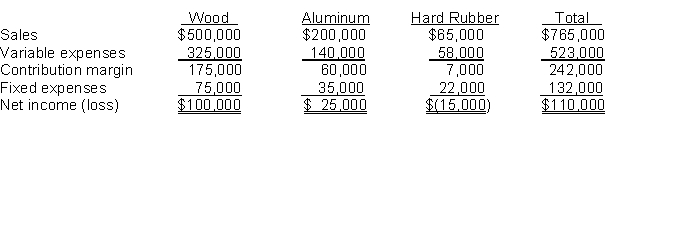 Assume none of the fixed expenses for the hard rubber line are avoidable. What will be total net income if the line is dropped?
 (Multiple Choice)
4.9/5 (70)
(70) If a plant is operating at full capacity and receives a one-time opportunity to accept an order at a special price below its usual price, then
(Multiple Choice)
4.8/5 (85)
(85) In making decisions, management ordinarily considers both financial and nonfinancial information.
(True/False)
4.9/5 (83)
(83) Capital budgeting decisions usually involve large investments and can have a significant impact on a company's future profitability.
(True/False)
4.8/5 (80)
(80) A company is considering replacing old equipment with new equipment. Which of the following is a relevant cost for incremental analysis?
(Multiple Choice)
4.9/5 (82)
(82) If a company is operating at full capacity, the incremental costs of a special order will likely include fixed manufacturing costs.
(True/False)
4.9/5 (70)
(70) The interest rate yielded by a project is a rate that will cause the present value of the proposed capital expenditure to equal the present value of the expected annual cash inflows.
(True/False)
4.8/5 (85)
(85) Woods Company wants to purchase an asset with a 3-year useful life, which is expected to produce cash inflows of $15,000 each year for two years, and $10,000 in year 3. Woods has a 14% cost of capital, and uses the following factors. What is the present value of these future cash flows? 
(Multiple Choice)
4.9/5 (78)
(78) Match the items below by entering the appropriate code letter in the space provided.
A. Incremental analysis F. Cash payback technique
B. Opportunity cost G. Hurdle or cutoff rate
C. Discounted cash flow technique H. Net present value method
D. Capital budgeting I. Sunk cost
E. Annual rate of return technique J. Internal rate of return method
____ 1. A cost that cannot be changed by any present or future decision.
____ 2. A capital budgeting technique that considers both the estimated total cash inflows from the investment and the time value of money.
____ 3. A method used in capital budgeting in which cash inflows are discounted to their present value and then compared to the capital outlay required by the capital investment.
____ 4. The process of identifying the financial data that change under alternative courses of action.
____ 5. A method used in capital budgeting that results in finding the interest yield of the potential investment.
____ 6. The minimum rate of return management requires on an investment.
____ 7. The determination of the profitability of a capital expenditure by dividing expected annual net income by the average investment.
____ 8. The potential benefit that may be lost from following an alternative course of action.
____ 9. The process of making capital expenditure decisions in business.
____ 10. A capital budgeting technique that identifies the time period required to recover the cost of a capital investment from the annual cash inflow produced by the investment.
(Short Answer)
4.8/5 (87)
(87) The following are all quantitative capital budgeting techniques except
(Multiple Choice)
5.0/5 (80)
(80) A hurdle rate is the rate of return set by applying ideal standards.
(True/False)
5.0/5 (78)
(78) 
Filters
- Essay(0)
- Multiple Choice(0)
- Short Answer(0)
- True False(0)
- Matching(0)