



 Chat with AI
Exam 12: The Design of the Tax System

Exam 1: Ten Principles of Economics455 Questions
Exam 2: Thinking Like an Economist645 Questions
Exam 3: Interdependence and the Gains From Trade550 Questions
Exam 4: The Market Forces of Supply and Demand693 Questions
Exam 5: Elasticity and Its Application625 Questions
Exam 6: Supply, Demand, and Government Policies671 Questions
Exam 7: Consumers, Producers, and the Efficiency of Markets547 Questions
Exam 8: Application: The Costs of Taxation507 Questions
Exam 9: Application: International Trade521 Questions
Exam 10: Externalities543 Questions
Exam 11: Public Goods and Common Resources453 Questions
Exam 12: The Design of the Tax System563 Questions
Exam 13: The Costs of Production649 Questions
Exam 14: Firms in Competitive Markets608 Questions
Exam 15: Monopoly662 Questions
Exam 16: Monopolistic Competition649 Questions
Exam 17: Oligopoly522 Questions
Exam 18: The Markets for the Factors of Production592 Questions
Exam 19: Earnings and Discrimination511 Questions
Exam 20: Income Inequality and Poverty478 Questions
Exam 21: The Theory of Consumer Choice568 Questions
Exam 22: Frontiers in Microeconomics461 Questions
Select questions type


Who observed that "in this world nothing is certain but death and taxes"?
(Multiple Choice)
5.0/5  (86)
(86) In 1789, the average American paid approximately what percent of income in taxes?
(Multiple Choice)
4.9/5 (75)
(75) Over the past century in the U.S., what has been federal government revenue as a percentage of GDP? What has been state and local government revenue as a percentage of GDP?
(Essay)
4.9/5 (87)
(87) Suppose the government levies a "fat tax" on naturally-sweetened carbonated beverages to try to reduce the number of overweight children. If the tax revenues pay for the health problems of overweight children, the tax would satisfy the
(Multiple Choice)
4.9/5 (94)
(94) A family's tax liability is the amount of money it owes in taxes.
(True/False)
4.9/5 (77)
(77) Table 12-21
The dollar amounts in the last three columns are the taxes owed under the three different tax systems.  -Refer to Table 12-21. Which of the three tax systems is regressive?
 (Multiple Choice)
5.0/5 (78)
(78) The principle that people should pay taxes based on the benefits they receive from government services is called the
(Multiple Choice)
4.9/5 (94)
(94) Table 12-22  -Refer to Table 12-22. A lump-sum tax is illustrated by tax
 (Multiple Choice)
4.8/5 (85)
(85) Suppose Luke values a scoop of Italian gelato at $4. Leia values a scoop of Italian gelato at $6. The pre-tax price of a scoop of Italian gelato is $2. The government imposes a "fat tax" of $3 on each scoop of Italian gelato, and the price rises to $5. The deadweight loss from the tax is
(Multiple Choice)
4.9/5 (87)
(87) As a person's or family's income rises, the marginal federal income tax rate __________.
(Short Answer)
4.8/5 (86)
(86) The claim that all citizens should make an "equal sacrifice" to support government programs is usually associated with
(Multiple Choice)
4.8/5 (73)
(73) Economics alone cannot determine the best way to balance the goals of efficiency and equity.
(True/False)
4.8/5 (67)
(67) Table 12-11 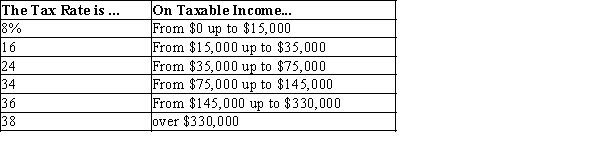 -Refer to Table 12-11. If Bud has taxable income of $78,000, his average tax rate is
 (Multiple Choice)
4.9/5 (79)
(79) An income tax in which the average tax rate is the same for all taxpayers would be considered a
(Multiple Choice)
4.8/5 (70)
(70) Table 12-9
United States Income Tax Rates for a Single Individual, 2012 and 2013. 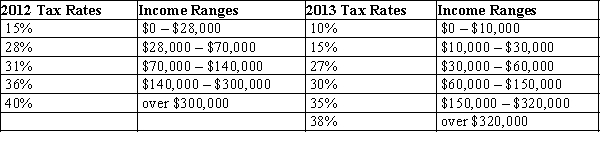 -Refer to Table 12-9. Samantha is a single person whose taxable income is $100,000 a year. What is her average tax rate in 2013?
 (Multiple Choice)
4.9/5 (64)
(64) The average American pays a higher percent of his income in taxes today than he would have in the late 18th century.
(True/False)
4.8/5 (86)
(86) If tax revenues from a cigarette tax are used to pay for healthcare expenses related to lung cancer, the cigarette tax could be justified using the __________.
(Short Answer)
4.8/5 (78)
(78) 
Filters
- Essay(0)
- Multiple Choice(0)
- Short Answer(0)
- True False(0)
- Matching(0)