



 Chat with AI
Exam 12: The Design of the Tax System

Exam 1: Ten Principles of Economics455 Questions
Exam 2: Thinking Like an Economist645 Questions
Exam 3: Interdependence and the Gains From Trade550 Questions
Exam 4: The Market Forces of Supply and Demand693 Questions
Exam 5: Elasticity and Its Application625 Questions
Exam 6: Supply, Demand, and Government Policies671 Questions
Exam 7: Consumers, Producers, and the Efficiency of Markets547 Questions
Exam 8: Application: The Costs of Taxation507 Questions
Exam 9: Application: International Trade521 Questions
Exam 10: Externalities543 Questions
Exam 11: Public Goods and Common Resources453 Questions
Exam 12: The Design of the Tax System563 Questions
Exam 13: The Costs of Production649 Questions
Exam 14: Firms in Competitive Markets608 Questions
Exam 15: Monopoly662 Questions
Exam 16: Monopolistic Competition649 Questions
Exam 17: Oligopoly522 Questions
Exam 18: The Markets for the Factors of Production592 Questions
Exam 19: Earnings and Discrimination511 Questions
Exam 20: Income Inequality and Poverty478 Questions
Exam 21: The Theory of Consumer Choice568 Questions
Exam 22: Frontiers in Microeconomics461 Questions
Select questions type


Taxes can be justified if the government uses the revenue to (i)
Provide public goods such as national defense.(ii)
Clean up negative externalities such as water pollution.
(iii)
Regulate a common resource such as fish in a public lake.(iv)
Provide goods with positive externalities such as medical research.
(Multiple Choice)
4.9/5  (86)
(86) Of all the taxes collected in the U.S. economy, what percentage is collected by the federal government?
(Short Answer)
4.8/5 (89)
(89) Vertical equity refers to a tax system in which individuals with higher incomes pay more in taxes than individuals with lower incomes.
(True/False)
4.9/5 (87)
(87) If Mary earns $80,000 in taxable income and pays $40,000 in taxes, her marginal tax rate must be 50 percent.
(True/False)
4.9/5 (76)
(76) Table 12-20
The following table presents the total tax liability for an unmarried taxpayer under four different tax schedules for the income levels shown.  -Refer to Table 12-20. Which tax schedules are progressive?
 (Multiple Choice)
4.9/5 (74)
(74) If Christopher earns $80,000 in taxable income and pays $20,000 in taxes, his average tax rate is 20 percent.
(True/False)
4.9/5 (84)
(84) Table 12-23
The dollar amounts in the last three columns are the taxes owed under the three different tax systems.  -Refer to Table 12-23. Which of the three tax systems is proportional?
 (Multiple Choice)
4.9/5 (79)
(79) When interest income from savings is taxed, people will save
(Multiple Choice)
4.9/5 (73)
(73) Table 12-24  -Refer to Table 12-24. Does the tax system achieve vertical equity?
 (Essay)
4.8/5 (83)
(83) Suppose a country imposes a lump-sum income tax of $5,000 on each individual in the country. What is the average income tax rate for an individual who earns $40,000 during the year?
(Multiple Choice)
4.8/5 (85)
(85) The income tax requires that taxpayers pay 10 percent on the first $50,000 of income and 20 percent on all income over $50,000. Andy paid $9,000 in taxes. What were his marginal and average tax rates?
(Multiple Choice)
4.9/5 (86)
(86) Scenario 12-3
Suppose Roger and Regina receive great satisfaction from their consumption of cheesecake. Regina would be willing to purchase only one slice and would pay up to $8 for it. Roger would be willing to pay $11 for his first slice, $9 for his second slice, and $5 for his third slice. The current market price is $5 per slice.
-Refer to Scenario 12-3. How much consumer surplus does Regina receive from consuming her slice of cheesecake?
(Multiple Choice)
4.8/5 (74)
(74) The state government requires all persons to pay 5% of their incomes in income tax.This is an example of:
(Multiple Choice)
4.8/5 (88)
(88) If tax revenues from a tax on fried foods are used to pay for healthcare expenses related to cardio-vascular diseases, the fried foods tax could be justified using the __________.
(Short Answer)
4.8/5 (76)
(76) 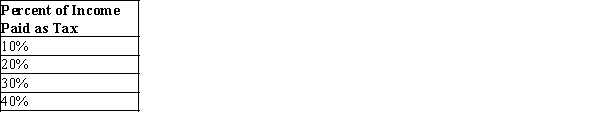 -Refer to Table 12-16. The tax system is

Filters
- Essay(0)
- Multiple Choice(0)
- Short Answer(0)
- True False(0)
- Matching(0)