



 Chat with AI
Exam 21: The Theory of Consumer Choice

Exam 1: Ten Principles of Economics455 Questions
Exam 2: Thinking Like an Economist645 Questions
Exam 3: Interdependence and the Gains From Trade550 Questions
Exam 4: The Market Forces of Supply and Demand693 Questions
Exam 5: Elasticity and Its Application625 Questions
Exam 6: Supply, Demand, and Government Policies671 Questions
Exam 7: Consumers, Producers, and the Efficiency of Markets547 Questions
Exam 8: Application: The Costs of Taxation507 Questions
Exam 9: Application: International Trade521 Questions
Exam 10: Externalities543 Questions
Exam 11: Public Goods and Common Resources453 Questions
Exam 12: The Design of the Tax System563 Questions
Exam 13: The Costs of Production649 Questions
Exam 14: Firms in Competitive Markets608 Questions
Exam 15: Monopoly662 Questions
Exam 16: Monopolistic Competition649 Questions
Exam 17: Oligopoly522 Questions
Exam 18: The Markets for the Factors of Production592 Questions
Exam 19: Earnings and Discrimination511 Questions
Exam 20: Income Inequality and Poverty478 Questions
Exam 21: The Theory of Consumer Choice568 Questions
Exam 22: Frontiers in Microeconomics461 Questions
Select questions type


Figure 21-3
In each case, the budget constraint moves from BC-1 to BC-2. 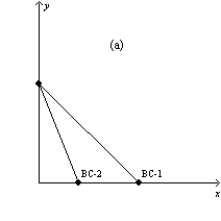
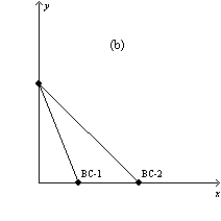
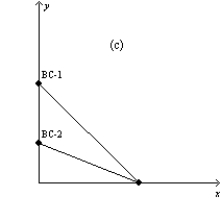
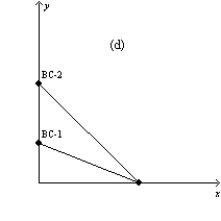 -Refer to Figure 21-3. Which of the graphs in the figure reflects a decrease in the price of good X only?
 (Multiple Choice)
4.9/5  (72)
(72) If an indifference curve is bowed out away from the origin, the marginal rate of substitution is
(Multiple Choice)
4.8/5 (90)
(90) The indifference curves for nickels and dimes are straight lines.
(True/False)
4.9/5 (76)
(76) What is significant about a point on a graph at which an indifference curve is tangent to a budget constraint?
(Essay)
4.8/5 (85)
(85) When two goods are perfect substitutes, the indifference curve is
(Multiple Choice)
4.8/5 (76)
(76) Figure 21-7 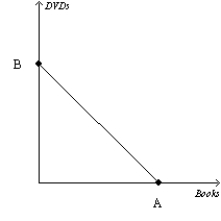 -Refer to Figure 21-7. Suppose a consumer has $200 in income, the price of a book is $5, and the price of a DVD is $10. What is the value of A?
 (Multiple Choice)
4.9/5 (75)
(75) If a consumer experiences a decrease in income, the new budget constraint will have the same slope as the old budget constraint.
(True/False)
4.8/5 (91)
(91) If Priscilla regards cheese and crackers as perfect complements, then
(Multiple Choice)
4.8/5 (69)
(69) The following diagram shows a budget constraint for a particular consumer.  If the price of X is $12, then what is the price of Y?
 (Multiple Choice)
4.8/5 (68)
(68) Jake experiences an increase in his wages. The hours of labor that he supplies to the market would decrease if
(Multiple Choice)
4.8/5 (90)
(90) The marginal rate of substitution is the slope of the budget constraint.
(True/False)
4.9/5 (80)
(80) Figure 21-3
In each case, the budget constraint moves from BC-1 to BC-2.
-Refer to Figure 21-3. Which of the graphs in the figure reflects a decrease in the price of good Y only?
-Refer to Figure 21-3. Which of the graphs in the figure reflects a decrease in the price of good Y only? (Multiple Choice)
4.8/5 (70)
(70) As long as a consumer remains on the same indifference curve,
(Multiple Choice)
4.8/5 (86)
(86) Figure 21-31 The figure shows two indifference curves and two budget constraints for a consumer named Kevin. 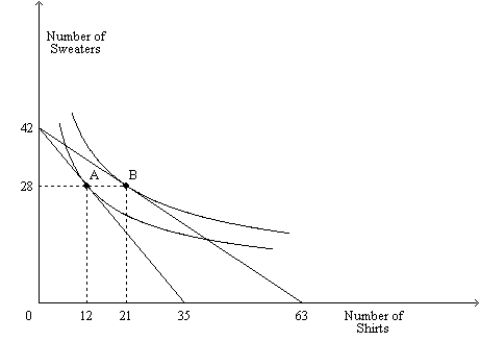 -Refer to Figure 21-31. Suppose point A was Kevin's optimum last week, and point B is his optimum this week. What happened between last week and this week?
 (Short Answer)
4.9/5 (73)
(73) When economists describe preferences, they often use the concept of
(Multiple Choice)
4.9/5 (70)
(70) Figure 21-31 The figure shows two indifference curves and two budget constraints for a consumer named Kevin.
-Refer to Figure 21-31. If point B is Kevin's optimum, then at that optimum, what is his opportunity cost of a sweater in terms of shirts?
-Refer to Figure 21-31. If point B is Kevin's optimum, then at that optimum, what is his opportunity cost of a sweater in terms of shirts? (Essay)
4.9/5 (76)
(76) Figure 21-5
(a)
(b) 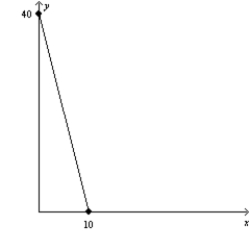
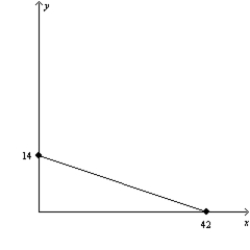 -Refer to Figure 21-5. In graph (a), what is the price of good X relative to the price of good Y (i.e., PX/PY)?
 (Multiple Choice)
4.9/5 (82)
(82) 
Filters
- Essay(0)
- Multiple Choice(0)
- Short Answer(0)
- True False(0)
- Matching(0)