



 Chat with AI
Exam 21: The Theory of Consumer Choice

Exam 1: Ten Principles of Economics455 Questions
Exam 2: Thinking Like an Economist645 Questions
Exam 3: Interdependence and the Gains From Trade550 Questions
Exam 4: The Market Forces of Supply and Demand693 Questions
Exam 5: Elasticity and Its Application625 Questions
Exam 6: Supply, Demand, and Government Policies671 Questions
Exam 7: Consumers, Producers, and the Efficiency of Markets547 Questions
Exam 8: Application: The Costs of Taxation507 Questions
Exam 9: Application: International Trade521 Questions
Exam 10: Externalities543 Questions
Exam 11: Public Goods and Common Resources453 Questions
Exam 12: The Design of the Tax System563 Questions
Exam 13: The Costs of Production649 Questions
Exam 14: Firms in Competitive Markets608 Questions
Exam 15: Monopoly662 Questions
Exam 16: Monopolistic Competition649 Questions
Exam 17: Oligopoly522 Questions
Exam 18: The Markets for the Factors of Production592 Questions
Exam 19: Earnings and Discrimination511 Questions
Exam 20: Income Inequality and Poverty478 Questions
Exam 21: The Theory of Consumer Choice568 Questions
Exam 22: Frontiers in Microeconomics461 Questions
Select questions type


Figure 21-1 The downward-sloping line on the figure represents a consumer's budget
constraint.  -Refer to Figure 21-1. If the price of a CD is $12, then the consumer's income amounts to
 (Multiple Choice)
4.9/5  (77)
(77) Giffen goods have positively-sloped demand curves because they are
(Multiple Choice)
4.8/5 (79)
(79) The change in consumption that results when a price change moves the consumer along a given indifference curve to a point illustrating the new marginal rate of substitution is called the
(Multiple Choice)
4.8/5 (78)
(78) Assume that goods X and Y are not Giffen goods. If the price of good X falls, a consumer will definitely
(Multiple Choice)
4.9/5 (80)
(80) Figure 21-32 The figure shows three indifference curves and a budget constraint for a consumer named Hannah. When young, Hannah works and earns income. When old, she is retired and earns no income. 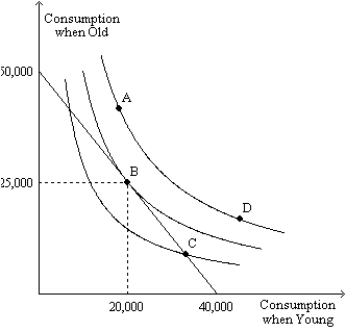 -Refer to Figure 21-32. Of the four labeled points, which is (are) affordable to Hannah?
 (Short Answer)
4.9/5 (76)
(76) Consumer theory provides the foundation for understanding demand curves because
(Multiple Choice)
4.9/5 (81)
(81) Figure 21-10 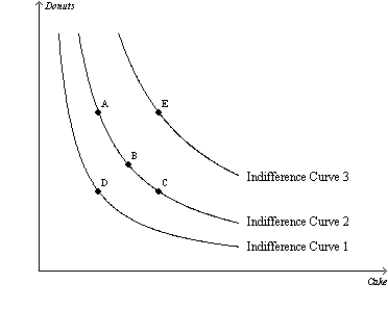 -Refer to Figure 21-10. When comparing bundle B to bundle C, the consumer
 (Multiple Choice)
4.9/5 (85)
(85) When we derive the demand curve for a good, we should remember that the
(Multiple Choice)
4.7/5 (82)
(82) On a graph we draw indifference curves to illustrate Steven's preferences for steak and broccoli. If two of Steven's indifference curves cross, then it cannot be the case that Steven
(Multiple Choice)
4.8/5 (71)
(71) A consumer's preferences for $1 bills and $20 bills can be represented by indifference curves that are
(Multiple Choice)
4.9/5 (66)
(66) Figure 21-31 The figure shows two indifference curves and two budget constraints for a consumer named Kevin. 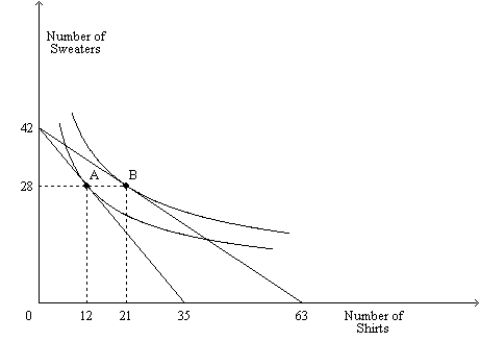 -Refer to Figure 21-31. For Kevin, are sweaters and shirts substitutes, complements, or neither?
 (Essay)
4.8/5 (72)
(72) A worker with a backward-bending labor supply curve responds to an increase in wages by working more hours.
(True/False)
4.7/5 (90)
(90) The marginal rate of substitution is the slope of the indifference curve.
(True/False)
4.8/5 (83)
(83) A set of indifference curves that are only slightly bowed inward represent goods that could best be described as
(Multiple Choice)
5.0/5 (73)
(73) Alicia is a vegetarian, so she does not eat beef. That is, beef provides no additional utility to Alicia. She loves potatoes, however. If we illustrate Alicia's indifference curves by drawing beef on the horizontal axis and potatoes on the vertical axis, her indifference curves will
(Multiple Choice)
4.8/5 (92)
(92) Consider the indifference curve map for nickels and quarters. Assume nickels are on the horizontal axis and quarters are on the vertical axis. The indifference curves for nickels and quarters are
(Multiple Choice)
4.9/5 (70)
(70) If a consumer consumes two goods, X and Y, and has indifference curves that are bowed inward, the consumer's optional choice occurs when
(Multiple Choice)
4.8/5 (69)
(69) 
Filters
- Essay(0)
- Multiple Choice(0)
- Short Answer(0)
- True False(0)
- Matching(0)