



 Chat with AI
Exam 36: Protection, Support, and Movement

Exam 1: Invitation to Biology75 Questions
Exam 2: Lifes Chemical Basis66 Questions
Exam 3: Molecules of Life85 Questions
Exam 4: Cell Structure and Function72 Questions
Exam 5: A Closer Look at Cell Membranes50 Questions
Exam 6: Ground Rules of Metabolism54 Questions
Exam 7: Where It Startsphotosynthesis69 Questions
Exam 8: Energy-Releasing Pathways86 Questions
Exam 9: How Cells Reproduce53 Questions
Exam 10: Meiosis and Sexual Reproduction50 Questions
Exam 11: Observing Patterns in Inherited Traits123 Questions
Exam 12: Chromosomes and Human Inheritance66 Questions
Exam 13: Dna Structure and Function42 Questions
Exam 14: From Dna to Protein63 Questions
Exam 15: Controls Over Genes47 Questions
Exam 16: Recombinant Dna and Genetic Engineering59 Questions
Exam 17: The Macroevolutionary Puzzle47 Questions
Exam 18: Emergence of Evolutionary Thought108 Questions
Exam 19: Organizing Information About Species30 Questions
Exam 20: The Origin and Evolution of Life52 Questions
Exam 21: Viruses and Prokaryotes66 Questions
Exam 22: Protists the Simplest Eukaryotes74 Questions
Exam 23: Plants67 Questions
Exam 24: Fungi52 Questions
Exam 25: Animals: the Invertebrates143 Questions
Exam 26: Animal Evolution the Chordates105 Questions
Exam 27: Human Evolution: a Case Study44 Questions
Exam 28: Plant Tissues90 Questions
Exam 29: Plant Nutrition and Transport71 Questions
Exam 30: Plant Reproduction67 Questions
Exam 31: Plant Growth and Development77 Questions
Exam 32: Animal Tissues and Organ Systems58 Questions
Exam 33: Neural Control123 Questions
Exam 34: Sensory Perception95 Questions
Exam 35: Endocrine Control100 Questions
Exam 36: Protection, Support, and Movement65 Questions
Exam 37: Circulation96 Questions
Exam 38: Immunity99 Questions
Exam 39: Respiration71 Questions
Exam 40: Digestion and Human Nutrition49 Questions
Exam 41: Maintaining the Internal Environment40 Questions
Exam 42: Animal Reproductive Systems37 Questions
Exam 43: Animal Development27 Questions
Exam 44: Animal Behavior35 Questions
Exam 45: Population Ecology62 Questions
Exam 46: Community Structure and Biodiversity52 Questions
Exam 47: Ecosystems33 Questions
Exam 48: The Biosphere51 Questions
Exam 49: Human Impacts on the Biosphere36 Questions
Select questions type


The most prevalent mineral ion stored in and released from bone tissue is
(Multiple Choice)
5.0/5  (73)
(73) Which of the following is an example of a stretchy cord of connective tissue?
(Multiple Choice)
4.8/5 (73)
(73) Andro has all of the following effects on males, EXCEPT _____?
(Multiple Choice)
4.9/5 (83)
(83) Which of the following are components of the axial skeleton?
(Multiple Choice)
4.9/5 (99)
(99) The organism in the above photograph has which of the following structural systems? 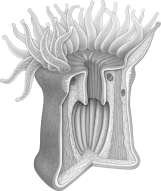
(Multiple Choice)
4.9/5 (83)
(83) Which of the following is NOT a function of the vertebral column in most animals?
(Multiple Choice)
4.9/5 (90)
(90) Which of the following is an example of a cartilaginous joint?
(Multiple Choice)
4.9/5 (90)
(90) Sarcomeres consist of a zone and several bands.Actin and myosin filaments overlap at the __________ while the __________ is actin filaments alone and the __________ is myosin filaments alone.
(Multiple Choice)
4.8/5 (76)
(76) When calcium levels decline, the __________ secrete(s) __________, which __________ osteoclast activity.
(Multiple Choice)
4.7/5 (73)
(73) The trunk of the body has muscles of all of the following EXCEPT
(Multiple Choice)
4.9/5 (94)
(94) Sea anemones have a(n) __________ that causes them to extend into a feeding position when longitudinal cells __________ and radial cells __________.
(Multiple Choice)
4.7/5 (75)
(75) When calcium levels rise, the __________ secrete(s) __________, which __________ osteoclast activity.
(Multiple Choice)
4.9/5 (76)
(76) 
Filters
- Essay(0)
- Multiple Choice(0)
- Short Answer(0)
- True False(0)
- Matching(0)