



 Chat with AI
Exam 9: Inventories: Additional Valuation Issues

Exam 1: Financial Accounting and Accounting Standards103 Questions
Exam 2: Conceptual Framework for Financial Reporting155 Questions
Exam 3: The Accounting Information System144 Questions
Exam 4: Income Statement and Related Information139 Questions
Exam 5: Balance Sheet and Statement of Cash Flows127 Questions
Exam 6: Accounting and the Time Value of Money152 Questions
Exam 7: Cash and Receivables173 Questions
Exam 8: Valuation of Inventories: a Cost-Basis Approach173 Questions
Exam 9: Inventories: Additional Valuation Issues168 Questions
Exam 10: Acquisition and Disposition of Property, Plant, and Equipment170 Questions
Exam 11: Depreciation, Impairments, and Depletion156 Questions
Exam 12: Intangible Assets171 Questions
Exam 13: Current Liabilities and Contingencies170 Questions
Exam 14: Long-Term Liabilities140 Questions
Exam 15: Stockholders Equity155 Questions
Exam 16: Dilutive Securities and Earnings Per Share160 Questions
Exam 17: Investments141 Questions
Exam 18: Revenue Recognition145 Questions
Exam 19: Accounting for Income Taxes127 Questions
Exam 20: Accounting for Pensions and Postretirement Benefits137 Questions
Exam 21: Accounting for Leases128 Questions
Exam 22: Accounting Changes and Error Analysis103 Questions
Exam 23: Statement of Cash Flows143 Questions
Exam 24: Full Disclosure in Financial Reporting108 Questions
Exam 25: Appendix89 Questions
Select questions type


Dollar-value LIFO-retail method.
The records of Heese Stores provided the following data for the year:  Other data are: Freight-in, $14,000; net markups, $8,000; net markdowns, $6,000; and the price index for the year is 110.
Instructions
Determine the approximate valuation of the final inventory by the dollar-value, LIFO-retail method. Label all figures.

Other data are: Freight-in, $14,000; net markups, $8,000; net markdowns, $6,000; and the price index for the year is 110.
Instructions
Determine the approximate valuation of the final inventory by the dollar-value, LIFO-retail method. Label all figures. (Essay)
4.9/5  (85)
(85) Given the acquisition cost of product ALPHA is $34, the net realizable value for product ALPHA is $33.50, the normal profit for product ALPHA is $2.50, and the market value (replacement cost) for product ALPHA is $29.50, what is the proper per unit inventory price for product ALPHA?
(Multiple Choice)
4.8/5 (72)
(72) IFRS records market in the lower-of-cost-or-market differently than U.S. GAAP.
(True/False)
4.9/5 (80)
(80) During the prior fiscal year, Jeremiah Corp. signed a long-term noncancellable purchase commitment with its primary supplier to purchase $1.5 million of raw materials. Jeremiah paid the $1.5 million to acquire the raw materials when the raw materials were only worth $1.2 million. Assume that the purchase commitment was properly recorded. What is the journal entry to record the purchase?
(Multiple Choice)
4.9/5 (82)
(82) Which of the following is not a reason the retail inventory method is used widely?
(Multiple Choice)
4.8/5 (76)
(76) Boxer Inc. reported inventory at the beginning of the current year of $360,000 and at the end of the current year of $411,000. If net sales for the current year are $4,429,200 and the corresponding cost of sales totaled $3,758,800, what is the inventory turnover ratio for the current year?
(Multiple Choice)
4.8/5 (73)
(73) At the end of the fiscal year, Apha Airlines has an outstanding purchase commitment for the purchase of 1 million gallons of jet fuel at a price of $4.60 per gallon for delivery during the coming summer. The company prices its inventory at the lower of cost or market. If the market price for jet fuel at the end of the year is $4.25, how would this situation be reflected in the annual financial statements?
(Multiple Choice)
4.7/5 (76)
(76) Lower-of-cost-or-market.
Assume in each case that the selling expenses are $8 per unit and that the normal profit is $5 per unit. Calculate the limits for each case. Then enter the amount that should be used for lower of cost or market. 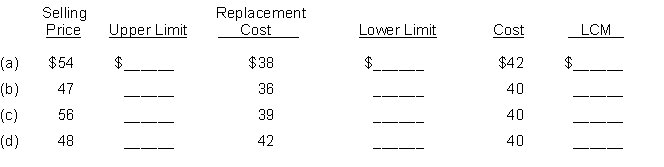
(Essay)
4.9/5 (89)
(89) On March 15, a fire destroyed Interlock Company's entire retail inventory. The inventory on hand as of January 1 totaled $4,950,000. From January 1 through the time of the fire, the company made purchases of $2,049,000, incurred freight-in of $234,000, and had sales of $3,630,000. Assuming the rate of gross profit to selling price is 30%, what is the approximate value of the inventory that was destroyed?
(Multiple Choice)
5.0/5 (77)
(77) Dicer uses the conventional retail method to determine its ending inventory at cost. Assume the beginning inventory at cost (retail) were $260,000 ($396,000), purchases during the current year at cost (retail) were $1,370,000 ($2,200,000), freight-in on these purchases totaled $86,000, sales during the current year totaled $2,000,000, and net markups (markdowns) were $48,000 ($72,000). What is the ending inventory value at cost?
(Multiple Choice)
4.7/5 (70)
(70) Use the following information for questions 114 through 118.
The following data concerning the retail inventory method are taken from the financial records of Welch Company. 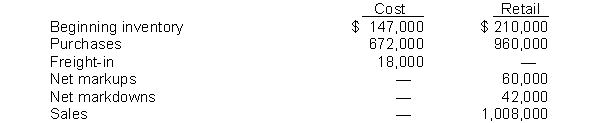 -Assuming no change in the price level if the LIFO inventory method were used in conjunction with the data, the ending inventory at cost would be
 (Multiple Choice)
4.8/5 (78)
(78) A markup of 20% on cost is equivalent to what markup on selling price?
(Multiple Choice)
4.7/5 (86)
(86) Reyes Company had a gross profit of $720,000, total purchases of $840,000, and an ending inventory of $480,000 in its first year of operations as a retailer. Reyes's sales in its first year must have been
(Multiple Choice)
4.8/5 (79)
(79) The 2014 financial statements of Sito Company reported a beginning inventory of $80,000, an ending inventory of $120,000, and cost of goods sold of $900,000 for the year. Sito's inventory turnover ratio for 2014 is
(Multiple Choice)
4.8/5 (86)
(86) Lower-of-cost-or-market.
Determine the unit value that should be used for inventory costing following "lower of cost or market value" as described in ARB No. 43. 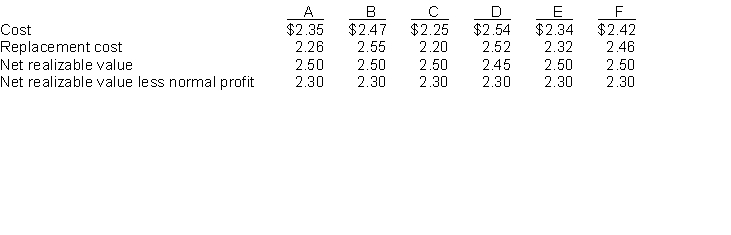
(Essay)
5.0/5 (72)
(72) IFRS defines market as replacement cost subject to certain constraints.
(True/False)
4.9/5 (66)
(66) To produce an inventory valuation which approximates the lower of cost or market using the conventional retail inventory method, the computation of the ratio of cost to retail should
(Multiple Choice)
4.9/5 (71)
(71) Which of the following is not required when using the retail inventory method?
(Multiple Choice)
4.8/5 (87)
(87) In the retail inventory method, abnormal shortages are deducted from both the cost and retail amounts and reported as a loss.
(True/False)
4.8/5 (86)
(86) Where is the authoritative IFRS guidance related to accounting and reporting for inventories found?
(Multiple Choice)
4.8/5 (74)
(74) 
Filters
- Essay(0)
- Multiple Choice(0)
- Short Answer(0)
- True False(0)
- Matching(0)