



 Chat with AI
Exam 11: Depreciation, Impairments, and Depletion

Exam 1: Financial Accounting and Accounting Standards103 Questions
Exam 2: Conceptual Framework for Financial Reporting155 Questions
Exam 3: The Accounting Information System144 Questions
Exam 4: Income Statement and Related Information139 Questions
Exam 5: Balance Sheet and Statement of Cash Flows127 Questions
Exam 6: Accounting and the Time Value of Money152 Questions
Exam 7: Cash and Receivables173 Questions
Exam 8: Valuation of Inventories: a Cost-Basis Approach173 Questions
Exam 9: Inventories: Additional Valuation Issues168 Questions
Exam 10: Acquisition and Disposition of Property, Plant, and Equipment170 Questions
Exam 11: Depreciation, Impairments, and Depletion156 Questions
Exam 12: Intangible Assets171 Questions
Exam 13: Current Liabilities and Contingencies170 Questions
Exam 14: Long-Term Liabilities140 Questions
Exam 15: Stockholders Equity155 Questions
Exam 16: Dilutive Securities and Earnings Per Share160 Questions
Exam 17: Investments141 Questions
Exam 18: Revenue Recognition145 Questions
Exam 19: Accounting for Income Taxes127 Questions
Exam 20: Accounting for Pensions and Postretirement Benefits137 Questions
Exam 21: Accounting for Leases128 Questions
Exam 22: Accounting Changes and Error Analysis103 Questions
Exam 23: Statement of Cash Flows143 Questions
Exam 24: Full Disclosure in Financial Reporting108 Questions
Exam 25: Appendix89 Questions
Select questions type


Orton Corporation, which has a calendar year accounting period, purchased a new machine for $60,000 on April 1, 2010. At that time Orton expected to use the machine for nine years and then sell it for $6,000. The machine was sold for $33,000 on Sept. 30, 2015. Assuming straight-line depreciation, no depreciation in the year of acquisition, and a full year of depreciation in the year of retirement, the gain to be recognized at the time of sale would be
(Multiple Choice)
4.8/5  (81)
(81) Composite depreciation.
Callon Co. uses the composite method to depreciate its equipment. The following totals are for all of the equipment in the group:  Instructions
(a) What is the composite rate of depreciation? (To nearest tenth of a percent.)
(b) A machine with a cost of $23,000 was sold for $14,000 at the end of the third year. What entry should be made?
Instructions
(a) What is the composite rate of depreciation? (To nearest tenth of a percent.)
(b) A machine with a cost of $23,000 was sold for $14,000 at the end of the third year. What entry should be made? (Essay)
4.9/5 (84)
(84) Endeavor Company purchased a depreciable asset for $800,000. The estimated salvage value is $40,000, and the estimated useful life is 10,000 hours. Endeavor used the asset for 1,100 hours in the current year. The activity method will be used for depreciation. What is the depreciation expense on this asset?
(Multiple Choice)
4.8/5 (82)
(82) Depreciation methods.
On July 1, 2014, Sport Company purchased for $2,880,000 snow-making equipment having an estimated useful life of 5 years with an estimated salvage value of $120,000. Depreciation is taken for the portion of the year the asset is used.
Instructions
(a) Complete the form below by determining the depreciation expense and year-end book values for 2014 and 2015 using the
1. sum-of-the-years'-digits method."
2. double-declining balance method. 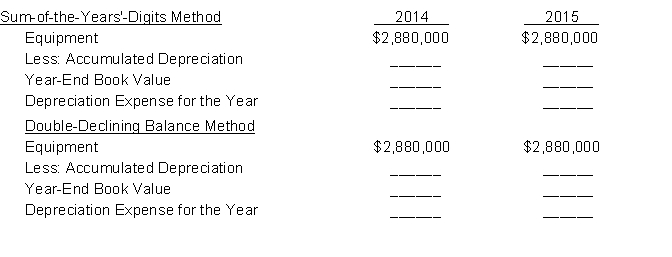 (b) Assume the company had used straight-line depreciation during 2014 and 2015. During 2016, the company determined that the equipment would be useful to the company for only one more year beyond 2016. Salvage value is estimated at $160,000.(1) Compute the amount of depreciation expense for the 2016 income statement.(2) What is the depreciation base of this asset?"
 (Essay)
4.9/5 (84)
(84) U.S. GAAP, like IFRS, permits write-up for subsequent recoveries of impairment, back up to the original amount before the impairment in all circumstances.
(True/False)
4.8/5 (93)
(93) Questions 7 through 10 are based on the following information:
Tongas Company applies revaluation accounting to plant assets with a carrying value of $1,600,000, a useful life of 4 years, and no salvage value. Depreciation is calculated on the straight-line basis. At the end of year 1, independent appraisers determine that the asset has a fair value of $1,500,000.
-The financial statements for year one will include the following information
(Multiple Choice)
4.9/5 (77)
(77) Depreciation, depletion, and amortization all involve the allocation of the cost of a long-lived asset to expense.
(True/False)
4.8/5 (75)
(75) Worley Truck Rental uses the group depreciation method for its fleet of trucks. When it retires one of its trucks and receives cash from a salvage company, the carrying value of property, plant, and equipment will be decreased by the
(Multiple Choice)
4.9/5 (80)
(80) The term "depreciable base," or "depreciation base," as it is used in accounting, refers to
(Multiple Choice)
4.9/5 (72)
(72) The three factors involved in the depreciation process are the depreciation base, the useful life, and the risk of obsolescence.
(True/False)
4.8/5 (81)
(81) Porter Resources Company acquired a tract of land containing an extractable natural resource. Porter is required by its purchase contract to restore the land to a condition suitable for recreational use after it has extracted the natural resource. Geological surveys estimate that the recoverable reserves will be 2,000,000 tons, and that the land will have a value of $1,000,000 after restoration. Relevant cost information follows:  If Porter maintains no inventories of extracted material, what should be the charge to depletion expense per ton of extracted material?
 (Multiple Choice)
4.8/5 (80)
(80) Use the following information for questions 115 and 116:
On January 1, 2014, Garrett Company purchased a machine costing $250,000. The machine is in the MACRS 5-year recovery class for tax purposes and has an estimated $50,000 salvage value at the end of its economic life.
-Assuming the company uses the general MACRS approach, the amount of MACRS deduction for tax purposes for the year 2014 is
(Multiple Choice)
4.9/5 (86)
(86) A plant asset has a cost of $32,000 and a salvage value of $8,000. The asset has a three-year life. If depreciation in the third year amounted to $4,000, which depreciation method was used?
(Multiple Choice)
4.8/5 (82)
(82) IFRS, like U.S. GAAP, capitalizes all direct costs in self-constructed assets.
(True/False)
4.7/5 (85)
(85) On July 1, 2014, Mendes Corporation purchased factory equipment for $225,000. Salvage value was estimated to be $6,000. The equipment will be depreciated over five years using the double-declining balance method. Counting the year of acquisition as one-half year, Mendes should record depreciation expense for 2015 on this equipment of
(Multiple Choice)
4.8/5 (70)
(70) A general description of the depreciation methods applicable to major classes of depreciable assets
(Multiple Choice)
4.9/5 (86)
(86) An accelerated depreciation method is appropriate when the asset's economic usefulness is the same each year.
(True/False)
4.9/5 (82)
(82) A graph is set up with "yearly depreciation expense" on the vertical axis and "time" on the horizontal axis. Assuming linear relationships, how would the graphs for straight-line and sum-of-the-years'-digits depreciation, respectively, be drawn?
(Multiple Choice)
4.9/5 (76)
(76) Falcon Corporation purchased a depreciable asset for $630,000 on January 1, 2012. The estimated salvage value is $63,000, and the estimated total useful life is 9 years. The straight-line method is used for depreciation. In 2015, Falcon changed its estimates to a useful life of 5 years with a salvage value of $105,000. What is 2015 depreciation expense?
(Multiple Choice)
4.7/5 (75)
(75) A principal objection to the straight-line method of depreciation is that it
(Multiple Choice)
4.8/5 (68)
(68) 
Filters
- Essay(0)
- Multiple Choice(0)
- Short Answer(0)
- True False(0)
- Matching(0)