



 Chat with AI
Exam 8: Perfect Competition

Exam 1: Introducing the Economic Way of Thinking251 Questions
Exam 2: Production Possibilities, Opportunity Cost, and Economic Growth202 Questions
Exam 3: Market Demand and Supply412 Questions
Exam 4: Markets in Action253 Questions
Exam 5: Price Elasticity of Demand and Supply280 Questions
Exam 6: Consumer Choice Theory272 Questions
Exam 7: Production Costs243 Questions
Exam 8: Perfect Competition237 Questions
Exam 9: Monopoly168 Questions
Exam 10: Monopolistic Competition and Oligopoly187 Questions
Exam 11: Labor Markets202 Questions
Exam 12: Income Distribution, Poverty, and Discrimination130 Questions
Exam 13: Antitrust and Regulation203 Questions
Exam 14: Environmental Economics106 Questions
Exam 15: International Trade and Finance241 Questions
Exam 16: Economies in Transition108 Questions
Exam 17: Growth and the117 Questions
Select questions type


A firm operating in a perfectly competitive market is a price taker because:
(Multiple Choice)
4.9/5  (88)
(88) If a firm in a competitive industry is making zero economic profit but still producing, it must be the case that:
(Multiple Choice)
4.8/5 (92)
(92) Above the shutdown point, a competitive firm's supply curve coincides with its:
(Multiple Choice)
4.8/5 (82)
(82) Exhibit 8-18 A typical firm in a perfectly competitive market 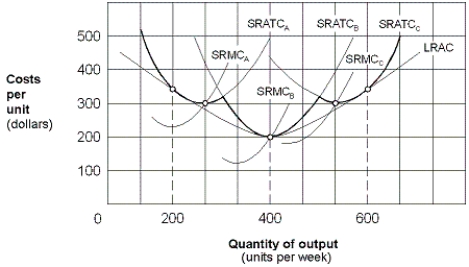 -As shown in Exhibit 8-18, the perfectly competitive firm is in long-run equilibrium at an output of:
 (Multiple Choice)
4.8/5 (88)
(88) Assume that a firm's marginal revenue just barely exceeds marginal cost. Under these conditions the firm should:
(Multiple Choice)
4.8/5 (81)
(81) Assume a competitive market has firms earning large economic profits. What is expected to happen over time in this competitive market and to firm's profits?
(Essay)
4.7/5 (72)
(72) Exhibit 8-18 A typical firm in a perfectly competitive market
-In Exhibit 8-18, assume the perfectly competitive firm is in long-run equilibrium and there is an increase in demand. As a result, the firm in the short run will increase output along its:
-In Exhibit 8-18, assume the perfectly competitive firm is in long-run equilibrium and there is an increase in demand. As a result, the firm in the short run will increase output along its: (Multiple Choice)
4.8/5 (75)
(75) Suppose product price is fixed at $24; MR = MC at Q = 200; AFC = $6; AVC = $16. What do you advise this firm to do?
(Multiple Choice)
4.9/5 (69)
(69) The neighborhood ice cream shop finds that when it charges $3 per ice cream cone, its total revenues are $90,000. It has total variable costs of $30,000 and total fixed costs of $40,000. From this we can infer the:
(Multiple Choice)
4.7/5 (84)
(84) A perfectly competitive firm's short-run supply curve is the part of its marginal cost curve that is:
(Multiple Choice)
4.9/5 (81)
(81) In the perfectly competitive market, all firms in the market are assumed to be producing:
(Multiple Choice)
4.9/5 (86)
(86) When the price of a good is a constant, the marginal revenue per unit of output is the same as:
(Multiple Choice)
4.9/5 (96)
(96) A perfectly competitive market is characterized by the free entry and exit of firms.
(True/False)
4.8/5 (73)
(73) Consider a firm with the following cost and revenue information: ATC = $8, AVC = $7, and MR = MC = $6. If the firm produces Q = 60 in the short run, it:
(Multiple Choice)
5.0/5 (89)
(89) Which of the following correctly explains why sellers in a perfectly competitive market are price takers?
(Multiple Choice)
4.9/5 (82)
(82) Exhibit 8-5 A firm's MR and MC curves 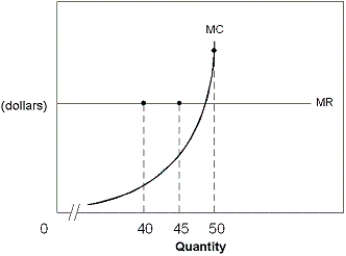 -In Exhibit 8-5, suppose a firm is currently producing 50 units of output. What would you advise this firm to do?
 (Multiple Choice)
4.8/5 (90)
(90) In long-run equilibrium, a competitive firm produces the level of output at which:
(Multiple Choice)
4.9/5 (86)
(86) 
Filters
- Essay(0)
- Multiple Choice(0)
- Short Answer(0)
- True False(0)
- Matching(0)