



 Chat with AI
Exam 8: Perfect Competition

Exam 1: Introducing the Economic Way of Thinking251 Questions
Exam 2: Production Possibilities, Opportunity Cost, and Economic Growth202 Questions
Exam 3: Market Demand and Supply412 Questions
Exam 4: Markets in Action253 Questions
Exam 5: Price Elasticity of Demand and Supply280 Questions
Exam 6: Consumer Choice Theory272 Questions
Exam 7: Production Costs243 Questions
Exam 8: Perfect Competition237 Questions
Exam 9: Monopoly168 Questions
Exam 10: Monopolistic Competition and Oligopoly187 Questions
Exam 11: Labor Markets202 Questions
Exam 12: Income Distribution, Poverty, and Discrimination130 Questions
Exam 13: Antitrust and Regulation203 Questions
Exam 14: Environmental Economics106 Questions
Exam 15: International Trade and Finance241 Questions
Exam 16: Economies in Transition108 Questions
Exam 17: Growth and the117 Questions
Select questions type


In the short run, a firm should shut down its operation if:
(Multiple Choice)
4.8/5  (82)
(82) If, at the point where MR = MC, the firm incurs losses, in the short run the firm should:
(Multiple Choice)
4.8/5 (87)
(87) In the short run, a perfectly competitive firm's most profitable level of output is where:
(Multiple Choice)
4.7/5 (91)
(91) If marginal revenue equals marginal cost in the short run, the perfectly competitive firm earns zero profits.
(True/False)
4.9/5 (84)
(84) Maximizing profit means finding the maximum difference between:
(Multiple Choice)
4.9/5 (75)
(75) When faced with an economic loss, a competitive firm will shut down its operations in the short run.
(True/False)
4.9/5 (67)
(67) The profit maximizing or loss minimizing quantity of output for any firm to produce exists at that output level in which:
(Multiple Choice)
4.9/5 (74)
(74) Exhibit 8-12 Marginal revenue and cost per unit curves 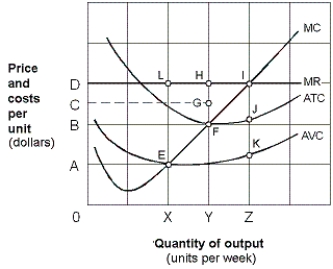 -As shown in Exhibit 8-12, if the price is OB, the firm's total cost of producing at its most profitable level of output is:
 (Multiple Choice)
4.9/5 (86)
(86) Exhibit 8-14 Total cost and total revenue curves 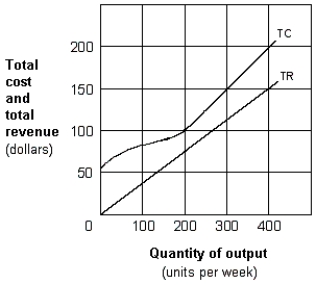 -If the firm in Exhibit 8-14 minimizes its loss at 200 units of output, marginal cost is:
 (Multiple Choice)
4.7/5 (72)
(72) Exhibit 8-3 Cost per unit curves 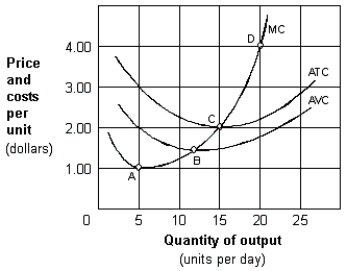 -As shown in Exhibit 8-3, the price at which the firm earns zero economic profit in the short-run is:
 (Multiple Choice)
4.8/5 (78)
(78) When faced with an economic loss, a competitive firm will exit the industry in the long run.
(True/False)
4.8/5 (70)
(70) In the short run, a firm should shut down its business if price is less than:
(Multiple Choice)
4.8/5 (91)
(91) Exhibit 8-2 Total revenue and total cost graph 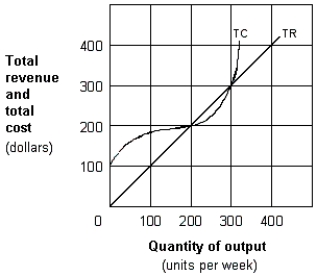 -In Exhibit 8-2, if output is 200 units per week, economic profit for the firm is:
 (Multiple Choice)
4.8/5 (73)
(73) If a potato farmer expands output, he finds that the increase in total revenue is less than the increase in total costs. This means that:
(Multiple Choice)
4.7/5 (88)
(88) In long-run equilibrium, a perfectly competitive firm's short-run marginal cost curve crosses the long-run average cost curve at the lowest point on the long-run average cost curve.
(True/False)
5.0/5 (73)
(73) A perfectly competitive market is characterized by highly advertised goods.
(True/False)
4.8/5 (75)
(75) Exhibit 8-19 Long-run perfectly competitive industry 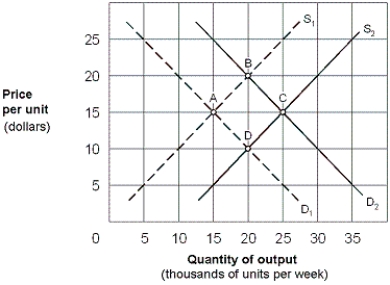 -As shown in Exhibit 8-19, assume that a perfectly competitive industry is in long-run equilibrium at point A and the demand curve shifts from D1 to D2. The result is a long-run supply curve drawn from point:
 (Multiple Choice)
4.9/5 (80)
(80) 
Filters
- Essay(0)
- Multiple Choice(0)
- Short Answer(0)
- True False(0)
- Matching(0)