



 Chat with AI
Exam 4: Corporations: Organization and Capital Structure

Exam 1: Understanding and Working With the Federal Tax Law71 Questions
Exam 2: Corporations: Introduction and Operating Rules94 Questions
Exam 3: Corporations: Special Situations99 Questions
Exam 4: Corporations: Organization and Capital Structure84 Questions
Exam 5: Corporations: Earnings Profits and Dividend Distributions114 Questions
Exam 6: Corporations: Redemptions and Liquidations88 Questions
Exam 7: Corporations: Reorganizations86 Questions
Exam 8: Consolidated Tax Returns138 Questions
Exam 9: Taxation of International Transactions163 Questions
Exam 10: Partnerships: Formation, Operation, and Basis122 Questions
Exam 11: Partnerships: Distributions, Transfer of Interests, and Terminations128 Questions
Exam 12: S Corporations135 Questions
Exam 13: Comparative Forms of Doing Business108 Questions
Exam 14: Taxes on the Financial Statements55 Questions
Exam 15: Exempt Entities100 Questions
Exam 16: Multistate Corporate Taxation123 Questions
Exam 17: Tax Practice and Ethics129 Questions
Exam 18: The Federal Gift and Estate Taxes188 Questions
Exam 19: Family Tax Planning145 Questions
Exam 20: Income Taxation of Trusts and Estates136 Questions
Select questions type


Lark City donates land worth $300,000 and cash of $100,000 to Orange Corporation as an inducement to locate in the city. Four months later, Orange purchases additional land and a building at a cost of $500,000 and moves its operations to Lark City. Ann, the sole shareholder, contributes equipment (basis of $70,000 and fair market value of $200,000) to help Orange in its new operations. What are the tax consequences of these transfers to Orange Corporation?

Free
(Essay)
4.8/5  (84)
(84) Correct Answer: Verified
Orange Corporation will not have income on the transfers from Lark City or Ann. However, its basis in the donated land is zero. In addition, Orange must reduce its basis in the purchased land and building from $500,000 to $400,000. The basis of any property acquired with money received from a nonshareholder during a 12-month period beginning on the day the contribution is received is reduced by the amount of the contribution. Orange will have a basis of $70,000 in the equipment it receives from Ann. Finally, the transfer, which is a capital contribution by Ann, increases her stock basis in Orange by $70,000.
If a shareholder owns stock received as a gift from her mother, it cannot be § 1244 stock.
Free
(True/False)
4.9/5 (71)
(71) Correct Answer:Verified
VerifiedTrue
Ruth transfers property worth $200,000 (basis of $60,000) to Goldfinch Corporation. In return, she receives 80% of its stock (worth $180,000) and a long-term note, executed by Goldfinch and made payable to Ruth (worth $20,000). Ruth will recognize no gain on the transfer.
Free
(True/False)
4.8/5 (76)
(76) Correct Answer:Verified
VerifiedFalse
Sarah and Tony (mother and son) form Dove Corporation with the following investments: cash by Sarah of $65,000; land by Tony (basis of $25,000 and fair market value of $35,000). Dove Corporation issues 400 shares of stock, 200 each to Sarah and Tony. Thus, each receives stock in Dove worth $50,000.
(Multiple Choice)
5.0/5 (85)
(85) For § 351 purposes, stock rights and stock warrants are included in the definition of "stock."
(True/False)
4.9/5 (79)
(79) To ease a liquidity problem, all of the shareholders of Osprey Corporation contribute additional cash to its capital. Osprey has no tax consequences from the contribution.
(True/False)
4.9/5 (80)
(80) If a transaction qualifies under § 351, any recognized gain is equal to the value of the boot received.
(True/False)
4.9/5 (73)
(73) Joyce, a single taxpayer, transfers property (basis of $120,000 and fair market value of $60,000) to Wren Corporation in exchange for shares of § 1244 stock. As the transfer qualifies under § 351, Joyce takes a $120,000 basis in the Wren stock. In the current year, Joyce sells the Wren Corporation stock for $40,000. What are the consequences of the sale to Joyce?
(Essay)
4.7/5 (88)
(88) Ann transferred land worth $200,000, with a tax basis of $40,000, to Brown Corporation, an existing entity, for 100 shares of its stock. Brown Corporation has two other shareholders, Bill and Bob, each of whom holds 100 shares. With respect to the transfer:
(Multiple Choice)
4.8/5 (77)
(77) Jane transfers property (basis of $180,000 and fair market value of $500,000) to Green Corporation for 80% of its stock (worth $425,000) and a long-term note (worth $75,000), executed by Green Corporation and made payable to Jane. As a result of the transfer:
(Multiple Choice)
4.9/5 (81)
(81) Wren Corporation (a minority shareholder in Lark Corporation) has made loans to Lark Corporation that become worthless in the current year.
(Multiple Choice)
4.8/5 (74)
(74) Four individuals form Chickadee Corporation under § 351. Two of these individuals, Jane and Walt, made the following contributions: 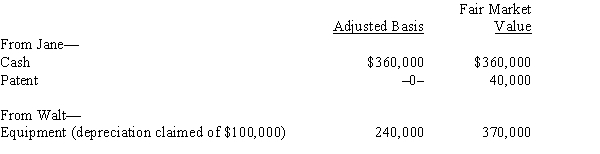 Both Jane and Walt receive stock in Chickadee Corporation equal to the value of their investments.
 (Multiple Choice)
4.7/5 (90)
(90) In a § 351 transaction, if a transferor receives consideration other than stock, the transaction can be taxable.
(True/False)
4.9/5 (90)
(90) The control requirement under § 351 requires that the person or persons transferring property to the corporation, immediately after the transfer, own stock possessing at least 80% of the total combined voting power of all classes of stock entitled to vote and at least 80% of the total number of shares of all other classes of stock of the corporation.
(True/False)
4.9/5 (81)
(81) Because services are not considered property under § 351, a taxpayer must report as income the fair market value of stock received for such services.
(True/False)
5.0/5 (78)
(78) A shareholder contributes land to his wholly owned corporation but receives no stock in return. The corporation has a zero basis in the land.
(True/False)
4.8/5 (89)
(89) In order to encourage the development of an industrial park, a county donates land to Ecru Corporation. The donation does not result in gross income to Ecru.
(True/False)
4.8/5 (92)
(92) Three individuals form Skylark Corporation with the following contributions: Cliff, cash of $50,000 for 50 shares; Brad, land worth $20,000 (basis of $11,000) for 20 shares; and Ron, cattle worth $9,000 (basis of $6,000) for 9 shares and services worth $21,000 for 21 shares.
(Multiple Choice)
4.8/5 (81)
(81) In order to retain the services of Eve, a key employee in Ted's sole proprietorship, Ted contracts with Eve to make her a 30% owner. Ted incorporates the business receiving in return 100% of the stock. Three days later, Ted transfers 30% of the stock to Eve. Under these circumstances, § 351 will not apply to the incorporation of Ted's business.
(True/False)
4.8/5 (78)
(78) Mitchell and Powell form Green Corporation. Mitchell transfers property (basis of $105,000 and fair market value of $90,000) while Powell transfers land (basis of $8,000 and fair market value of $75,000) and $15,000 of cash. Each receives 50% of Green Corporation's stock (total value of $180,000). As a result of these transfers:
(Multiple Choice)
4.8/5 (80)
(80) 
Filters
- Essay(0)
- Multiple Choice(0)
- Short Answer(0)
- True False(0)
- Matching(0)