



 Chat with AI
Exam 13: Comparative Forms of Doing Business

Exam 1: Understanding and Working With the Federal Tax Law71 Questions
Exam 2: Corporations: Introduction and Operating Rules94 Questions
Exam 3: Corporations: Special Situations99 Questions
Exam 4: Corporations: Organization and Capital Structure84 Questions
Exam 5: Corporations: Earnings Profits and Dividend Distributions114 Questions
Exam 6: Corporations: Redemptions and Liquidations88 Questions
Exam 7: Corporations: Reorganizations86 Questions
Exam 8: Consolidated Tax Returns138 Questions
Exam 9: Taxation of International Transactions163 Questions
Exam 10: Partnerships: Formation, Operation, and Basis122 Questions
Exam 11: Partnerships: Distributions, Transfer of Interests, and Terminations128 Questions
Exam 12: S Corporations135 Questions
Exam 13: Comparative Forms of Doing Business108 Questions
Exam 14: Taxes on the Financial Statements55 Questions
Exam 15: Exempt Entities100 Questions
Exam 16: Multistate Corporate Taxation123 Questions
Exam 17: Tax Practice and Ethics129 Questions
Exam 18: The Federal Gift and Estate Taxes188 Questions
Exam 19: Family Tax Planning145 Questions
Exam 20: Income Taxation of Trusts and Estates136 Questions
Select questions type


Included among the factors that influence the choice of the form of a business entity are the following:
∙
Capital formation.
∙
Limited liability.
∙
Estimated life of the business.
∙
Number of owners and their roles in the management of the business.
∙
Freedom of choice in transferring ownership interest.
∙
Organizational formality including the related cost and extent of governmental regulations.
Evaluate the validity of the statement.

Free
(Essay)
4.8/5  (67)
(67) Correct Answer: Verified
All of these factors are relevant factors in selecting the form of a business entity.
Do the § 465 at-risk rules treat recourse debt and nonrecourse debt differently?
Free
(Essay)
4.7/5 (71)
(71) Correct Answer:Verified
VerifiedYes. In calculating the at-risk basis for a taxpayer, only recourse debt is included in the calculation.
To the extent of built-in gain or built-in loss at the time of contribution, partnerships may choose to allocate or not allocate this built-in gain or loss to the contributing partner on the sale of the contributed property by the partnership.
Free
(True/False)
4.9/5 (85)
(85) Correct Answer:Verified
VerifiedFalse
Match the following attributes with the different forms. A particular attribute may apply to more than one entity form
-Sole proprietorship
(Multiple Choice)
5.0/5 (92)
(92) Arnold purchases a building for $750,000 which is going to be used by his wholly-owned corporation. Which of the following statements are correct?
(Multiple Choice)
4.8/5 (102)
(102) Match the following statements:
-Sale of corporate stock by the C corporation shareholders.
(Multiple Choice)
4.8/5 (61)
(61) Albert's sole proprietorship owns the following assets: 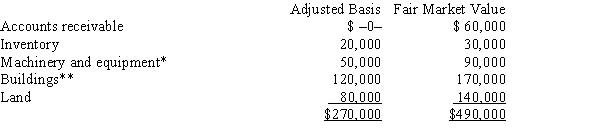 * Potential § 1245 recapture of $45,000.
** Straight-line depreciation was used.
Albert sells his sole proprietorship for $500,000. Calculate Albert's recognized gain or loss and classify it as capital or ordinary.
* Potential § 1245 recapture of $45,000.
** Straight-line depreciation was used.
Albert sells his sole proprietorship for $500,000. Calculate Albert's recognized gain or loss and classify it as capital or ordinary. (Multiple Choice)
4.9/5 (69)
(69) C corporations and their shareholders are subject to double taxation. S corporations and their shareholders typically are subject to single taxation. Therefore, for any given amount of corporate taxable income, the combined tax liability of a C corporation and its shareholders will exceed that of an S corporation and its shareholders.
(True/False)
4.9/5 (81)
(81) After a § 721 contribution by a partner to a partnership, the partner's basis for his or her ownership interest is the same as the basis of the assets contributed (no liabilities are involved).
(True/False)
4.8/5 (72)
(72) Malcomb and Sandra (shareholders) each loan Crow Corporation $50,000 at the market rate of 6% interest. Which of the following statements are false?
(Multiple Choice)
4.8/5 (83)
(83) Bev and Cabel each own one-half of the stock of Finch, Inc., an S corporation with no accumulated E & P. Bev's basis in the Finch stock is $225,000. Finch's taxable income for the current year is $100,000, and it distributes $180,000 to each shareholder. Bev's stock basis at the end of the year is:
(Multiple Choice)
5.0/5 (86)
(86) Match the following attributes with the different forms. A particular attribute may apply to more than one entity form
-General partnership
(Multiple Choice)
4.9/5 (77)
(77) A corporation may alternate between S corporation and C corporation status each year, depending on which results in more tax savings.
(True/False)
4.9/5 (97)
(97) Amber, Inc., has taxable income of $212,000. In addition, Amber accumulates the following information which may affect its AMT.
∙
Depreciation on buildings placed in service in the early 1990s was $52,000. ADS would have been $41,000.
∙
The president of Amber exercised stock options on Amber stock. She paid $30,000 for the stock, which had a fair market value at exercise date of $49,000. At the end of the year, the stock was worth $54,000.
∙
Amber deducted percentage depletion of $65,000. The adjusted basis of the natural resource at the beginning of the year was $39,000.
∙
Amber contributed CSX stock worth $20,000 to the Red Cross. Amber purchased the stock four months ago for $19,000.
What is Amber's AMTI?
(Multiple Choice)
4.8/5 (83)
(83) The legal form of Edith and Fran's business entity is an LLC. Under the check-the-box Regulations, what options are available to them for Federal income tax purposes? Which option would you normally recommend?
(Essay)
4.8/5 (75)
(75) Amos contributes land with an adjusted basis of $150,000 and a fair market value of $200,000 to White, Inc., an S corporation, in exchange for 50% of the stock of White, Inc. Carol contributes cash of $200,000 for the other 50% of the stock. If White later sells the land for $225,000, $62,500 [$50,000 + 50%($25,000)] is allocated to Amos and $12,500 ($25,000 × 50%) is allocated to Carol.
(True/False)
4.7/5 (85)
(85) 
Filters
- Essay(0)
- Multiple Choice(0)
- Short Answer(0)
- True False(0)
- Matching(0)