



 Chat with AI
Exam 55: Ecosystems and Restoration Ecology

Exam 1: Evolution, the Themes of Biology, and Scientific Inquiry51 Questions
Exam 2: The Chemical Context of Life61 Questions
Exam 3: Water and Life55 Questions
Exam 4: Carbon and the Molecular Diversity of Life58 Questions
Exam 5: The Structure and Function of Large Biological Molecules70 Questions
Exam 6: A Tour of the Cell66 Questions
Exam 7: Membrane Structure and Function68 Questions
Exam 8: An Introduction to Metabolism67 Questions
Exam 9: Cellular Respiration and Fermentation68 Questions
Exam 10: Photosynthesis65 Questions
Exam 11: Cell Communication65 Questions
Exam 12: The Cell Cycle66 Questions
Exam 13: Meiosis and Sexual Life Cycles64 Questions
Exam 14: Mendel and the Gene Idea62 Questions
Exam 15: The Chromosomal Basis of Inheritance58 Questions
Exam 16: The Molecular Basis of Inheritance65 Questions
Exam 17: Gene Expression: From Gene to Protein67 Questions
Exam 18: Regulation of Gene Expression66 Questions
Exam 19: Viruses54 Questions
Exam 20: DNA Tools and Biotechnology57 Questions
Exam 21: Genomes and Their Evolution44 Questions
Exam 22: Descent with Modification: A Darwinian View of Life60 Questions
Exam 23: The Evolution of Populations64 Questions
Exam 24: The Origin of Species67 Questions
Exam 25: The History of Life on Earth59 Questions
Exam 26: Phylogeny and the Tree of Life75 Questions
Exam 27: Bacteria and Archaea75 Questions
Exam 28: Protists79 Questions
Exam 29: Plant Diversity I: How Plants Colonized Land82 Questions
Exam 30: Plant Diversity II: The Evolution of Seed Plants80 Questions
Exam 31: Fungi75 Questions
Exam 32: An Overview of Animal Diversity67 Questions
Exam 33: An Introduction to Invertebrates83 Questions
Exam 34: The Origin and Evolution of Vertebrates82 Questions
Exam 35: Vascular Plant Structure, Growth, and Development65 Questions
Exam 36: Resource Acquisition and Transport in Vascular Plants74 Questions
Exam 37: Soil and Plant Nutrition52 Questions
Exam 38: Angiosperm Reproduction and Biotechnology60 Questions
Exam 39: Plant Responses to Internal and External Signals61 Questions
Exam 40: Basic Principles of Animal Form and Function68 Questions
Exam 41: Animal Nutrition64 Questions
Exam 42: Circulation and Gas Exchange67 Questions
Exam 43: The Immune System69 Questions
Exam 44: Osmoregulation and Excretion64 Questions
Exam 45: Hormones and the Endocrine System66 Questions
Exam 46: Animal Reproduction68 Questions
Exam 47: Animal Development70 Questions
Exam 48: Neurons, Synapses, and Signaling68 Questions
Exam 49: Nervous Systems65 Questions
Exam 50: Sensory and Motor Mechanisms67 Questions
Exam 51: Animal Behavior69 Questions
Exam 52: An Introduction to Ecology and the Biosphere68 Questions
Exam 53: Population Ecology69 Questions
Exam 54: Community Ecology71 Questions
Exam 55: Ecosystems and Restoration Ecology68 Questions
Exam 56: Conservation Biology and Global Change69 Questions
Select questions type


Use the following figure to answer the question.
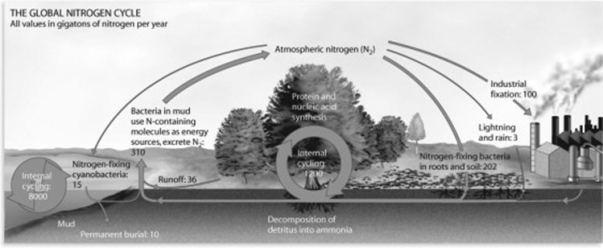 Consider the global nitrogen cycle depicted in the figure. What is the limiting portion of the cycle for plants?
 (Multiple Choice)
4.7/5  (65)
(65) Use the following figure to answer the question.
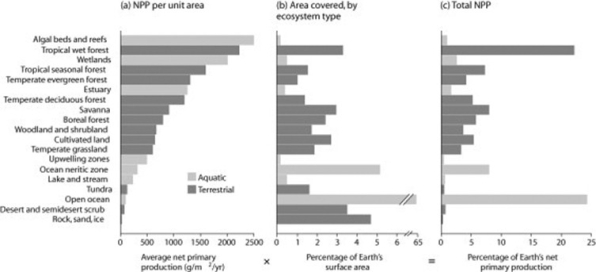 Which habitat type in the figure makes available the most new tissue to consumers?
 (Multiple Choice)
4.8/5 (80)
(80) Which of the following ecosystems would likely have the largest net primary productivity per hectare and why?
(Multiple Choice)
4.8/5 (72)
(72) Use the following figure to answer the question.
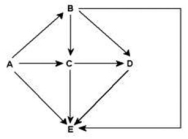 Food web for a particular terrestrial ecosystem (arrows represent energy flow and letters represent species)
Examine this food web for a particular terrestrial ecosystem. Which pair of species could be omnivores?
Food web for a particular terrestrial ecosystem (arrows represent energy flow and letters represent species)
Examine this food web for a particular terrestrial ecosystem. Which pair of species could be omnivores? (Multiple Choice)
4.9/5 (71)
(71) Which of the following is an accurate statement regarding mineral nutrients in soils and their implication for primary productivity?
(Multiple Choice)
4.7/5 (81)
(81) Which of the following locations are major reservoirs for carbon in the carbon cycle?
(Multiple Choice)
4.9/5 (79)
(79) Owls eat rats, mice, shrews, and small birds. Assume that, over a period of time, an owl consumes 5,000 J of animal material. The owl loses 2,300 J in feces and owl pellets and uses 2,500 J for cellular respiration. What is the production efficiency of this owl?
(Multiple Choice)
4.9/5 (72)
(72) Use the following figure to answer the question.
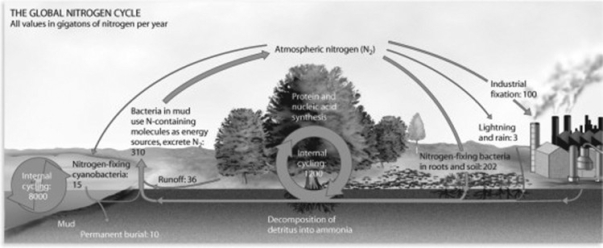 Consider the global nitrogen cycle depicted in the figure. How are humans altering this cycle?
 (Multiple Choice)
4.7/5 (86)
(86) Why is terrestrial productivity higher in equatorial climates?
(Multiple Choice)
4.9/5 (75)
(75) Use the following figure to answer the question.
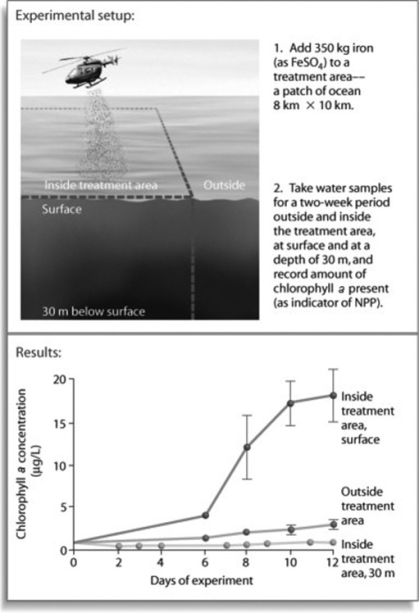 After looking at the experiment in the figure, what can be concluded about productivity in marine ecosystems?
 (Multiple Choice)
4.8/5 (79)
(79) Use the following figure to answer the question.
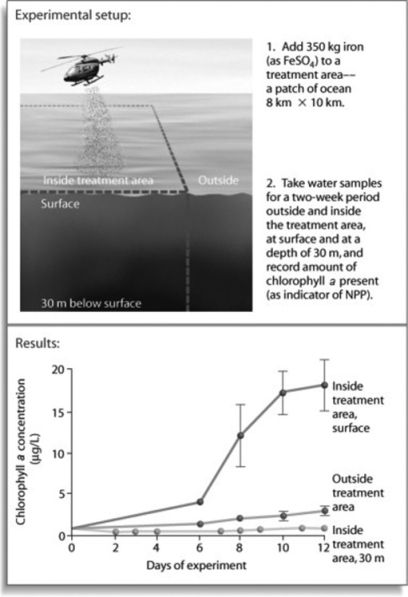 After looking at the results in the figure, what can be concluded about productivity in the experimental ecosystem?
 (Multiple Choice)
4.8/5 (79)
(79) What advantage would there be for an ecosystem ecologist to measure net ecosystem production (NEP) instead of net primary production (NPP)?
(Multiple Choice)
4.9/5 (68)
(68) Which of the following has the greatest effect on the rate of chemical cycling in an ecosystem?
(Multiple Choice)
4.8/5 (81)
(81) Which of the following organisms is incorrectly paired with its trophic level?
(Multiple Choice)
4.9/5 (81)
(81) Many of the organisms in the ocean are nutrient-limited. If you wanted to investigate this phenomenon, one reasonable approach would be to ________.
(Multiple Choice)
4.8/5 (97)
(97) Which of the following statements is correct about biogeochemical cycling?
(Multiple Choice)
4.9/5 (88)
(88) Nitrifying bacteria participate in the nitrogen cycle mainly by
(Multiple Choice)
4.8/5 (84)
(84) How is net ecosystem production (NEP) typically estimated in ecosystems?
(Multiple Choice)
4.9/5 (67)
(67) Suppose you are studying the nitrogen cycling between vegetation, sediments, and water in a pond ecosystem over the course of a month. While you are collecting data, a flock of 100 Canada geese lands and spends the night during a fall migration. What could you do to eliminate error in your study as a result of this event?
(Multiple Choice)
4.9/5 (85)
(85) Why does a vegetarian leave a smaller ecological footprint than an omnivore?
(Multiple Choice)
4.7/5 (88)
(88) 
Filters
- Essay(0)
- Multiple Choice(0)
- Short Answer(0)
- True False(0)
- Matching(0)