



 Chat with AI
Exam 54: Community Ecology

Exam 1: Evolution, the Themes of Biology, and Scientific Inquiry51 Questions
Exam 2: The Chemical Context of Life61 Questions
Exam 3: Water and Life55 Questions
Exam 4: Carbon and the Molecular Diversity of Life58 Questions
Exam 5: The Structure and Function of Large Biological Molecules70 Questions
Exam 6: A Tour of the Cell66 Questions
Exam 7: Membrane Structure and Function68 Questions
Exam 8: An Introduction to Metabolism67 Questions
Exam 9: Cellular Respiration and Fermentation68 Questions
Exam 10: Photosynthesis65 Questions
Exam 11: Cell Communication65 Questions
Exam 12: The Cell Cycle66 Questions
Exam 13: Meiosis and Sexual Life Cycles64 Questions
Exam 14: Mendel and the Gene Idea62 Questions
Exam 15: The Chromosomal Basis of Inheritance58 Questions
Exam 16: The Molecular Basis of Inheritance65 Questions
Exam 17: Gene Expression: From Gene to Protein67 Questions
Exam 18: Regulation of Gene Expression66 Questions
Exam 19: Viruses54 Questions
Exam 20: DNA Tools and Biotechnology57 Questions
Exam 21: Genomes and Their Evolution44 Questions
Exam 22: Descent with Modification: A Darwinian View of Life60 Questions
Exam 23: The Evolution of Populations64 Questions
Exam 24: The Origin of Species67 Questions
Exam 25: The History of Life on Earth59 Questions
Exam 26: Phylogeny and the Tree of Life75 Questions
Exam 27: Bacteria and Archaea75 Questions
Exam 28: Protists79 Questions
Exam 29: Plant Diversity I: How Plants Colonized Land82 Questions
Exam 30: Plant Diversity II: The Evolution of Seed Plants80 Questions
Exam 31: Fungi75 Questions
Exam 32: An Overview of Animal Diversity67 Questions
Exam 33: An Introduction to Invertebrates83 Questions
Exam 34: The Origin and Evolution of Vertebrates82 Questions
Exam 35: Vascular Plant Structure, Growth, and Development65 Questions
Exam 36: Resource Acquisition and Transport in Vascular Plants74 Questions
Exam 37: Soil and Plant Nutrition52 Questions
Exam 38: Angiosperm Reproduction and Biotechnology60 Questions
Exam 39: Plant Responses to Internal and External Signals61 Questions
Exam 40: Basic Principles of Animal Form and Function68 Questions
Exam 41: Animal Nutrition64 Questions
Exam 42: Circulation and Gas Exchange67 Questions
Exam 43: The Immune System69 Questions
Exam 44: Osmoregulation and Excretion64 Questions
Exam 45: Hormones and the Endocrine System66 Questions
Exam 46: Animal Reproduction68 Questions
Exam 47: Animal Development70 Questions
Exam 48: Neurons, Synapses, and Signaling68 Questions
Exam 49: Nervous Systems65 Questions
Exam 50: Sensory and Motor Mechanisms67 Questions
Exam 51: Animal Behavior69 Questions
Exam 52: An Introduction to Ecology and the Biosphere68 Questions
Exam 53: Population Ecology69 Questions
Exam 54: Community Ecology71 Questions
Exam 55: Ecosystems and Restoration Ecology68 Questions
Exam 56: Conservation Biology and Global Change69 Questions
Select questions type


Use the figure to answer the following question.
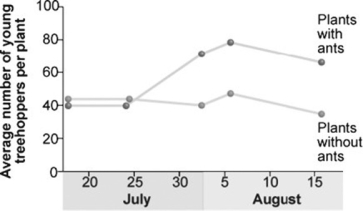 Treehoppers (a type of insect) produce honeydew, which ants use for food. Treehoppers have a major predator, the jumping spider. Researchers hypothesized that the ants would protect the treehoppers from the spiders. In an experiment, researchers followed study plots with ants removed from the system and compared them to a control plot. From the figure, what can you conclude?
 (Multiple Choice)
4.9/5  (80)
(80) How might an ecologist test whether a species is occupying all of its fundamental niche or only a portion of it?
(Multiple Choice)
4.8/5 (78)
(78) Which of the following statements is consistent with the principle of competitive exclusion?
(Multiple Choice)
4.9/5 (83)
(83) Use the figure to answer the following question.
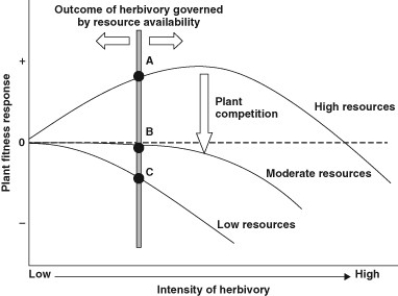 The figure proposes a combination of a top-down and bottom-up model (a hypothesis) to describe the variable effects of biological control herbivores on the fitness (growth and reproduction) of an invasive, non-native plant, spotted knapweed (Centaurea stoebe). These herbivores include multiple insects that were first studied in the plant's native home range in eastern Europe, where the plant is not dominant in grassland communities and does not pose a problem to land managers and conservationists. Many insects there were found to consume the plant's tissues, including stems, leaves, and seeds, and some were very host specific and were not found to attack plants other than C. stoebe. Several insects were subsequently transported and released in an attempt to reduce densities of this non-native and problematic weed in the United States. The y-axis shows C. stoebe plant fitness, and the x-axis represents the intensity of herbivory by the insects, from low to high. As the vertical shaded bar is moved along the x-axis, the ultimate effect of herbivory (now A, B, and C) on plant fitness can change based on its intensity and also may depend on the other factors. The horizontal dashed line represents no predicted change in fitness under the effects of varying intensity of herbivory, plant competition, and soil resources available to the plant (such as nitrogen or water), while the three solid lines represent other possible outcomes.
(D)G. Knochel and T.R. Seastedt. 2011. Reconciling contradictory findings of herbivore impacts on spotted knapweed (Centaurea stoebe) growth and reproduction. Ecological Applications 20(7):1903-1912.
What is the model's prediction for C. stoebe plant fitness when growing under high soil resource conditions?
The figure proposes a combination of a top-down and bottom-up model (a hypothesis) to describe the variable effects of biological control herbivores on the fitness (growth and reproduction) of an invasive, non-native plant, spotted knapweed (Centaurea stoebe). These herbivores include multiple insects that were first studied in the plant's native home range in eastern Europe, where the plant is not dominant in grassland communities and does not pose a problem to land managers and conservationists. Many insects there were found to consume the plant's tissues, including stems, leaves, and seeds, and some were very host specific and were not found to attack plants other than C. stoebe. Several insects were subsequently transported and released in an attempt to reduce densities of this non-native and problematic weed in the United States. The y-axis shows C. stoebe plant fitness, and the x-axis represents the intensity of herbivory by the insects, from low to high. As the vertical shaded bar is moved along the x-axis, the ultimate effect of herbivory (now A, B, and C) on plant fitness can change based on its intensity and also may depend on the other factors. The horizontal dashed line represents no predicted change in fitness under the effects of varying intensity of herbivory, plant competition, and soil resources available to the plant (such as nitrogen or water), while the three solid lines represent other possible outcomes.
(D)G. Knochel and T.R. Seastedt. 2011. Reconciling contradictory findings of herbivore impacts on spotted knapweed (Centaurea stoebe) growth and reproduction. Ecological Applications 20(7):1903-1912.
What is the model's prediction for C. stoebe plant fitness when growing under high soil resource conditions? (Multiple Choice)
4.8/5 (71)
(71) If two species are close competitors, and one species is experimentally removed from the community, the remaining species would be expected to ________.
(Multiple Choice)
4.8/5 (65)
(65) Approximately how many kilograms (kg) of carnivore (secondary consumer) biomass can be supported by a field plot containing 1000 kg of plant material?
(Multiple Choice)
4.9/5 (87)
(87) Red-cheeked salamanders are partially protected from predators because of cardiac glycosides they produce from glands on their back. When ingested, cardiac glycosides disrupt normal heart rhythms. A different salamander species, the imitator salamander, also has red cheek patches, but does not produce cardiac glycosides. It does gain protection from predators that have learned to avoid red-cheeked salamanders. How does this relationship affect the population dynamics of both species?
(Multiple Choice)
4.8/5 (67)
(67) Based on the intermediate disturbance hypothesis, a community's species diversity is increased by ________.
(Multiple Choice)
5.0/5 (78)
(78) The symbols +, -, and 0 are used to show the results of interactions between individuals and groups of individuals. The symbol + denotes a positive interaction, - denotes a negative interaction, and 0 denotes interactions in which individuals are not affected. The first symbol refers to the first organism mentioned. What interactions exist between a lion pride and African wild dogs, if the dogs are found to typically avoid areas with lions?
(Multiple Choice)
4.8/5 (71)
(71) Use the following diagram of a hypothetical food web to answer the question. The arrows represent the transfer of energy between the various trophic levels.
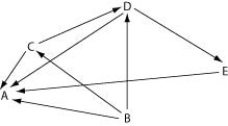 Which letter represents an organism that could be a producer?
 (Multiple Choice)
4.8/5 (65)
(65) Which of the following is a correct statement about MacArthur and Wilson's island equilibrium model?
(Multiple Choice)
4.8/5 (85)
(85) Which of the following measurements would be most helpful in understanding the structure of an ecological community?
I. determining how many species are present overall
II. determining which particular species are present
III.determining the kinds of interactions that occur among individuals of the same species
IV.determining the abundance of resources available for one species
(Multiple Choice)
4.9/5 (81)
(81) Use the following diagram of five islands formed at around the same time near a particular mainland, as well as MacArthur and Wilson's island equilibrium model principles to answer the question.
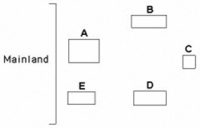 Which island would likely have the lowest extinction rate?
 (Multiple Choice)
4.8/5 (97)
(97) Use the following diagram of five islands formed at around the same time near a particular mainland, as well as MacArthur and Wilson's island equilibrium model principles to answer the question.
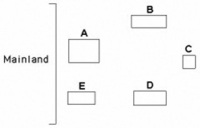 Which region would likely have the greatest species diversity?
 (Multiple Choice)
4.9/5 (81)
(81) Use the figure to answer the following question.
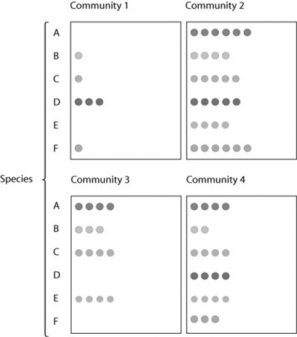 In the figure, imagine that community 4 represents a marine community off the coast of Florida, where overfishing of a particular trophy fish (imagine a species G. for two decades gradually shifted it to resemble community 3. The species that was overfished was likely ________.
 (Multiple Choice)
4.9/5 (88)
(88) Use the figures to answer the following question.
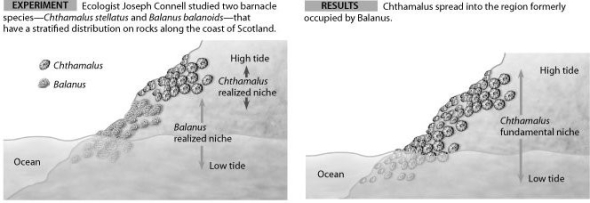 Connell conducted this experiment to learn more about ________.
 (Multiple Choice)
4.8/5 (79)
(79) Which of the following is an example of aposematic coloration?
(Multiple Choice)
4.8/5 (73)
(73) 
Filters
- Essay(0)
- Multiple Choice(0)
- Short Answer(0)
- True False(0)
- Matching(0)