



 Chat with AI
Exam 54: Community Ecology

Exam 1: Evolution, the Themes of Biology, and Scientific Inquiry51 Questions
Exam 2: The Chemical Context of Life61 Questions
Exam 3: Water and Life55 Questions
Exam 4: Carbon and the Molecular Diversity of Life58 Questions
Exam 5: The Structure and Function of Large Biological Molecules70 Questions
Exam 6: A Tour of the Cell66 Questions
Exam 7: Membrane Structure and Function68 Questions
Exam 8: An Introduction to Metabolism67 Questions
Exam 9: Cellular Respiration and Fermentation68 Questions
Exam 10: Photosynthesis65 Questions
Exam 11: Cell Communication65 Questions
Exam 12: The Cell Cycle66 Questions
Exam 13: Meiosis and Sexual Life Cycles64 Questions
Exam 14: Mendel and the Gene Idea62 Questions
Exam 15: The Chromosomal Basis of Inheritance58 Questions
Exam 16: The Molecular Basis of Inheritance65 Questions
Exam 17: Gene Expression: From Gene to Protein67 Questions
Exam 18: Regulation of Gene Expression66 Questions
Exam 19: Viruses54 Questions
Exam 20: DNA Tools and Biotechnology57 Questions
Exam 21: Genomes and Their Evolution44 Questions
Exam 22: Descent with Modification: A Darwinian View of Life60 Questions
Exam 23: The Evolution of Populations64 Questions
Exam 24: The Origin of Species67 Questions
Exam 25: The History of Life on Earth59 Questions
Exam 26: Phylogeny and the Tree of Life75 Questions
Exam 27: Bacteria and Archaea75 Questions
Exam 28: Protists79 Questions
Exam 29: Plant Diversity I: How Plants Colonized Land82 Questions
Exam 30: Plant Diversity II: The Evolution of Seed Plants80 Questions
Exam 31: Fungi75 Questions
Exam 32: An Overview of Animal Diversity67 Questions
Exam 33: An Introduction to Invertebrates83 Questions
Exam 34: The Origin and Evolution of Vertebrates82 Questions
Exam 35: Vascular Plant Structure, Growth, and Development65 Questions
Exam 36: Resource Acquisition and Transport in Vascular Plants74 Questions
Exam 37: Soil and Plant Nutrition52 Questions
Exam 38: Angiosperm Reproduction and Biotechnology60 Questions
Exam 39: Plant Responses to Internal and External Signals61 Questions
Exam 40: Basic Principles of Animal Form and Function68 Questions
Exam 41: Animal Nutrition64 Questions
Exam 42: Circulation and Gas Exchange67 Questions
Exam 43: The Immune System69 Questions
Exam 44: Osmoregulation and Excretion64 Questions
Exam 45: Hormones and the Endocrine System66 Questions
Exam 46: Animal Reproduction68 Questions
Exam 47: Animal Development70 Questions
Exam 48: Neurons, Synapses, and Signaling68 Questions
Exam 49: Nervous Systems65 Questions
Exam 50: Sensory and Motor Mechanisms67 Questions
Exam 51: Animal Behavior69 Questions
Exam 52: An Introduction to Ecology and the Biosphere68 Questions
Exam 53: Population Ecology69 Questions
Exam 54: Community Ecology71 Questions
Exam 55: Ecosystems and Restoration Ecology68 Questions
Exam 56: Conservation Biology and Global Change69 Questions
Select questions type


Use the following diagram of a hypothetical food web to answer the question. The arrows represent the transfer of energy between the various trophic levels.
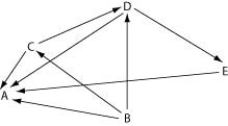 Which letter represents an organism that could only be a primary consumer?
 (Multiple Choice)
4.8/5  (67)
(67) Use the figure to answer the following question.
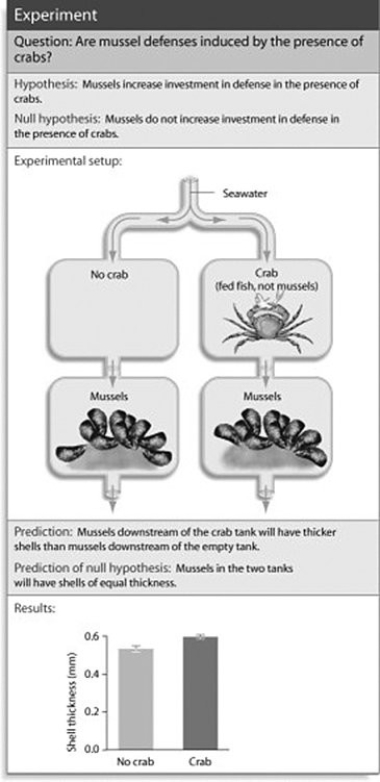 What conclusion can you draw from the figure?
 (Multiple Choice)
4.9/5 (66)
(66) Recall that Clements's view of biological communities is that of a highly predictable and interrelated structure, while Gleason's view of biological communities is that individual species operate independently. If we set up many identical sterilized ponds in the same area and allowed them to be colonized, what result should we expect Gleason had a more accurate view of communities than did Clement's hypothesis?
(Multiple Choice)
4.8/5 (79)
(79) Which of the following could qualify as a top-down control on a grassland community?
(Multiple Choice)
4.8/5 (89)
(89) According to bottom-up and top-down control models of community organization, which of the following expressions would imply that an increase in the size of a carnivore (C) population would negatively impact its prey (P) population, but not vice versa? The arrows between species indicate a negative impact toward the population at the arrowhead.
(Multiple Choice)
4.8/5 (86)
(86) Use the figures to answer the following question.
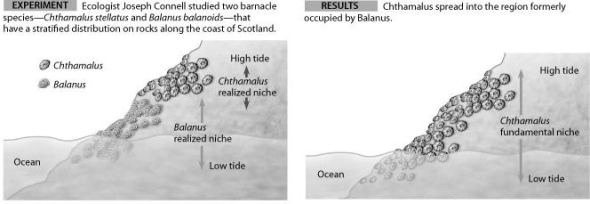 In this experiment, Balanus was removed from the habitat shown on the left.
Which of the following statements is a valid conclusion of this experiment?
In this experiment, Balanus was removed from the habitat shown on the left.
Which of the following statements is a valid conclusion of this experiment? (Multiple Choice)
4.8/5 (78)
(78) In terms of community ecology, why are pathogens often more virulent now than in the past?
(Multiple Choice)
4.9/5 (95)
(95) The feeding relationships among the species in a community determine the community's
(Multiple Choice)
4.7/5 (79)
(79) Which of the following studies would a community ecologist undertake to learn about competitive interactions?
I.selectivity of nest sites among cavity-nesting songbirds
II. the grass species preferred by grazing pronghorn antelope and bison
III.stomach analysis of brown trout and brook trout in streams where they coexist
(Multiple Choice)
4.9/5 (77)
(77) Some birds follow moving swarms of army ants in the tropics. As the ants march along the forest floor hunting insects and small vertebrates, birds follow and pick off any insects or small vertebrates that fly or jump out of the way of the ants. This situation is an example of what kind of species interaction between the birds and the ants?
(Multiple Choice)
4.9/5 (77)
(77) Which of the following studies would shed light on the mechanism of spread of H5N1 virus from Asia to North America?
(Multiple Choice)
4.7/5 (82)
(82) Scientists interested in how populations interact within communities are attempting to determine the species diversity of an island under study. What kind of data would be most helpful to the scientists in determining diversity?
(Multiple Choice)
4.8/5 (90)
(90) Use the figures to answer the following question.
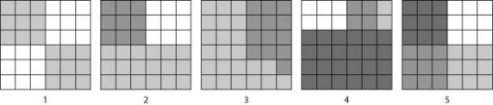 According to the Shannon Diversity Index, which of the five blocks above, with each containing 36 squares, would show the greatest diversity? The different shades represent different species, and more squares of a shade represent higher abundance.
 (Multiple Choice)
4.8/5 (77)
(77) Predators that are keystone species can maintain species diversity in a community if they
(Multiple Choice)
4.8/5 (82)
(82) According to the island equilibrium model, species richness would be greatest on an island that is
(Multiple Choice)
4.9/5 (75)
(75) Why do moderate levels of disturbance result in an increase in community diversity?
(Multiple Choice)
4.8/5 (66)
(66) There are more species in tropical areas than in places more distant from the equator. This is probably a result of ________.
(Multiple Choice)
4.9/5 (78)
(78) Use the figure to answer the following question.
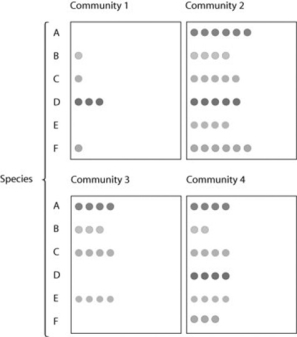 In the figure, species A through F are found among four communities, with the number of circles representing their abundance. Which community has the highest species richness but does not have the highest diversity overall because of the relative abundance of the different species?
 (Multiple Choice)
4.9/5 (80)
(80) Elephants are not the most abundant species in African grasslands, yet they influence community structure. The grasslands contain scattered woody plants, but they are kept in check by the uprooting activities of the elephants. Take away the elephants, and the grasslands are converted to forests or to shrublands. The newly growing forests support fewer species than the previous grasslands. Which of the following statements describes why elephants are the keystone species in this scenario?
(Multiple Choice)
4.8/5 (90)
(90) 
Filters
- Essay(0)
- Multiple Choice(0)
- Short Answer(0)
- True False(0)
- Matching(0)