



 Chat with AI
Exam 51: Animal Behavior

Exam 1: Evolution, the Themes of Biology, and Scientific Inquiry51 Questions
Exam 2: The Chemical Context of Life61 Questions
Exam 3: Water and Life55 Questions
Exam 4: Carbon and the Molecular Diversity of Life58 Questions
Exam 5: The Structure and Function of Large Biological Molecules70 Questions
Exam 6: A Tour of the Cell66 Questions
Exam 7: Membrane Structure and Function68 Questions
Exam 8: An Introduction to Metabolism67 Questions
Exam 9: Cellular Respiration and Fermentation68 Questions
Exam 10: Photosynthesis65 Questions
Exam 11: Cell Communication65 Questions
Exam 12: The Cell Cycle66 Questions
Exam 13: Meiosis and Sexual Life Cycles64 Questions
Exam 14: Mendel and the Gene Idea62 Questions
Exam 15: The Chromosomal Basis of Inheritance58 Questions
Exam 16: The Molecular Basis of Inheritance65 Questions
Exam 17: Gene Expression: From Gene to Protein67 Questions
Exam 18: Regulation of Gene Expression66 Questions
Exam 19: Viruses54 Questions
Exam 20: DNA Tools and Biotechnology57 Questions
Exam 21: Genomes and Their Evolution44 Questions
Exam 22: Descent with Modification: A Darwinian View of Life60 Questions
Exam 23: The Evolution of Populations64 Questions
Exam 24: The Origin of Species67 Questions
Exam 25: The History of Life on Earth59 Questions
Exam 26: Phylogeny and the Tree of Life75 Questions
Exam 27: Bacteria and Archaea75 Questions
Exam 28: Protists79 Questions
Exam 29: Plant Diversity I: How Plants Colonized Land82 Questions
Exam 30: Plant Diversity II: The Evolution of Seed Plants80 Questions
Exam 31: Fungi75 Questions
Exam 32: An Overview of Animal Diversity67 Questions
Exam 33: An Introduction to Invertebrates83 Questions
Exam 34: The Origin and Evolution of Vertebrates82 Questions
Exam 35: Vascular Plant Structure, Growth, and Development65 Questions
Exam 36: Resource Acquisition and Transport in Vascular Plants74 Questions
Exam 37: Soil and Plant Nutrition52 Questions
Exam 38: Angiosperm Reproduction and Biotechnology60 Questions
Exam 39: Plant Responses to Internal and External Signals61 Questions
Exam 40: Basic Principles of Animal Form and Function68 Questions
Exam 41: Animal Nutrition64 Questions
Exam 42: Circulation and Gas Exchange67 Questions
Exam 43: The Immune System69 Questions
Exam 44: Osmoregulation and Excretion64 Questions
Exam 45: Hormones and the Endocrine System66 Questions
Exam 46: Animal Reproduction68 Questions
Exam 47: Animal Development70 Questions
Exam 48: Neurons, Synapses, and Signaling68 Questions
Exam 49: Nervous Systems65 Questions
Exam 50: Sensory and Motor Mechanisms67 Questions
Exam 51: Animal Behavior69 Questions
Exam 52: An Introduction to Ecology and the Biosphere68 Questions
Exam 53: Population Ecology69 Questions
Exam 54: Community Ecology71 Questions
Exam 55: Ecosystems and Restoration Ecology68 Questions
Exam 56: Conservation Biology and Global Change69 Questions
Select questions type


Although many chimpanzees live in environments with oil palm nuts, members of only a few populations use stones to crack open the nuts. The likely explanation is that
(Multiple Choice)
4.9/5  (72)
(72) Female spotted sandpipers aggressively court males and, after mating and egg laying, leave the clutch of young for the male to incubate. This sequence may be repeated several times with different males until no available males remain, forcing the female to incubate her last clutch. Which of the following terms best describes this behavior?
(Multiple Choice)
4.9/5 (80)
(80) Use the following figures to answer the question.
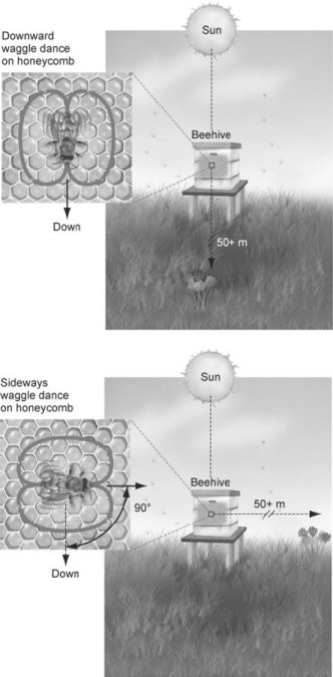 What could you conclude if the honeybee in the figure switched from the "waggle dance" to the "round dance"?
 (Multiple Choice)
4.9/5 (85)
(85) Listed are several examples of types of animal behavior. Choose the letter of the correct term (A-E) that matches each example in the following questions.
A. operant conditioning
B. classical conditioning
C. innate behavior
D. imprinting
E. altruistic behavior
-The fru gene in fruit flies ________.
I.is a master regulatory gene that directs expression of many other genes
II.can be genetically manipulated in females so that they will perform male sex behaviors
III. programs males for appropriate courtship behaviors
(Multiple Choice)
4.7/5 (83)
(83) You observe scrub jays hiding food and notice that one particular individual only pretends to hide food. What kind of experiment could you perform to test whether this behavior was random or in response to another signal?
(Multiple Choice)
4.8/5 (77)
(77) During a field trip, an instructor touched a moth resting on a tree trunk. The moth raised its forewings to reveal large eyespots on its hind wings. The instructor asked why the moth lifted its wings. One student answered that sensory receptors had fired and triggered a neuronal reflex culminating in the contraction of certain muscles. A second student responded that the behavior might frighten predators. Which statement best describes these explanations?
(Multiple Choice)
4.8/5 (83)
(83) A vampire bat sharing blood with another bat that is not its kin is an example of ________.
(Multiple Choice)
4.8/5 (91)
(91) Listed are several examples of types of animal behavior. Choose the letter of the correct term (A-E) that matches each example in the following questions.
A. operant conditioning
B. classical conditioning
C. innate behavior
D. imprinting
E. altruistic behavior
-A human baby performs a sucking behavior perfectly when it is put in the presence of the nipple of its mother's breast.
A) A
B) B
C) C
D) D
(Essay)
4.8/5 (87)
(87) 
Filters
- Essay(0)
- Multiple Choice(0)
- Short Answer(0)
- True False(0)
- Matching(0)