



 Chat with AI
Exam 51: Animal Behavior

Exam 1: Evolution, the Themes of Biology, and Scientific Inquiry51 Questions
Exam 2: The Chemical Context of Life61 Questions
Exam 3: Water and Life55 Questions
Exam 4: Carbon and the Molecular Diversity of Life58 Questions
Exam 5: The Structure and Function of Large Biological Molecules70 Questions
Exam 6: A Tour of the Cell66 Questions
Exam 7: Membrane Structure and Function68 Questions
Exam 8: An Introduction to Metabolism67 Questions
Exam 9: Cellular Respiration and Fermentation68 Questions
Exam 10: Photosynthesis65 Questions
Exam 11: Cell Communication65 Questions
Exam 12: The Cell Cycle66 Questions
Exam 13: Meiosis and Sexual Life Cycles64 Questions
Exam 14: Mendel and the Gene Idea62 Questions
Exam 15: The Chromosomal Basis of Inheritance58 Questions
Exam 16: The Molecular Basis of Inheritance65 Questions
Exam 17: Gene Expression: From Gene to Protein67 Questions
Exam 18: Regulation of Gene Expression66 Questions
Exam 19: Viruses54 Questions
Exam 20: DNA Tools and Biotechnology57 Questions
Exam 21: Genomes and Their Evolution44 Questions
Exam 22: Descent with Modification: A Darwinian View of Life60 Questions
Exam 23: The Evolution of Populations64 Questions
Exam 24: The Origin of Species67 Questions
Exam 25: The History of Life on Earth59 Questions
Exam 26: Phylogeny and the Tree of Life75 Questions
Exam 27: Bacteria and Archaea75 Questions
Exam 28: Protists79 Questions
Exam 29: Plant Diversity I: How Plants Colonized Land82 Questions
Exam 30: Plant Diversity II: The Evolution of Seed Plants80 Questions
Exam 31: Fungi75 Questions
Exam 32: An Overview of Animal Diversity67 Questions
Exam 33: An Introduction to Invertebrates83 Questions
Exam 34: The Origin and Evolution of Vertebrates82 Questions
Exam 35: Vascular Plant Structure, Growth, and Development65 Questions
Exam 36: Resource Acquisition and Transport in Vascular Plants74 Questions
Exam 37: Soil and Plant Nutrition52 Questions
Exam 38: Angiosperm Reproduction and Biotechnology60 Questions
Exam 39: Plant Responses to Internal and External Signals61 Questions
Exam 40: Basic Principles of Animal Form and Function68 Questions
Exam 41: Animal Nutrition64 Questions
Exam 42: Circulation and Gas Exchange67 Questions
Exam 43: The Immune System69 Questions
Exam 44: Osmoregulation and Excretion64 Questions
Exam 45: Hormones and the Endocrine System66 Questions
Exam 46: Animal Reproduction68 Questions
Exam 47: Animal Development70 Questions
Exam 48: Neurons, Synapses, and Signaling68 Questions
Exam 49: Nervous Systems65 Questions
Exam 50: Sensory and Motor Mechanisms67 Questions
Exam 51: Animal Behavior69 Questions
Exam 52: An Introduction to Ecology and the Biosphere68 Questions
Exam 53: Population Ecology69 Questions
Exam 54: Community Ecology71 Questions
Exam 55: Ecosystems and Restoration Ecology68 Questions
Exam 56: Conservation Biology and Global Change69 Questions
Select questions type


Upon returning to its hive, a European honeybee communicates to other worker bees the presence of a nearby food source it has discovered by ________.
(Multiple Choice)
4.8/5  (73)
(73) Scientists have tried raising endangered whooping cranes in captivity by using sandhill cranes as foster parents. This strategy is no longer used because ________.
(Multiple Choice)
4.9/5 (79)
(79) Use the following figure to answer the question.
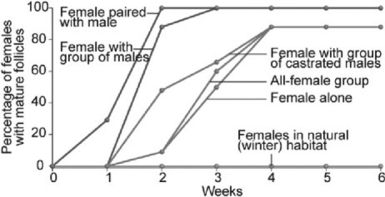 Based only on the information in the figure, which of the following conclusions is most logical?
 (Multiple Choice)
4.9/5 (78)
(78) The occurrence of sexual dimorphism in a species is a likely indicator of ________.
(Multiple Choice)
5.0/5 (75)
(75) Squirrels will make alarm sounds when a model of an owl is placed in their territory. When a red block the same size of the owl is placed in the territory, the squirrel does not alarm. What can you conclude from these observations?
(Multiple Choice)
4.9/5 (77)
(77) Female spotted sandpipers aggressively court males and, after mating, leave the clutch of young for the male to incubate. This sequence may be repeated several times with different males until no available males remain, forcing the female to incubate her last clutch. Which of the following terms best describes this behavior?
(Multiple Choice)
4.9/5 (90)
(90) The presence of altruistic behavior is most likely due to kin selection, a theory maintaining that ________.
(Multiple Choice)
4.9/5 (81)
(81) What type of signal is brief and can work among obstructions at night?
(Multiple Choice)
4.8/5 (79)
(79) Which of the following examples reflects the concept of optimal foraging?
(Multiple Choice)
4.9/5 (82)
(82) Although many chimpanzees live in environments containing oil palm nuts, members of only a few populations use stones to crack open the nuts. The likely explanation is that ________.
(Multiple Choice)
4.7/5 (83)
(83) The proximate causes of behavior are interactions with the environment, but behavior is ultimately shaped by ________.
(Multiple Choice)
4.8/5 (79)
(79) Fred and Joe, two unrelated, mature male gorillas, encounter one another. Fred is courting a female. Fred grunts as Joe comes near. As Joe continues to advance, Fred begins drumming (pounding his chest) and bares his teeth. Joe then rolls on the ground on his back, gets up, and quickly leaves. This behavioral pattern is repeated several times during the mating season. Choose the most specific behavior described by this example.
(Multiple Choice)
4.9/5 (76)
(76) Listed are several examples of types of animal behavior. Choose the letter of the correct term (A-E) that matches each example in the following questions.
A. operant conditioning
B. classical conditioning
C. innate behavior
D. imprinting
E. altruistic behavior
-Through trial and error, a rat learns to run a maze without mistakes to receive a food reward.
A) A
B) B
C) C
D) D
(Essay)
4.8/5 (75)
(75) A stickleback fish will attack a fish model as long as the model has red coloring. What animal behavior idea is manifested by this observation?
(Multiple Choice)
4.9/5 (80)
(80) A region of the canary forebrain shrinks during the nonbreeding season and enlarges when breeding season begins. This change is probably associated with the annual ________.
(Multiple Choice)
4.9/5 (72)
(72) The head-butting behavior of male bighorn sheep to establish a mating hierarchy is an example of ________.
(Multiple Choice)
4.8/5 (90)
(90) If a prairie dog had the opportunity to perform an altruistic act (that is, give an alarm call) to help its relatives, which combination of the following relatives would the prairie dog be most likely to help (base your answer solely on the genetic relationships)?
(Multiple Choice)
4.8/5 (75)
(75) Every morning at the same time, John went into the den to feed his new tropical fish. After a few weeks, he noticed that the fish swam to the top of the tank when he entered the room. This is an example of ________.
(Multiple Choice)
4.9/5 (78)
(78) 
Filters
- Essay(0)
- Multiple Choice(0)
- Short Answer(0)
- True False(0)
- Matching(0)