



 Chat with AI
Exam 34: The Origin and Evolution of Vertebrates

Exam 1: Evolution, the Themes of Biology, and Scientific Inquiry51 Questions
Exam 2: The Chemical Context of Life61 Questions
Exam 3: Water and Life55 Questions
Exam 4: Carbon and the Molecular Diversity of Life58 Questions
Exam 5: The Structure and Function of Large Biological Molecules70 Questions
Exam 6: A Tour of the Cell66 Questions
Exam 7: Membrane Structure and Function68 Questions
Exam 8: An Introduction to Metabolism67 Questions
Exam 9: Cellular Respiration and Fermentation68 Questions
Exam 10: Photosynthesis65 Questions
Exam 11: Cell Communication65 Questions
Exam 12: The Cell Cycle66 Questions
Exam 13: Meiosis and Sexual Life Cycles64 Questions
Exam 14: Mendel and the Gene Idea62 Questions
Exam 15: The Chromosomal Basis of Inheritance58 Questions
Exam 16: The Molecular Basis of Inheritance65 Questions
Exam 17: Gene Expression: From Gene to Protein67 Questions
Exam 18: Regulation of Gene Expression66 Questions
Exam 19: Viruses54 Questions
Exam 20: DNA Tools and Biotechnology57 Questions
Exam 21: Genomes and Their Evolution44 Questions
Exam 22: Descent with Modification: A Darwinian View of Life60 Questions
Exam 23: The Evolution of Populations64 Questions
Exam 24: The Origin of Species67 Questions
Exam 25: The History of Life on Earth59 Questions
Exam 26: Phylogeny and the Tree of Life75 Questions
Exam 27: Bacteria and Archaea75 Questions
Exam 28: Protists79 Questions
Exam 29: Plant Diversity I: How Plants Colonized Land82 Questions
Exam 30: Plant Diversity II: The Evolution of Seed Plants80 Questions
Exam 31: Fungi75 Questions
Exam 32: An Overview of Animal Diversity67 Questions
Exam 33: An Introduction to Invertebrates83 Questions
Exam 34: The Origin and Evolution of Vertebrates82 Questions
Exam 35: Vascular Plant Structure, Growth, and Development65 Questions
Exam 36: Resource Acquisition and Transport in Vascular Plants74 Questions
Exam 37: Soil and Plant Nutrition52 Questions
Exam 38: Angiosperm Reproduction and Biotechnology60 Questions
Exam 39: Plant Responses to Internal and External Signals61 Questions
Exam 40: Basic Principles of Animal Form and Function68 Questions
Exam 41: Animal Nutrition64 Questions
Exam 42: Circulation and Gas Exchange67 Questions
Exam 43: The Immune System69 Questions
Exam 44: Osmoregulation and Excretion64 Questions
Exam 45: Hormones and the Endocrine System66 Questions
Exam 46: Animal Reproduction68 Questions
Exam 47: Animal Development70 Questions
Exam 48: Neurons, Synapses, and Signaling68 Questions
Exam 49: Nervous Systems65 Questions
Exam 50: Sensory and Motor Mechanisms67 Questions
Exam 51: Animal Behavior69 Questions
Exam 52: An Introduction to Ecology and the Biosphere68 Questions
Exam 53: Population Ecology69 Questions
Exam 54: Community Ecology71 Questions
Exam 55: Ecosystems and Restoration Ecology68 Questions
Exam 56: Conservation Biology and Global Change69 Questions
Select questions type


Use the following information to answer the question.
Brown et al. and Morwood et al. reported in 2004 that they had found skeletal remains of a previously unknown type of hominin, now dubbed Homo floresiensis, on the Indonesian island of Flores. These hominins were small (approximately 1 meter tall) with small braincases (approximately 380 cubic centimeters) as compared with other hominins. The remains of H. floresiensis were found alongside handmade stone tools and the remains of dwarf elephants that also inhabited the island, suggesting that H. floresiensis was able both to make tools and to coordinate the hunting of animals much larger than itself. H. floresiensis is estimated to have lived at the site where the remains were found from at least 38,000 years ago to 18,000 years ago.
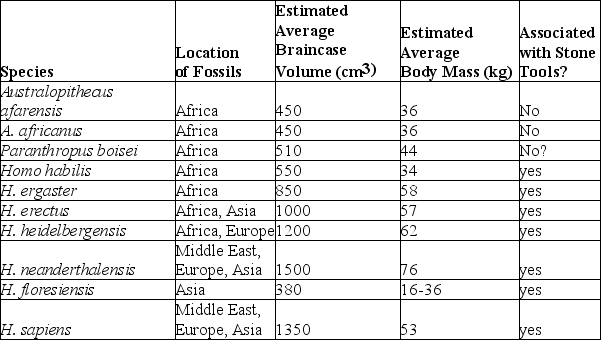 The table is a comparison of several characteristics of H. floresiensis to those of nine other hominin species (arranged roughly from oldest to most recent). What do these data suggest?
 (Multiple Choice)
4.7/5  (70)
(70) Use the following information to answer the question.
While on an intersession course in tropical ecology, Kris pulls a large, snakelike organism from a burrow (the class was granted a collecting permit). The 1-meter-long organism has smooth skin, which appears to be segmented. It has two tiny eyes that are hard to see because they seem to be covered by skin. Kris brings it back to the lab at the field station, where it is a source of puzzlement to the class. Kris says that it is a giant oligochaete worm; Shaun suggests it is a legless amphibian; Kelly proposes it belongs to a snake species that is purely fossorial (lives in a burrow).
The organism was found to have two lungs, but the left lung was much smaller than the right lung. Kelly added that the herpetology instructor had said that in most snakes, the same condition exists. If the size difference between the lungs in this organism is not a shared ancestral characteristic with its occurrence in snakes, then its existence in this organism is explained as which of the following?
(Multiple Choice)
4.8/5 (84)
(84) 
Filters
- Essay(0)
- Multiple Choice(0)
- Short Answer(0)
- True False(0)
- Matching(0)