



 Chat with AI
Exam 34: The Origin and Evolution of Vertebrates

Exam 1: Evolution, the Themes of Biology, and Scientific Inquiry51 Questions
Exam 2: The Chemical Context of Life61 Questions
Exam 3: Water and Life55 Questions
Exam 4: Carbon and the Molecular Diversity of Life58 Questions
Exam 5: The Structure and Function of Large Biological Molecules70 Questions
Exam 6: A Tour of the Cell66 Questions
Exam 7: Membrane Structure and Function68 Questions
Exam 8: An Introduction to Metabolism67 Questions
Exam 9: Cellular Respiration and Fermentation68 Questions
Exam 10: Photosynthesis65 Questions
Exam 11: Cell Communication65 Questions
Exam 12: The Cell Cycle66 Questions
Exam 13: Meiosis and Sexual Life Cycles64 Questions
Exam 14: Mendel and the Gene Idea62 Questions
Exam 15: The Chromosomal Basis of Inheritance58 Questions
Exam 16: The Molecular Basis of Inheritance65 Questions
Exam 17: Gene Expression: From Gene to Protein67 Questions
Exam 18: Regulation of Gene Expression66 Questions
Exam 19: Viruses54 Questions
Exam 20: DNA Tools and Biotechnology57 Questions
Exam 21: Genomes and Their Evolution44 Questions
Exam 22: Descent with Modification: A Darwinian View of Life60 Questions
Exam 23: The Evolution of Populations64 Questions
Exam 24: The Origin of Species67 Questions
Exam 25: The History of Life on Earth59 Questions
Exam 26: Phylogeny and the Tree of Life75 Questions
Exam 27: Bacteria and Archaea75 Questions
Exam 28: Protists79 Questions
Exam 29: Plant Diversity I: How Plants Colonized Land82 Questions
Exam 30: Plant Diversity II: The Evolution of Seed Plants80 Questions
Exam 31: Fungi75 Questions
Exam 32: An Overview of Animal Diversity67 Questions
Exam 33: An Introduction to Invertebrates83 Questions
Exam 34: The Origin and Evolution of Vertebrates82 Questions
Exam 35: Vascular Plant Structure, Growth, and Development65 Questions
Exam 36: Resource Acquisition and Transport in Vascular Plants74 Questions
Exam 37: Soil and Plant Nutrition52 Questions
Exam 38: Angiosperm Reproduction and Biotechnology60 Questions
Exam 39: Plant Responses to Internal and External Signals61 Questions
Exam 40: Basic Principles of Animal Form and Function68 Questions
Exam 41: Animal Nutrition64 Questions
Exam 42: Circulation and Gas Exchange67 Questions
Exam 43: The Immune System69 Questions
Exam 44: Osmoregulation and Excretion64 Questions
Exam 45: Hormones and the Endocrine System66 Questions
Exam 46: Animal Reproduction68 Questions
Exam 47: Animal Development70 Questions
Exam 48: Neurons, Synapses, and Signaling68 Questions
Exam 49: Nervous Systems65 Questions
Exam 50: Sensory and Motor Mechanisms67 Questions
Exam 51: Animal Behavior69 Questions
Exam 52: An Introduction to Ecology and the Biosphere68 Questions
Exam 53: Population Ecology69 Questions
Exam 54: Community Ecology71 Questions
Exam 55: Ecosystems and Restoration Ecology68 Questions
Exam 56: Conservation Biology and Global Change69 Questions
Select questions type


Use the following information to answer the question.
Due to its system of air sacs connected to the lungs, the respiratory system of birds is arguably the most effective respiratory system of all air-breathers. Upon inhalation, air first flows into posterior air sacs, then into the lungs, and then into anterior air sacs on the way to being exhaled. Thus, there is one-way flow of air through the lungs, along thousands of tubules called parabronchi.
The one-way flow of air along parabronchi makes what type of gas exchange mechanism possible, at least theoretically?
(Multiple Choice)
4.8/5  (71)
(71) Chordate pharyngeal slits appear to have functioned first as ________.
(Multiple Choice)
4.8/5 (81)
(81) Which characteristic is common to all the modern representatives of all major reptilian lineages (turtles, lepidosaurs, crocodilians, and birds)?
(Multiple Choice)
4.8/5 (77)
(77) Female birds lay their eggs, thereby facilitating flight by reducing weight. Which "strategy" seems most likely for female bats to use to achieve the same goal?
(Multiple Choice)
4.8/5 (86)
(86) As hominins diverged from other primates, which of the following appeared first?
(Multiple Choice)
4.9/5 (85)
(85) Which of the following statements would be most acceptable to most zoologists?
(Multiple Choice)
4.8/5 (83)
(83) On the back of your skull you can feel a small bump, below which is an opening where the spinal cord enters the skull. The location of this opening toward the bottom of the skull is significant in evolutionary biology for what reason?
(Multiple Choice)
4.8/5 (70)
(70) Why do adult urochordates (tunicates) lack notochords, even though larval urochordates have them? Larvae use notochords to ________.
(Multiple Choice)
4.8/5 (75)
(75) Scientific views are based on evidence rather than an appeal to authority. Which of the following statements demonstrates a conclusion based on evidence?
(Multiple Choice)
4.7/5 (79)
(79) Birds are descended from species that laid eggs in water. It could be argued that embryos of birds still develop in water because ________.
(Multiple Choice)
4.7/5 (73)
(73) Suppose, while out camping in a forest, you found a chordate with a long, slender, limbless body slithering across the ground near your tent. This critter could be ________.
(Multiple Choice)
4.8/5 (88)
(88) It is believed that the coelacanths and lungfish represent a crucial link between other fishes and tetrapods. What is the major feature in these fish in support of this hypothesis?
(Multiple Choice)
4.7/5 (72)
(72) Which of the following is the most inclusive (most general) group in which all of the members have fully opposable thumbs?
(Multiple Choice)
4.9/5 (81)
(81) Use the following figure and information to answer the question.
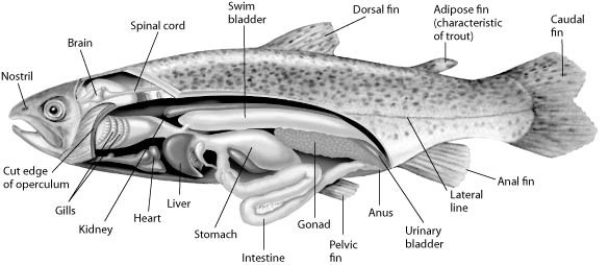 Fishes that have swim bladders can regulate their density and, thus, their buoyancy. There are two types of swim bladder: physostomous and physoclistous. The ancestral version is the physostomous version, in which the swim bladder is connected to the esophagus via a short tube (see the figure). The fish fills this version by swimming to the surface, taking gulps of air, and directing them into the swim bladder. Air is removed from this version by "belching." The physoclistous version is more derived and has lost its connection to the esophagus. Instead, gas enters and leaves the swim bladder via special circulatory mechanisms within the wall of the swim bladder.
The presence of a swim bladder allows the typical ray-finned fish to stop swimming and still ________.
Fishes that have swim bladders can regulate their density and, thus, their buoyancy. There are two types of swim bladder: physostomous and physoclistous. The ancestral version is the physostomous version, in which the swim bladder is connected to the esophagus via a short tube (see the figure). The fish fills this version by swimming to the surface, taking gulps of air, and directing them into the swim bladder. Air is removed from this version by "belching." The physoclistous version is more derived and has lost its connection to the esophagus. Instead, gas enters and leaves the swim bladder via special circulatory mechanisms within the wall of the swim bladder.
The presence of a swim bladder allows the typical ray-finned fish to stop swimming and still ________. (Multiple Choice)
4.9/5 (84)
(84) Which of the following types of evidence would be useful in understanding if the impact of a comet caused the extinction of the dinosaurs?
(Multiple Choice)
4.9/5 (66)
(66) Ancient fossils that seem to be an intermediate stage in the evolution from fish to tetrapods had which of the following characteristics?
(Multiple Choice)
4.7/5 (89)
(89) A trend first observed in the evolution of the earliest tetrapods was ________.
(Multiple Choice)
4.9/5 (85)
(85) 
Filters
- Essay(0)
- Multiple Choice(0)
- Short Answer(0)
- True False(0)
- Matching(0)