



 Chat with AI
Exam 27: Bacteria and Archaea

Exam 1: Evolution, the Themes of Biology, and Scientific Inquiry51 Questions
Exam 2: The Chemical Context of Life61 Questions
Exam 3: Water and Life55 Questions
Exam 4: Carbon and the Molecular Diversity of Life58 Questions
Exam 5: The Structure and Function of Large Biological Molecules70 Questions
Exam 6: A Tour of the Cell66 Questions
Exam 7: Membrane Structure and Function68 Questions
Exam 8: An Introduction to Metabolism67 Questions
Exam 9: Cellular Respiration and Fermentation68 Questions
Exam 10: Photosynthesis65 Questions
Exam 11: Cell Communication65 Questions
Exam 12: The Cell Cycle66 Questions
Exam 13: Meiosis and Sexual Life Cycles64 Questions
Exam 14: Mendel and the Gene Idea62 Questions
Exam 15: The Chromosomal Basis of Inheritance58 Questions
Exam 16: The Molecular Basis of Inheritance65 Questions
Exam 17: Gene Expression: From Gene to Protein67 Questions
Exam 18: Regulation of Gene Expression66 Questions
Exam 19: Viruses54 Questions
Exam 20: DNA Tools and Biotechnology57 Questions
Exam 21: Genomes and Their Evolution44 Questions
Exam 22: Descent with Modification: A Darwinian View of Life60 Questions
Exam 23: The Evolution of Populations64 Questions
Exam 24: The Origin of Species67 Questions
Exam 25: The History of Life on Earth59 Questions
Exam 26: Phylogeny and the Tree of Life75 Questions
Exam 27: Bacteria and Archaea75 Questions
Exam 28: Protists79 Questions
Exam 29: Plant Diversity I: How Plants Colonized Land82 Questions
Exam 30: Plant Diversity II: The Evolution of Seed Plants80 Questions
Exam 31: Fungi75 Questions
Exam 32: An Overview of Animal Diversity67 Questions
Exam 33: An Introduction to Invertebrates83 Questions
Exam 34: The Origin and Evolution of Vertebrates82 Questions
Exam 35: Vascular Plant Structure, Growth, and Development65 Questions
Exam 36: Resource Acquisition and Transport in Vascular Plants74 Questions
Exam 37: Soil and Plant Nutrition52 Questions
Exam 38: Angiosperm Reproduction and Biotechnology60 Questions
Exam 39: Plant Responses to Internal and External Signals61 Questions
Exam 40: Basic Principles of Animal Form and Function68 Questions
Exam 41: Animal Nutrition64 Questions
Exam 42: Circulation and Gas Exchange67 Questions
Exam 43: The Immune System69 Questions
Exam 44: Osmoregulation and Excretion64 Questions
Exam 45: Hormones and the Endocrine System66 Questions
Exam 46: Animal Reproduction68 Questions
Exam 47: Animal Development70 Questions
Exam 48: Neurons, Synapses, and Signaling68 Questions
Exam 49: Nervous Systems65 Questions
Exam 50: Sensory and Motor Mechanisms67 Questions
Exam 51: Animal Behavior69 Questions
Exam 52: An Introduction to Ecology and the Biosphere68 Questions
Exam 53: Population Ecology69 Questions
Exam 54: Community Ecology71 Questions
Exam 55: Ecosystems and Restoration Ecology68 Questions
Exam 56: Conservation Biology and Global Change69 Questions
Select questions type


Leaf-cutter ants harvest plant leaves and bring them back to their nests. There, in the warm, moist environments of their underground nests, they grow fungi (Leucoagaricus) that they then eat. These ants also host bacteria on their exoskeleton. Another fungus, Escovopsis, kills Leucoagaricus when the ants are removed from the nest. Knowing that the bacteria on the ants are in the same phylogenetic group of other bacteria that produce antibiotics, which of the following research hypotheses is most likely correct?
(Multiple Choice)
4.9/5  (74)
(74) Genetic variation in bacterial populations cannot result from
(Multiple Choice)
4.8/5 (88)
(88) The following question refers to the figure.
In this eight-year experiment, 12 populations of E. coli, each begun from a single cell, were grown in low-glucose conditions for 20,000 generations. Each culture was introduced to fresh growth medium every 24 hours. Occasionally, samples were removed from the populations, and their fitness in low-glucose conditions was tested against that of members sampled from the ancestral (common ancestor) E. coli population.
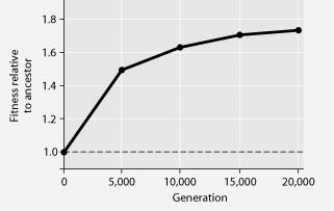 Compare the bacteria in the figure above in generation 1 and generation 20,000. The bacteria in generation 1 have a greater ________.
 (Multiple Choice)
4.9/5 (64)
(64) Use the following information and graph to answer the question.
The figure below depicts changes to the amount of DNA present in a recipient cell that is engaged in conjugation with an Hfr cell. Hfr cell DNA begins entering the recipient cell at Time A. Assume that reciprocal crossing over occurs (in other words, a fragment of the recipient's chromosome is exchanged for a homologous fragment from the Hfr cell's DNA).
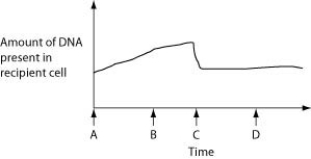 How is the recipient cell different at Time D than it was at Time A?
 (Multiple Choice)
4.8/5 (90)
(90) The following table depicts characteristics of five prokaryotic species (A-E). Use the information in the table to answer the following question.
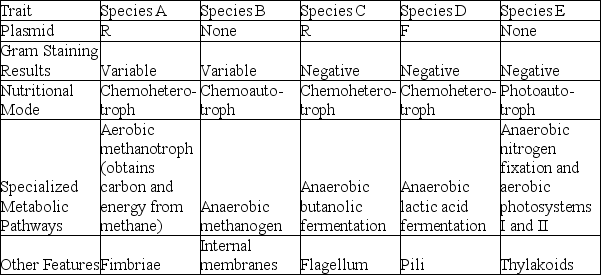 Which two species should have much more phospholipid, in the form of bilayers, in their cytoplasms than most other bacteria?
 (Multiple Choice)
4.8/5 (81)
(81) The following question refers to the figure.
In this eight-year experiment, 12 populations of E. coli, each begun from a single cell, were grown in low-glucose conditions for 20,000 generations. Each culture was introduced to fresh growth medium every 24 hours. Occasionally, samples were removed from the populations, and their fitness in low-glucose conditions was tested against that of members sampled from the ancestral (common ancestor) E. coli population.
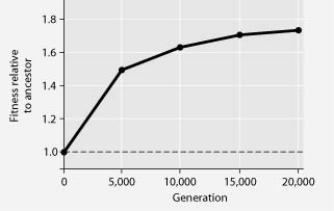 E. coli cells typically make most of their ATP by metabolizing glucose. Under the conditions of this experiment, E. coli generation times in the experimental lines and low-glucose conditions should ________.
 (Multiple Choice)
4.7/5 (83)
(83) When a virus infects a bacterial cell, often new viruses are assembled and released when the host bacterial cell is lysed. If these new viruses go on to infect new bacterial cells, the new host cells may not be lysed. What is the most plausible explanation for this?
(Multiple Choice)
5.0/5 (64)
(64) Broad-spectrum antibiotics inhibit the growth of most intestinal bacteria. Consequently, assuming that nothing is done to counter the reduction of intestinal bacteria, a hospital patient who is receiving broad-spectrum antibiotics is most likely to become ________.
(Multiple Choice)
4.9/5 (85)
(85) Recently, a microbe that is able to digest cellulose was discovered in a hot spring with an average temperature of 95°C. Predict the group to which this microbe most likely belongs.
(Multiple Choice)
4.8/5 (73)
(73) Which of the following involves metabolic cooperation among prokaryotic cells?
(Multiple Choice)
4.9/5 (93)
(93) Jams, jellies, preserves, honey, and other foods with high sugar content hardly ever become contaminated by bacteria, even when the food containers are left open at room temperature. This is because bacteria that encounter such an environment ________.
(Multiple Choice)
4.8/5 (75)
(75) Which of the following observations about flagella is accurate and is consistent with the scientific conclusion that the flagella from eukaryotes and bacteria evolved independently?
(Multiple Choice)
4.8/5 (80)
(80) The following question refers to the figure.
In this eight-year experiment, 12 populations of E. coli, each begun from a single cell, were grown in low-glucose conditions for 20,000 generations. Each culture was introduced to fresh growth medium every 24 hours. Occasionally, samples were removed from the populations, and their fitness in low-glucose conditions was tested against that of members sampled from the ancestral (common ancestor) E. coli population.
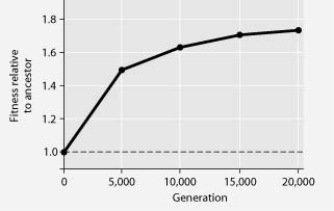 The cells in the 12 cell lines grown in low-glucose conditions showed the effects of which of the following processes?
 (Multiple Choice)
4.9/5 (73)
(73) Use the following information and graph to answer the question.
The figure below depicts changes to the amount of DNA present in a recipient cell that is engaged in conjugation with an Hfr cell. Hfr cell DNA begins entering the recipient cell at Time A. Assume that reciprocal crossing over occurs (in other words, a fragment of the recipient's chromosome is exchanged for a homologous fragment from the Hfr cell's DNA).
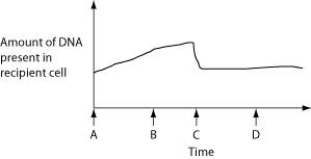 Which two processes are responsible for the shape of the curve at Time B?
 (Multiple Choice)
4.9/5 (84)
(84) 
Filters
- Essay(0)
- Multiple Choice(0)
- Short Answer(0)
- True False(0)
- Matching(0)