



 Chat with AI
Exam 27: Bacteria and Archaea

Exam 1: Evolution, the Themes of Biology, and Scientific Inquiry51 Questions
Exam 2: The Chemical Context of Life61 Questions
Exam 3: Water and Life55 Questions
Exam 4: Carbon and the Molecular Diversity of Life58 Questions
Exam 5: The Structure and Function of Large Biological Molecules70 Questions
Exam 6: A Tour of the Cell66 Questions
Exam 7: Membrane Structure and Function68 Questions
Exam 8: An Introduction to Metabolism67 Questions
Exam 9: Cellular Respiration and Fermentation68 Questions
Exam 10: Photosynthesis65 Questions
Exam 11: Cell Communication65 Questions
Exam 12: The Cell Cycle66 Questions
Exam 13: Meiosis and Sexual Life Cycles64 Questions
Exam 14: Mendel and the Gene Idea62 Questions
Exam 15: The Chromosomal Basis of Inheritance58 Questions
Exam 16: The Molecular Basis of Inheritance65 Questions
Exam 17: Gene Expression: From Gene to Protein67 Questions
Exam 18: Regulation of Gene Expression66 Questions
Exam 19: Viruses54 Questions
Exam 20: DNA Tools and Biotechnology57 Questions
Exam 21: Genomes and Their Evolution44 Questions
Exam 22: Descent with Modification: A Darwinian View of Life60 Questions
Exam 23: The Evolution of Populations64 Questions
Exam 24: The Origin of Species67 Questions
Exam 25: The History of Life on Earth59 Questions
Exam 26: Phylogeny and the Tree of Life75 Questions
Exam 27: Bacteria and Archaea75 Questions
Exam 28: Protists79 Questions
Exam 29: Plant Diversity I: How Plants Colonized Land82 Questions
Exam 30: Plant Diversity II: The Evolution of Seed Plants80 Questions
Exam 31: Fungi75 Questions
Exam 32: An Overview of Animal Diversity67 Questions
Exam 33: An Introduction to Invertebrates83 Questions
Exam 34: The Origin and Evolution of Vertebrates82 Questions
Exam 35: Vascular Plant Structure, Growth, and Development65 Questions
Exam 36: Resource Acquisition and Transport in Vascular Plants74 Questions
Exam 37: Soil and Plant Nutrition52 Questions
Exam 38: Angiosperm Reproduction and Biotechnology60 Questions
Exam 39: Plant Responses to Internal and External Signals61 Questions
Exam 40: Basic Principles of Animal Form and Function68 Questions
Exam 41: Animal Nutrition64 Questions
Exam 42: Circulation and Gas Exchange67 Questions
Exam 43: The Immune System69 Questions
Exam 44: Osmoregulation and Excretion64 Questions
Exam 45: Hormones and the Endocrine System66 Questions
Exam 46: Animal Reproduction68 Questions
Exam 47: Animal Development70 Questions
Exam 48: Neurons, Synapses, and Signaling68 Questions
Exam 49: Nervous Systems65 Questions
Exam 50: Sensory and Motor Mechanisms67 Questions
Exam 51: Animal Behavior69 Questions
Exam 52: An Introduction to Ecology and the Biosphere68 Questions
Exam 53: Population Ecology69 Questions
Exam 54: Community Ecology71 Questions
Exam 55: Ecosystems and Restoration Ecology68 Questions
Exam 56: Conservation Biology and Global Change69 Questions
Select questions type


Use the following information and graph to answer the question.
The figure below depicts changes to the amount of DNA present in a recipient cell that is engaged in conjugation with an Hfr cell. Hfr cell DNA begins entering the recipient cell at Time A. Assume that reciprocal crossing over occurs (in other words, a fragment of the recipient's chromosome is exchanged for a homologous fragment from the Hfr cell's DNA).
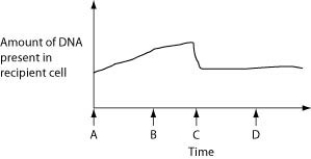 What process is occurring at Time C that is decreasing the DNA content?
 (Multiple Choice)
4.9/5  (83)
(83) Which of the following traits do archaeans and bacteria share?
(Multiple Choice)
4.7/5 (69)
(69) Use the following information and figure to answer the question.
The sea slug Pteraeolidia ianthina (P. ianthina) can harbor living dinoflagellates (photosynthetic protists) in its skin. These endosymbiotic dinoflagellates reproduce quickly enough to maintain their populations. Low populations of the dinoflagellates do not affect the sea slugs very much, but high populations (> 5 x 10⁵ cells/mg of sea slug protein) can promote sea slug survival.
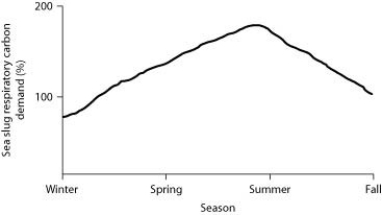 Percent of sea slug respiratory carbon demand provided by indwelling dinoflagellates.
Which of the following would be a potential disadvantage to the sea slugs of housing the dinoflagellates?
Percent of sea slug respiratory carbon demand provided by indwelling dinoflagellates.
Which of the following would be a potential disadvantage to the sea slugs of housing the dinoflagellates? (Multiple Choice)
4.8/5 (76)
(76) Use the following information and figure to answer the question.
The sea slug Pteraeolidia ianthina (P. ianthina) can harbor living dinoflagellates (photosynthetic protists) in its skin. These endosymbiotic dinoflagellates reproduce quickly enough to maintain their populations. Low populations of the dinoflagellates do not affect the sea slugs very much, but high populations (> 5 x 10⁵ cells/mg of sea slug protein) can promote sea slug survival.
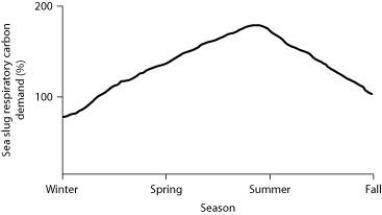 Percent of sea slug respiratory carbon demand provided by indwelling dinoflagellates.
If we assume that carbon is the sole nutrient needed by sea slugs to drive their cellular respiration, then based on the graph, during which season(s) is it least necessary for P. ianthina to act as a chemoheterotroph?
Percent of sea slug respiratory carbon demand provided by indwelling dinoflagellates.
If we assume that carbon is the sole nutrient needed by sea slugs to drive their cellular respiration, then based on the graph, during which season(s) is it least necessary for P. ianthina to act as a chemoheterotroph? (Multiple Choice)
4.8/5 (90)
(90) The following question refers to the figure.
In this eight-year experiment, 12 populations of E. coli, each begun from a single cell, were grown in low-glucose conditions for 20,000 generations. Each culture was introduced to fresh growth medium every 24 hours. Occasionally, samples were removed from the populations, and their fitness in low-glucose conditions was tested against that of members sampled from the ancestral (common ancestor) E. coli population.
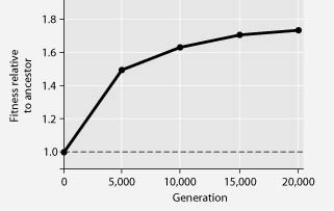 Which term best describes what has occurred among the experimental populations of cells over this eight-year period?
 (Multiple Choice)
4.8/5 (82)
(82) Bacteria perform each of the following ecological roles. Which role typically does not involve symbiosis?
(Multiple Choice)
4.9/5 (79)
(79) Use the information in the following paragraph to answer the question.
A hypothetical bacterium swims among human intestinal contents until it finds a suitable location on the intestinal lining. It adheres to the intestinal lining using a feature that also protects it from phagocytes, bacteriophages, and dehydration. Fecal matter from a human in whose intestine this bacterium lives can spread the bacterium, even after being mixed with water and boiled. The bacterium is not susceptible to the penicillin family of antibiotics. It contains no plasmids and relatively little peptidoglycan.
Adherence to the intestinal lining by this bacterium is due to its possession of ________.
(Multiple Choice)
4.8/5 (73)
(73) A fish that has been salt-cured subsequently develops a reddish color. You suspect that the fish has been contaminated by the extreme halophile Halobacterium. Which of these features of cells removed from the surface of the fish, if confirmed, would support your suspicion?
(Multiple Choice)
4.8/5 (85)
(85) In a hypothetical situation, a bacterium lives on the surface of a leaf, where it obtains nutrition from the leaf's nonliving, waxy covering while inhibiting the growth of other microbes that are plant pathogens. If this bacterium gains access to the inside of a leaf, however, it causes a fatal disease in the plant. Once the plant dies, the bacterium and its offspring decompose the plant. What is the correct sequence of ecological roles played by the bacterium in the situation described here?
(Multiple Choice)
4.7/5 (73)
(73) Termites eat wood, but many do not produce enzymes themselves that will digest the cellulose in the wood. Instead, some termites house a complex community of protozoa, bacteria, and archaea that could help digest the cellulose. Imagine an experiment that fed termites either wood only or wood and antibiotics, and then measured the amount of energy extracted from the wood. If both groups gained equal amounts of energy, which of the conclusions is the most logical?
(Multiple Choice)
4.9/5 (80)
(80) If a bacterium regenerates from an endospore that did not possess any of the plasmids that were contained in its original parent cell, the regenerated bacterium will probably also lack ________.
(Multiple Choice)
4.8/5 (80)
(80) In prokaryotes, new mutations accumulate quickly in populations, while in eukaryotes, new mutations accumulate much more slowly. The primary reasons for this are ________.
(Multiple Choice)
4.9/5 (66)
(66) Which of the following is least associated with the others?
(Multiple Choice)
4.9/5 (86)
(86) Use the following information to answer the question.
For several decades now, amphibian species worldwide have been in decline. A significant proportion of the decline seems to be due to the spread of the chytrid fungus, Batrachochytrium dendrobatidis (Bd). Chytrid sporangia reside within the epidermal cells of infected animals, animals that consequently show areas of sloughed skin. They can also be lethargic, which is expressed through failure to hide and failure to flee. The infection cycle typically takes four to five days, at the end of which zoospores are released from sporangia into the environment. In some amphibian species, mortality rates approach 100%; other species seem able to survive the infection.
If infection primarily involves the outermost layers of adult amphibian skin, and if the chytrids use the skin as their sole source of nutrition, then which term best applies to the chytrids?
(Multiple Choice)
4.8/5 (80)
(80) Chloramphenicol is an antibiotic that targets prokaryotic (70S) ribosomes, but not eukaryotic (80S) ribosomes. Which of these questions stems from this observation, plus an understanding of eukaryotic origins?
(Multiple Choice)
4.8/5 (74)
(74) A hypothetical bacterium swims among human intestinal contents until it finds a suitable location on the intestinal lining. It adheres to the intestinal lining using a feature that also protects it from phagocytes, bacteriophages, and dehydration. Fecal matter from a human in whose intestine this bacterium lives can spread the bacterium, even after being mixed with water and boiled. The bacterium is not susceptible to the penicillin family of antibiotics. It contains no plasmids and relatively little peptidoglycan. The cell also lacks F factors and F plasmids. Which of the following statements about the bacteria is most probably accurate?
(Multiple Choice)
4.9/5 (77)
(77) 
Filters
- Essay(0)
- Multiple Choice(0)
- Short Answer(0)
- True False(0)
- Matching(0)