



 Chat with AI
Exam 23: The Evolution of Populations

Exam 1: Evolution, the Themes of Biology, and Scientific Inquiry51 Questions
Exam 2: The Chemical Context of Life61 Questions
Exam 3: Water and Life55 Questions
Exam 4: Carbon and the Molecular Diversity of Life58 Questions
Exam 5: The Structure and Function of Large Biological Molecules70 Questions
Exam 6: A Tour of the Cell66 Questions
Exam 7: Membrane Structure and Function68 Questions
Exam 8: An Introduction to Metabolism67 Questions
Exam 9: Cellular Respiration and Fermentation68 Questions
Exam 10: Photosynthesis65 Questions
Exam 11: Cell Communication65 Questions
Exam 12: The Cell Cycle66 Questions
Exam 13: Meiosis and Sexual Life Cycles64 Questions
Exam 14: Mendel and the Gene Idea62 Questions
Exam 15: The Chromosomal Basis of Inheritance58 Questions
Exam 16: The Molecular Basis of Inheritance65 Questions
Exam 17: Gene Expression: From Gene to Protein67 Questions
Exam 18: Regulation of Gene Expression66 Questions
Exam 19: Viruses54 Questions
Exam 20: DNA Tools and Biotechnology57 Questions
Exam 21: Genomes and Their Evolution44 Questions
Exam 22: Descent with Modification: A Darwinian View of Life60 Questions
Exam 23: The Evolution of Populations64 Questions
Exam 24: The Origin of Species67 Questions
Exam 25: The History of Life on Earth59 Questions
Exam 26: Phylogeny and the Tree of Life75 Questions
Exam 27: Bacteria and Archaea75 Questions
Exam 28: Protists79 Questions
Exam 29: Plant Diversity I: How Plants Colonized Land82 Questions
Exam 30: Plant Diversity II: The Evolution of Seed Plants80 Questions
Exam 31: Fungi75 Questions
Exam 32: An Overview of Animal Diversity67 Questions
Exam 33: An Introduction to Invertebrates83 Questions
Exam 34: The Origin and Evolution of Vertebrates82 Questions
Exam 35: Vascular Plant Structure, Growth, and Development65 Questions
Exam 36: Resource Acquisition and Transport in Vascular Plants74 Questions
Exam 37: Soil and Plant Nutrition52 Questions
Exam 38: Angiosperm Reproduction and Biotechnology60 Questions
Exam 39: Plant Responses to Internal and External Signals61 Questions
Exam 40: Basic Principles of Animal Form and Function68 Questions
Exam 41: Animal Nutrition64 Questions
Exam 42: Circulation and Gas Exchange67 Questions
Exam 43: The Immune System69 Questions
Exam 44: Osmoregulation and Excretion64 Questions
Exam 45: Hormones and the Endocrine System66 Questions
Exam 46: Animal Reproduction68 Questions
Exam 47: Animal Development70 Questions
Exam 48: Neurons, Synapses, and Signaling68 Questions
Exam 49: Nervous Systems65 Questions
Exam 50: Sensory and Motor Mechanisms67 Questions
Exam 51: Animal Behavior69 Questions
Exam 52: An Introduction to Ecology and the Biosphere68 Questions
Exam 53: Population Ecology69 Questions
Exam 54: Community Ecology71 Questions
Exam 55: Ecosystems and Restoration Ecology68 Questions
Exam 56: Conservation Biology and Global Change69 Questions
Select questions type


In some jacana species, males take care of the eggs and young, and females compete among themselves for territories that contain one to several males. Female jacanas are significantly larger than males. Which of these statements would you predict to be true of this bird species?
1)Male jacana fitness is primarily limited by ability to take care of eggs and raise young.
2)Female jacana fitness is limited by the number of males in her territory with which a female mates.
3)Variation in reproductive success should be greater in male jacanas than in females.
4)Variation in reproductive success should be greater in female jacanas than in males.
5)Males and females have equal variation in reproductive success.
(Multiple Choice)
5.0/5  (75)
(75) Use the following information to answer the question below.
Martin Wikelski and L. Michael Romero (Body size, performance and fitness in Galápagos marine iguanas, Integrative and Comparative Biology 43 [2003]:376-86) measured the snout-to-vent (anus) length of Galápagos marine iguanas and observed the percent survival of different-sized animals, all of the same age. The graph shows the log snout-vent length (SVL, a measure of overall body size) plotted against the percent survival of these different size classes for males and females.
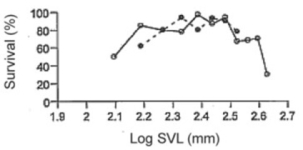 Examine the figure. What type of selection for body size appears to be occurring in these marine iguanas?
 (Multiple Choice)
4.9/5 (89)
(89) Which statement about the beak size of finches on the island of Daphne Major during prolonged drought is true?
(Multiple Choice)
4.8/5 (85)
(85) Three-spined stickleback fish (Gasterosteus aculeatus) show substantial heritable variation in gill-raker length related to differences in their diets. Longer gill rakers appear to function better for capturing open-water prey, while shorter gill rakers function better for capturing shallow-water prey.
Which of the following types of selection is most likely to be found in a large lake (open water in the middle and shallow water around the sides) with a high density of these fish?
(Multiple Choice)
4.7/5 (86)
(86) If the nucleotide variability of a locus equals 0%, what is the gene variability and number of alleles at that locus?
(Multiple Choice)
4.9/5 (82)
(82) An earthquake decimates a ground-squirrel population, killing 98% of the squirrels. The surviving population happens to have broader stripes, on average, than the initial population.
If broadness of stripes is genetically determined, what effect has the ground-squirrel population experienced during the earthquake?
(Multiple Choice)
4.9/5 (69)
(69) Swine are vulnerable to infection by bird flu virus and human flu virus, which can both be present in an individual pig at the same time. When this occurs, it is possible for genes from bird flu virus and human flu virus to be combined. If the human flu virus contributes a gene for Tamiflu resistance (Tamiflu is an antiviral drug) to the new virus, and if the new virus is introduced to an environment lacking Tamiflu, then what is most likely to occur?
(Multiple Choice)
4.8/5 (82)
(82) Use the following information to answer the question below.
Researchers studying a small milkweed population note that some plants produce a toxin and other plants do not. They identify the gene responsible for toxin production. The dominant allele (T) codes for an enzyme that makes the toxin, and the recessive allele (t) codes for a nonfunctional enzyme that cannot produce the toxin. Heterozygotes produce an intermediate amount of toxin. The genotypes of all individuals in the population are determined (see chart) and used to determine the actual allele frequencies in the population.
 Is this population in Hardy-Weinberg equilibrium?
 (Multiple Choice)
4.9/5 (75)
(75) A large population of laboratory animals has been allowed to breed randomly for a number of generations. After several generations, 25% of the animals display a recessive trait (aa), the same percentage as at the beginning of the breeding program.
The rest of the animals show the dominant phenotype, with heterozygotes indistinguishable from the homozygous dominants.
What is the most reasonable conclusion that can be drawn from the fact that the frequency of the recessive trait (aa) has not changed over time?
(Multiple Choice)
4.9/5 (81)
(81) A large population of laboratory animals has been allowed to breed randomly for a number of generations. After several generations, 25% of the animals display a recessive trait (aa), the same percentage as at the beginning of the breeding program.
The rest of the animals show the dominant phenotype, with heterozygotes indistinguishable from the homozygous dominants.
What proportion of the population is probably heterozygous (Aa) for this trait?
(Multiple Choice)
5.0/5 (78)
(78) A proficient engineer can easily design skeletal structures that are more functional than those currently found in the forelimbs of such diverse mammals as horses, whales, and bats. The actual forelimbs of these mammals do not seem to be optimally arranged because ________.
(Multiple Choice)
4.9/5 (78)
(78) Why does the fitness of a phenotype depend on frequency-dependent selection?
(Multiple Choice)
4.9/5 (71)
(71) In 1983, a population of dark-eyed junco birds became established on the campus of the University of California, San Diego (UCSD), which is located many miles from the junco's normal habitat in the mixed-coniferous temperate forests in the mountains. Juncos have white outer tail feathers that the males display during aggressive interactions and during courtship displays.
Males with more white in their tail are more likely to win aggressive interactions, and females prefer to mate with males with more white in their tails. Females have less white in their tails than do males, and display it less often. (Pamela J. Yeh. 2004. Rapid evolution of a sexually selected trait following population establishment in a novel habitat. Evolution 58[1]:166-74.)
The UCSD campus male junco population tails were, on average, 36% white, whereas the tails of males from nearby mountain populations averaged 40-45% white. If this observed trait difference were due to a difference in the original colonizing population, it would most likely be due to ________.
(Multiple Choice)
4.7/5 (79)
(79) In the formula for determining a population's genotype frequencies, the "2" in the term 2pq is necessary because ________.
(Multiple Choice)
4.8/5 (77)
(77) Which of the following is the most predictable outcome of increased gene flow between two populations?
(Multiple Choice)
4.8/5 (86)
(86) The following experiment is used for the corresponding question.
A researcher discovered a species of moth that lays its eggs on oak trees. Eggs are laid at two distinct times of the year: early in spring when the oak trees are flowering and in midsummer when flowering is past. Caterpillars from eggs that hatch in spring feed on oak flowers and look like oak flowers. But caterpillars that hatch in summer feed on oak leaves and look like oak twigs.
How does the same population of moths produce such different-looking caterpillars on the same trees? To answer this question, the biologist caught many female moths from the same population and collected their eggs. He put at least one egg from each female into eight identical cups. The eggs hatched, and at least two larvae from each female were maintained in one of the four temperature and light conditions listed below.
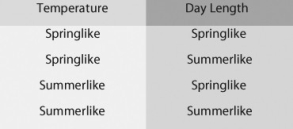 In each of the four environments, one of the caterpillars was fed oak flowers, the other oak leaves. Thus, there were a total of eight treatment groups (4 environments × 2 diets).
Which of the following is a testable hypothesis that would explain the differences in caterpillar appearance observed in this population?
In each of the four environments, one of the caterpillars was fed oak flowers, the other oak leaves. Thus, there were a total of eight treatment groups (4 environments × 2 diets).
Which of the following is a testable hypothesis that would explain the differences in caterpillar appearance observed in this population? (Multiple Choice)
4.9/5 (73)
(73) Arrange the following in order from most general to most specific.
1)natural selection
2)microevolution
3)intrasexual selection
4)evolution
5)sexual selection
(Multiple Choice)
4.8/5 (82)
(82) Cystic fibrosis is a genetic disorder in homozygous recessives that causes death during the teenage years. If 9 in 10,000 newborn babies have the disease, what are the expected frequencies of the dominant (A1) and recessive (A2) alleles according to the Hardy-Weinberg equation?
(Multiple Choice)
4.8/5 (81)
(81) You are maintaining a small population of fruit flies in the laboratory by transferring the flies to a new culture bottle after each generation. After several generations, you notice that the viability of the flies has decreased greatly. Recognizing that small population size is likely to be linked to decreased viability, the best way to reverse this trend is to ________.
(Multiple Choice)
4.7/5 (67)
(67) 
Filters
- Essay(0)
- Multiple Choice(0)
- Short Answer(0)
- True False(0)
- Matching(0)