



 Chat with AI
Exam 23: The Evolution of Populations

Exam 1: Evolution, the Themes of Biology, and Scientific Inquiry51 Questions
Exam 2: The Chemical Context of Life61 Questions
Exam 3: Water and Life55 Questions
Exam 4: Carbon and the Molecular Diversity of Life58 Questions
Exam 5: The Structure and Function of Large Biological Molecules70 Questions
Exam 6: A Tour of the Cell66 Questions
Exam 7: Membrane Structure and Function68 Questions
Exam 8: An Introduction to Metabolism67 Questions
Exam 9: Cellular Respiration and Fermentation68 Questions
Exam 10: Photosynthesis65 Questions
Exam 11: Cell Communication65 Questions
Exam 12: The Cell Cycle66 Questions
Exam 13: Meiosis and Sexual Life Cycles64 Questions
Exam 14: Mendel and the Gene Idea62 Questions
Exam 15: The Chromosomal Basis of Inheritance58 Questions
Exam 16: The Molecular Basis of Inheritance65 Questions
Exam 17: Gene Expression: From Gene to Protein67 Questions
Exam 18: Regulation of Gene Expression66 Questions
Exam 19: Viruses54 Questions
Exam 20: DNA Tools and Biotechnology57 Questions
Exam 21: Genomes and Their Evolution44 Questions
Exam 22: Descent with Modification: A Darwinian View of Life60 Questions
Exam 23: The Evolution of Populations64 Questions
Exam 24: The Origin of Species67 Questions
Exam 25: The History of Life on Earth59 Questions
Exam 26: Phylogeny and the Tree of Life75 Questions
Exam 27: Bacteria and Archaea75 Questions
Exam 28: Protists79 Questions
Exam 29: Plant Diversity I: How Plants Colonized Land82 Questions
Exam 30: Plant Diversity II: The Evolution of Seed Plants80 Questions
Exam 31: Fungi75 Questions
Exam 32: An Overview of Animal Diversity67 Questions
Exam 33: An Introduction to Invertebrates83 Questions
Exam 34: The Origin and Evolution of Vertebrates82 Questions
Exam 35: Vascular Plant Structure, Growth, and Development65 Questions
Exam 36: Resource Acquisition and Transport in Vascular Plants74 Questions
Exam 37: Soil and Plant Nutrition52 Questions
Exam 38: Angiosperm Reproduction and Biotechnology60 Questions
Exam 39: Plant Responses to Internal and External Signals61 Questions
Exam 40: Basic Principles of Animal Form and Function68 Questions
Exam 41: Animal Nutrition64 Questions
Exam 42: Circulation and Gas Exchange67 Questions
Exam 43: The Immune System69 Questions
Exam 44: Osmoregulation and Excretion64 Questions
Exam 45: Hormones and the Endocrine System66 Questions
Exam 46: Animal Reproduction68 Questions
Exam 47: Animal Development70 Questions
Exam 48: Neurons, Synapses, and Signaling68 Questions
Exam 49: Nervous Systems65 Questions
Exam 50: Sensory and Motor Mechanisms67 Questions
Exam 51: Animal Behavior69 Questions
Exam 52: An Introduction to Ecology and the Biosphere68 Questions
Exam 53: Population Ecology69 Questions
Exam 54: Community Ecology71 Questions
Exam 55: Ecosystems and Restoration Ecology68 Questions
Exam 56: Conservation Biology and Global Change69 Questions
Select questions type


When imbalances occur in the sex ratio of sexual species that have two sexes (that is, other than a 50:50 ratio), the members of the minority sex often receive a greater proportion of care and resources from parents than do the offspring of the majority sex. This is most clearly an example of ________.
(Multiple Choice)
4.8/5  (86)
(86) Homozygotes with two sickle-cell alleles are selected against because of mortality. However, heterozygotes for sickle-cell allele experience little effects of sickle allele and are more likely to survive malaria. The net effect of this exposure produced evolutionary change in areas where malaria is endemic by ________.
(Multiple Choice)
4.8/5 (81)
(81) HIV's genome of RNA includes the code for reverse transcriptase (RT), an enzyme that acts early in infection to synthesize a DNA genome off of an RNA template.
The HIV genome also codes for protease (PR), an enzyme that acts later in infection by cutting long viral polyproteins into smaller, functional proteins. Both RT and PR represent potential targets for antiretroviral drugs. Drugs called nucleoside analogs (NA) act against RT, whereas drugs called protease inhibitors (PI) act against PR.
Which of the following treatment options would most likely avoid the evolution of drug-resistant HIV (assuming no drug interactions or side effects)?
(Multiple Choice)
4.8/5 (81)
(81) Whenever diploid populations are in Hardy-Weinberg equilibrium at a particular locus, ________.
(Multiple Choice)
4.9/5 (66)
(66) Use the following information to answer the question below.
In those parts of equatorial Africa where the malaria parasite is most common, the sickle-cell allele constitutes 20% of the β hemoglobin alleles in the human gene pool.
In the United States, the parasite that causes malaria is not present, but it is present in African-Americans whose ancestors were from equatorial Africa. What should be happening to the sickle-cell allele in the United States, and what should be happening to it in equatorial Africa?
(Multiple Choice)
4.8/5 (90)
(90) Over time, the movement of people on Earth has steadily increased. This has altered the course of human evolution by increasing ________.
(Multiple Choice)
4.7/5 (80)
(80) In peas, a gene controls flower color such that R = purple and r = white. In an isolated pea patch, there are 36 purple-flowering plants and 64 white-flowering plants. Assuming Hardy-Weinberg equilibrium, what is the value of q for this population?
(Multiple Choice)
4.8/5 (79)
(79) On the Bahamian island of Andros, mosquitofish populations live in various, now-isolated, freshwater ponds that were once united. Currently, some predator-rich ponds have mosquitofish that can swim in short, fast bursts; other predator-poor ponds have mosquitofish that can swim continuously for a long time.
When placed together in the same body of water, the two kinds of female mosquitofish exhibit exclusive breeding preferences.
If one builds a canal linking a predator-rich pond to a predator-poor pond, then what type of selection should subsequently be most expected among the mosquitofish in the original predator-rich pond, and what type should be most expected among the mosquitofish in the formerly predator-poor pond?
(Multiple Choice)
4.7/5 (77)
(77) In 1983, a population of dark-eyed junco birds became established on the campus of the University of California, San Diego (UCSD), which is located many miles from the junco's normal habitat in the mixed-coniferous temperate forests in the mountains.
Juncos have white outer tail feathers that the males display during aggressive interactions and during courtship displays. Males with more white in their tail are more likely to win aggressive interactions, and females prefer to mate with males with more white in their tails. Females have less white in their tails than do males, and display it less often. (Pamela J. Yeh. 2004. Rapid evolution of a sexually selected trait following population establishment in a novel habitat. Evolution 58[1]:166-74.)
The UCSD campus male junco population tails are about 36% white, whereas the tails of males from nearby mountain populations are about 40-45% white. The founding stock of UCSD birds was likely from the nearby mountain populations because some of those birds overwinter on the UCSD campus each year. Population sizes on the UCSD campus have been reasonably large, and there are significant habitat differences between the UCSD campus and the mountain coniferous forests; UCSD campus has a more open environment (making birds more visible) and a lower junco density (decreasing intraspecific competition) than the mountain forests. Given this information, which of the following evolutionary mechanisms do you think is most likely responsible for the difference between the UCSD and mountain populations?
(Multiple Choice)
5.0/5 (76)
(76) The higher the proportion of loci that are "fixed" in a population, the lower are that population's ________.
(Multiple Choice)
4.8/5 (96)
(96) Genetic drift produces variation for evolution when ________.
(Multiple Choice)
4.9/5 (75)
(75) In a Hardy-Weinberg population with two alleles, A and a, that are in equilibrium, the frequency of allele a is 0.2. What is the frequency of individuals that are heterozygous for this allele?
(Multiple Choice)
4.9/5 (92)
(92) 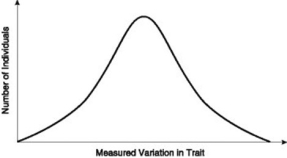 In a very large population, a quantitative trait has the following distribution pattern. If there is no gene flow, the curve shifts to the left or to the right, and the population size consequently increases over successive generations, which of the following is most likely occurring?
 (Multiple Choice)
4.9/5 (87)
(87) There are 25 individuals in population 1, all with genotype AA, and there are 40 individuals in population 2, all with genotype aa. Assume that these populations are located far from each other and that their environmental conditions are very similar. Based on the information given here, the observed genetic variation most likely resulted from
(Multiple Choice)
4.9/5 (82)
(82) A fruit fly population has a gene with two alleles, A1 and A2. Tests show that 70% of the gametes produced in the population contain the A1 allele. If the population is in Hardy-Weinberg equilibrium, what proportion of the flies carry both A1 and A2?
(Multiple Choice)
4.8/5 (84)
(84) In the formula for determining a population's genotype frequencies, the "pq" in the term 2pq is necessary because ________.
(Multiple Choice)
4.9/5 (71)
(71) Natural selection changes allele frequencies because some ________ survive and reproduce better than others.
(Multiple Choice)
4.8/5 (64)
(64) Comparisons of Neanderthal DNA revealed that there are more similarities to non-African DNA than reference sequences from West Africans. Additionally, scientists found that Neanderthal DNA is as closely related to East Asians as to Europeans. This indicates that interbreeding occurred before human migration further east.
What process of population genetics generated these results?
(Multiple Choice)
4.9/5 (81)
(81) Which one of the following conditions would allow gene frequencies to change by chance?
(Multiple Choice)
4.9/5 (83)
(83) 
Filters
- Essay(0)
- Multiple Choice(0)
- Short Answer(0)
- True False(0)
- Matching(0)