



 Chat with AI
Exam 13: Fiscal Policy

Exam 1: First Principles183 Questions
Exam 2: Economic Models: Trade-Offs and Trade341 Questions
Exam 3: Supply and Demand230 Questions
Exam 4: Price Controls and Quotas: Meddling With Markets187 Questions
Exam 5: International Trade224 Questions
Exam 6: Macroeconomics: the Big Picture128 Questions
Exam 7: GDP and the CPI: Tracking the Macroeconomy213 Questions
Exam 8: Unemployment and Inflation300 Questions
Exam 9: Long-Run Economic Growth268 Questions
Exam 10: Savings, Investment Spending, and the Financial Syst355 Questions
Exam 11: Income and Expenditure114 Questions
Exam 12: Aggregate Demand and Aggregate Supply308 Questions
Exam 13: Fiscal Policy120 Questions
Exam 14: Money, Banking, and the Federal Reserve System135 Questions
Exam 15: Monetary Policy316 Questions
Exam 16: Inflation, Disinflation, and Deflation194 Questions
Exam 17: Macroeconomics: Events and Ideas283 Questions
Exam 18: International Macroeconomics411 Questions
Select questions type


A change in taxes or a change in government transfers affects consumption through its effect on:
(Multiple Choice)
4.8/5  (78)
(78) Use the following to answer questions: 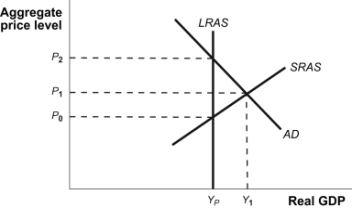 -(Figure: Short-Run Equilibrium) Refer to Figure: Short-Run Equilibrium. If the economy is at equilibrium at Y1 and P1, the government should use _____ fiscal policy to shift the aggregate demand curve to the _____.
 (Multiple Choice)
4.8/5 (78)
(78) An expansionary fiscal policy either _____ government spending or _____ taxes.
(Multiple Choice)
5.0/5 (66)
(66) Use the following to answer questions: 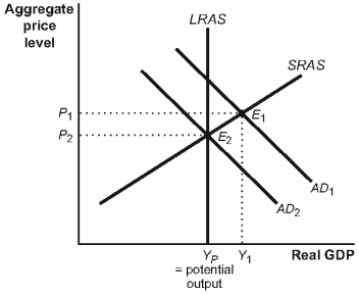 -(Figure: Fiscal Policy II) Refer to Figure: Fiscal Policy II. Suppose that this economy is in equilibrium at E2. If there is an increase in government transfers, _____ will shift to the _____, causing a(n) _____ in the price level and a(n) _____ in real GDP.
 (Multiple Choice)
4.9/5 (72)
(72) Expansionary fiscal policy shifts the aggregate demand curve to the _____ and is used to close a(n) _____ gap.
(Multiple Choice)
4.8/5 (74)
(74) Use the following to answer questions:  -(Figure: Fiscal Policy Options) Refer to Figure: Fiscal Policy Options. If the aggregate demand curve is ADʺ, the most appropriate discretionary fiscal policy is to _____ government transfer payments and _____ income tax rates.
 (Multiple Choice)
4.8/5 (84)
(84) Use the following to answer questions:
-(Figure: Fiscal Policy Options) Refer to Figure: Fiscal Policy Options. If the aggregate demand curve is AD'':
-(Figure: Fiscal Policy Options) Refer to Figure: Fiscal Policy Options. If the aggregate demand curve is AD'': (Multiple Choice)
4.9/5 (85)
(85) Use the following to answer questions:
-(Figure: Fiscal Policy II) Refer to Figure: Fiscal Policy II. Suppose that this economy is in equilibrium at E1. If there is an increase in taxes, _____ will shift to the _____, causing a(n) _____ in the price level and a(n) _____ in real GDP.
-(Figure: Fiscal Policy II) Refer to Figure: Fiscal Policy II. Suppose that this economy is in equilibrium at E1. If there is an increase in taxes, _____ will shift to the _____, causing a(n) _____ in the price level and a(n) _____ in real GDP. (Multiple Choice)
4.9/5 (69)
(69) Spending for Medicare and Medicaid accounts for approximately _____% of federal spending.
(Multiple Choice)
4.9/5 (72)
(72) Use the following to answer questions: 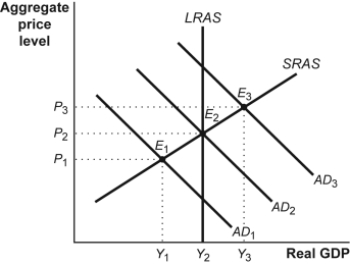 -(Figure: Inflationary and Recessionary Gaps) Refer to Figure: Inflationary and Recessionary Gaps. At E3, the economy:
 (Multiple Choice)
5.0/5 (73)
(73) Use the following to answer questions:  -(Figure: Fiscal Policy Choices) Refer to Figure: Fiscal Policy Choices. In panel (b), if real GDP is equal to Y1, there is:
 (Multiple Choice)
4.8/5 (62)
(62) Suppose the government increases taxes by more than is necessary to close an inflationary gap. What is the MOST likely result?
(Multiple Choice)
4.8/5 (71)
(71) To close an inflationary gap with fiscal policy, the government could:
(Multiple Choice)
4.8/5 (75)
(75) 
Filters
- Essay(0)
- Multiple Choice(0)
- Short Answer(0)
- True False(0)
- Matching(0)