



 Chat with AI
Exam 13: Fiscal Policy

Exam 1: First Principles183 Questions
Exam 2: Economic Models: Trade-Offs and Trade341 Questions
Exam 3: Supply and Demand230 Questions
Exam 4: Price Controls and Quotas: Meddling With Markets187 Questions
Exam 5: International Trade224 Questions
Exam 6: Macroeconomics: the Big Picture128 Questions
Exam 7: GDP and the CPI: Tracking the Macroeconomy213 Questions
Exam 8: Unemployment and Inflation300 Questions
Exam 9: Long-Run Economic Growth268 Questions
Exam 10: Savings, Investment Spending, and the Financial Syst355 Questions
Exam 11: Income and Expenditure114 Questions
Exam 12: Aggregate Demand and Aggregate Supply308 Questions
Exam 13: Fiscal Policy120 Questions
Exam 14: Money, Banking, and the Federal Reserve System135 Questions
Exam 15: Monetary Policy316 Questions
Exam 16: Inflation, Disinflation, and Deflation194 Questions
Exam 17: Macroeconomics: Events and Ideas283 Questions
Exam 18: International Macroeconomics411 Questions
Select questions type


Use the following to answer questions:  -(Figure: Inflationary and Recessionary Gaps) Refer to Figure: Inflationary and Recessionary Gaps. At E1, the economy:
 (Multiple Choice)
4.8/5  (80)
(80) Use the following to answer questions: 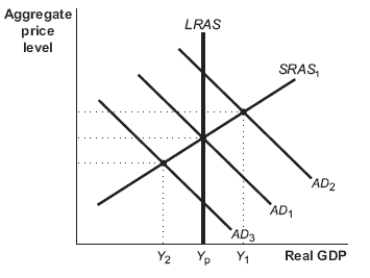 -(Figure: AD-AS) Refer to Figure: AD-AS. Suppose the economy is producing the output level Yp and a negative demand shock shifts the AD1 curve to AD3. The economy now has a(n) _____ gap, which can be closed by _____ fiscal policy.
 (Multiple Choice)
4.9/5 (81)
(81) Use the following to answer questions:  -(Figure: Short- and Long-Run Equilibrium II) Refer to Figure: Short- and Long-Run Equilibrium II. Which action would be the appropriate response on the part of the government upon viewing the state of the economy?
 (Multiple Choice)
4.9/5 (87)
(87) Some argue that budget deficits will lead to reduced private spending because:
(Multiple Choice)
4.9/5 (78)
(78) Use the following to answer questions:
-(Figure: Short- and Long-Run Equilibrium II) Refer to Figure: Short- and Long-Run Equilibrium II. If the economy is at equilibrium at E1, the government should use _____ fiscal policy to shift the aggregate demand curve to the _____.
-(Figure: Short- and Long-Run Equilibrium II) Refer to Figure: Short- and Long-Run Equilibrium II. If the economy is at equilibrium at E1, the government should use _____ fiscal policy to shift the aggregate demand curve to the _____. (Multiple Choice)
4.9/5 (80)
(80) Use the following to answer questions:
-(Figure: AD-AS) Refer to Figure: AD-AS. Consider an economy that is producing an output level of Y1. The economy has a(n) _____ gap, which can be closed by _____ fiscal policy.
-(Figure: AD-AS) Refer to Figure: AD-AS. Consider an economy that is producing an output level of Y1. The economy has a(n) _____ gap, which can be closed by _____ fiscal policy. (Multiple Choice)
4.9/5 (70)
(70) Use the following to answer questions:
-(Figure: Inflationary and Recessionary Gaps) Refer to Figure: Inflationary and Recessionary Gaps. A movement from AD1 to AD3 could be caused by:
-(Figure: Inflationary and Recessionary Gaps) Refer to Figure: Inflationary and Recessionary Gaps. A movement from AD1 to AD3 could be caused by: (Multiple Choice)
5.0/5 (78)
(78) Suppose that the government increases spending more than is necessary to close a recessionary gap. What is the MOST likely result?
(Multiple Choice)
4.8/5 (65)
(65) Use the following to answer questions:  -(Figure: Fiscal Policy Options) Refer to Figure: Fiscal Policy Options. If the aggregate demand curve is AD, the most appropriate discretionary fiscal policy is to _____ government spending and _____ income tax rates.
 (Multiple Choice)
4.9/5 (85)
(85) To close a recessionary gap with fiscal policy, the government could:
(Multiple Choice)
4.7/5 (82)
(82) Time lags associated with policy decision making and implementation suggest that:
(Multiple Choice)
4.9/5 (74)
(74) President Johnson's use of a temporary 10% surcharge on income taxes is a classic example of _____ policy.
(Multiple Choice)
4.9/5 (76)
(76) After passage of the stimulus in 2009 government borrowing _____, and interest rates_____.
(Multiple Choice)
4.7/5 (83)
(83) 
Filters
- Essay(0)
- Multiple Choice(0)
- Short Answer(0)
- True False(0)
- Matching(0)