



 Chat with AI
Exam 16: Inflation, Disinflation, and Deflation

Exam 1: First Principles183 Questions
Exam 2: Economic Models: Trade-Offs and Trade341 Questions
Exam 3: Supply and Demand230 Questions
Exam 4: Price Controls and Quotas: Meddling With Markets187 Questions
Exam 5: International Trade224 Questions
Exam 6: Macroeconomics: the Big Picture128 Questions
Exam 7: GDP and the CPI: Tracking the Macroeconomy213 Questions
Exam 8: Unemployment and Inflation300 Questions
Exam 9: Long-Run Economic Growth268 Questions
Exam 10: Savings, Investment Spending, and the Financial Syst355 Questions
Exam 11: Income and Expenditure114 Questions
Exam 12: Aggregate Demand and Aggregate Supply308 Questions
Exam 13: Fiscal Policy120 Questions
Exam 14: Money, Banking, and the Federal Reserve System135 Questions
Exam 15: Monetary Policy316 Questions
Exam 16: Inflation, Disinflation, and Deflation194 Questions
Exam 17: Macroeconomics: Events and Ideas283 Questions
Exam 18: International Macroeconomics411 Questions
Select questions type


Use the following to answer questions: 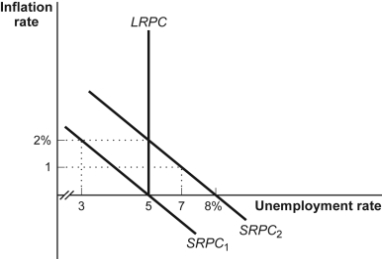 -(Figure: Short-Run Phillips Curve) Refer to Figure: Short-Run Phillips Curve. SRPC1 is based on an expected inflation rate of:
 (Multiple Choice)
4.8/5  (80)
(80) Suppose the economy is in long-run equilibrium. The government has just decided to lower income taxes. The long-run impact of this policy will be _____ in the natural rate of unemployment and _____ in price level.
(Multiple Choice)
4.8/5 (73)
(73) Politicians may accept moderate inflation in an election year, since the _____ in aggregate _____ serves to _____.
(Multiple Choice)
4.9/5 (85)
(85) Disinflation is costly to the economy if _____ is forced on the economy, _____, and _____.
(Multiple Choice)
4.8/5 (76)
(76) Use the following to answer questions:  -(Figure: Actual and Natural Rates of Unemployment) Refer to Figure: Actual and Natural Rates of Unemployment. In 2011, the amount of cyclical unemployment was approximately:
 (Multiple Choice)
4.9/5 (90)
(90) If the short-run Phillips curve has shifted downward, the _____ curve has shifted to the _____.
(Multiple Choice)
4.8/5 (73)
(73) Economists call the revenue generated by the government's right to print money:
(Multiple Choice)
4.8/5 (73)
(73) Use the following to answer questions: 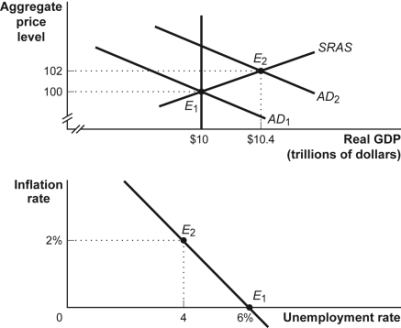 -(Figure: AD-AS Model and the Short-Run Phillips Curve) Refer to Figure: AD-AS Model and the Short-Run Phillips Curve. If the central bank increases the money supply so that aggregate demand shifts from AD1 to AD2, then the inflation rate will be:
 (Multiple Choice)
4.9/5 (77)
(77) According to Okun's law, unemployment must decrease by 1% for output to increase by 1%.
(True/False)
4.8/5 (92)
(92) Which statement is likely to be TRUE if actual output is equal to potential output?
(Multiple Choice)
4.8/5 (86)
(86) Use the following to answer questions:
-(Figure: Short-Run Phillips Curve) Refer to Figure: Short-Run Phillips Curve. The NAIRU is _____%.
-(Figure: Short-Run Phillips Curve) Refer to Figure: Short-Run Phillips Curve. The NAIRU is _____%. (Multiple Choice)
4.9/5 (89)
(89) Historical evidence has led economists to conclude that during periods of high inflation, the _____ model of the price level is a good approximation of reality because nominal wages and prices adjust more _____ than during periods of low inflation.
(Multiple Choice)
4.8/5 (72)
(72) The difference between real GDP and potential GDP is known as the:
(Multiple Choice)
5.0/5 (61)
(61) Workers in country A have wage contracts for cost-of-living adjustments (COLAs), which adjust wages to offset the effect of inflation, and workers in country B do not. When the central banks of countries A and B increase the money supply:
(Multiple Choice)
4.8/5 (73)
(73) Assume that the economy is contracting and unemployment is rising. Which of the following would be a logical explanation for a sudden fall in the unemployment rate even while the economy continues to contract?
(Multiple Choice)
4.9/5 (68)
(68) The natural rate of unemployment is 4%, and the economy is producing 95% of its potential output. Okun's law predicts an unemployment rate of _____%.
(Multiple Choice)
4.9/5 (78)
(78) 
Filters
- Essay(0)
- Multiple Choice(0)
- Short Answer(0)
- True False(0)
- Matching(0)