



 Chat with AI
Exam 16: Inflation, Disinflation, and Deflation

Exam 1: First Principles183 Questions
Exam 2: Economic Models: Trade-Offs and Trade341 Questions
Exam 3: Supply and Demand230 Questions
Exam 4: Price Controls and Quotas: Meddling With Markets187 Questions
Exam 5: International Trade224 Questions
Exam 6: Macroeconomics: the Big Picture128 Questions
Exam 7: GDP and the CPI: Tracking the Macroeconomy213 Questions
Exam 8: Unemployment and Inflation300 Questions
Exam 9: Long-Run Economic Growth268 Questions
Exam 10: Savings, Investment Spending, and the Financial Syst355 Questions
Exam 11: Income and Expenditure114 Questions
Exam 12: Aggregate Demand and Aggregate Supply308 Questions
Exam 13: Fiscal Policy120 Questions
Exam 14: Money, Banking, and the Federal Reserve System135 Questions
Exam 15: Monetary Policy316 Questions
Exam 16: Inflation, Disinflation, and Deflation194 Questions
Exam 17: Macroeconomics: Events and Ideas283 Questions
Exam 18: International Macroeconomics411 Questions
Select questions type


When economists state that there is a zero bound on nominal interest rates, they mean that the:
(Multiple Choice)
4.8/5  (84)
(84) In debt deflation, deflation raises the cost of existing debt by increasing the value of money needed to pay it off, leading to a(n) _____ in aggregate _____.
(Multiple Choice)
5.0/5 (81)
(81) Use the following to answer questions: 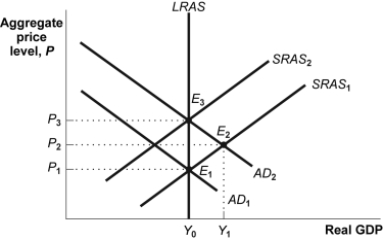 -(Figure: AD-AS) Refer to Figure: AD-AS. If our economy is at equilibrium with low-level inflation and the Fed uses expansionary monetary policy, the initial effect is that _____ will shift to _____ and the economy will move from _____.
 (Multiple Choice)
4.9/5 (83)
(83) Use the following to answer questions:
-(Figure: AD-AS) Refer to Figure: AD-AS. Suppose that the economy starts at E1 and moves to E2, where AD2 intersects SRAS1. Finally, the economy moves to E3. The classical model of price level assumes that the economy moves from _____; thus, inflation _____ and real GDP _____.
-(Figure: AD-AS) Refer to Figure: AD-AS. Suppose that the economy starts at E1 and moves to E2, where AD2 intersects SRAS1. Finally, the economy moves to E3. The classical model of price level assumes that the economy moves from _____; thus, inflation _____ and real GDP _____. (Multiple Choice)
4.8/5 (75)
(75) Which shape accurately portrays the long-run Phillips curve?
(Multiple Choice)
4.7/5 (80)
(80) Use the following to answer questions: 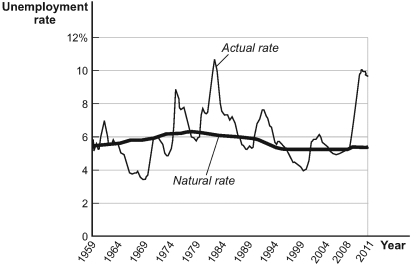 -(Figure: Actual and Natural Rates of Unemployment) Refer to Figure: Actual and Natural Rates of Unemployment. In 2011, the natural unemployment rate was approximately:
 (Multiple Choice)
4.8/5 (59)
(59) If the public holds $300 billion in monetary purchasing power and the inflation rate is 5%, then the inflation tax that year is:
(Multiple Choice)
4.9/5 (88)
(88) If the short-run Phillips curve has shifted upward, the _____ curve has shifted to the _____.
(Multiple Choice)
4.9/5 (79)
(79) If potential output is higher than actual output, then the unemployment rate is:
(Multiple Choice)
4.7/5 (72)
(72) Use the following to answer questions:
-(Figure: Actual and Natural Rates of Unemployment) Refer to Figure: Actual and Natural Rates of Unemployment. In 2011 the output gap was:
-(Figure: Actual and Natural Rates of Unemployment) Refer to Figure: Actual and Natural Rates of Unemployment. In 2011 the output gap was: (Multiple Choice)
4.9/5 (75)
(75) Use the following to answer questions:
-(Figure: Actual and Natural Rates of Unemployment) Refer to Figure: Actual and Natural Rates of Unemployment. In 2000, the output gap was:
-(Figure: Actual and Natural Rates of Unemployment) Refer to Figure: Actual and Natural Rates of Unemployment. In 2000, the output gap was: (Multiple Choice)
4.8/5 (78)
(78) People can avoid the inflation tax by reducing their real money balances.
(True/False)
4.9/5 (84)
(84) When workers and firms become aware of a rise in the general price level:
(Multiple Choice)
4.9/5 (76)
(76) In 1958, _____ came up with a theory regarding the trade-off between unemployment and inflation.
(Multiple Choice)
5.0/5 (67)
(67) Historically, governments have turned to seignorage to pay their bills when the:
(Multiple Choice)
4.7/5 (70)
(70) 
Filters
- Essay(0)
- Multiple Choice(0)
- Short Answer(0)
- True False(0)
- Matching(0)