



 Chat with AI
Exam 16: Inflation, Disinflation, and Deflation

Exam 1: First Principles183 Questions
Exam 2: Economic Models: Trade-Offs and Trade341 Questions
Exam 3: Supply and Demand230 Questions
Exam 4: Price Controls and Quotas: Meddling With Markets187 Questions
Exam 5: International Trade224 Questions
Exam 6: Macroeconomics: the Big Picture128 Questions
Exam 7: GDP and the CPI: Tracking the Macroeconomy213 Questions
Exam 8: Unemployment and Inflation300 Questions
Exam 9: Long-Run Economic Growth268 Questions
Exam 10: Savings, Investment Spending, and the Financial Syst355 Questions
Exam 11: Income and Expenditure114 Questions
Exam 12: Aggregate Demand and Aggregate Supply308 Questions
Exam 13: Fiscal Policy120 Questions
Exam 14: Money, Banking, and the Federal Reserve System135 Questions
Exam 15: Monetary Policy316 Questions
Exam 16: Inflation, Disinflation, and Deflation194 Questions
Exam 17: Macroeconomics: Events and Ideas283 Questions
Exam 18: International Macroeconomics411 Questions
Select questions type


Expecting the inflation rate to be 3%, Adrianna decides to put her savings in bonds yielding a fixed 5% interest rate over a year. If the actual inflation rate is _____, it can be argued that _____ is/are better off.
(Multiple Choice)
4.8/5  (79)
(79) The measure used by the Fed that excludes food and energy prices is the:
(Multiple Choice)
4.8/5 (78)
(78) If the money supply grows by 4% and the real money supply is $100 billion, real seignorage is:
(Multiple Choice)
4.8/5 (70)
(70) During periods of low inflation, the short-run aggregate supply curve is:
(Multiple Choice)
4.9/5 (80)
(80) To avoid falling into a liquidity trap, most central banks:
(Multiple Choice)
4.9/5 (69)
(69) In June 2008 Zimbabwe had the world's highest unemployment rate.
(True/False)
4.8/5 (83)
(83) Use the following to answer questions: 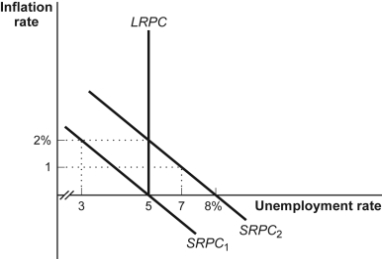 -(Figure: Short-Run Phillips Curve) Refer to Figure: Short-Run Phillips Curve. The natural rate of unemployment is _____%.
 (Multiple Choice)
4.9/5 (74)
(74) The unemployment rate will fall if potential output growth is:
(Multiple Choice)
4.9/5 (70)
(70) It is impossible for the U.S. government to raise revenue by printing more money because the Federal Reserve, not the Treasury, issues most of the U.S. money supply.
(True/False)
4.7/5 (81)
(81) The notion that there is a trade-off between inflation and unemployment is expressed as a _____ curve.
(Multiple Choice)
4.9/5 (89)
(89) Which of the following is the BEST explanation for an upward-sloping short-run aggregate supply curve?
(Multiple Choice)
4.8/5 (69)
(69) The inability to use monetary policy because the nominal rate of interest cannot fall below zero is called:
(Multiple Choice)
4.9/5 (95)
(95) If an administration pursues expansionary policy before an election to bring down unemployment, it can:
(Multiple Choice)
4.9/5 (81)
(81) If the money held by the public is $3 billion and inflation is 6%, the inflation tax is:
(Multiple Choice)
4.9/5 (87)
(87) If there has been a downward movement along the fixed short-run Phillips curve, the _____ curve has shifted to the _____.
(Multiple Choice)
4.8/5 (78)
(78) Use the following to answer questions: 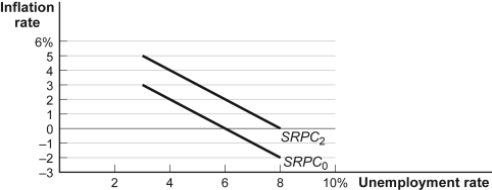 -(Figure: Expected Inflation and the Short-Run Phillips Curve) SRPC0 is the Phillips curve with an expected inflation rate of zero; SRPC2 is the Phillips curve with an expected inflation rate of 2%. Refer to Figure: Expected Inflation and the Short-Run Phillips Curve. Suppose that this economy has an unemployment rate of 6%, no inflation, and no expectation of inflation. If the central bank increases the money supply such that aggregate demand shifts to the right and unemployment falls to 4%, then inflation will:
 (Multiple Choice)
4.8/5 (81)
(81) The worst inflation in the United States in modern times occurred in the late 1970s, when prices were increasing at an annual rate of 13%.
(True/False)
4.9/5 (77)
(77) The problem of debt deflation deepens during an economic slump because:
(Multiple Choice)
4.8/5 (72)
(72) 
Filters
- Essay(0)
- Multiple Choice(0)
- Short Answer(0)
- True False(0)
- Matching(0)