



 Chat with AI
Exam 17: Macroeconomics: Events and Ideas

Exam 1: First Principles183 Questions
Exam 2: Economic Models: Trade-Offs and Trade341 Questions
Exam 3: Supply and Demand230 Questions
Exam 4: Price Controls and Quotas: Meddling With Markets187 Questions
Exam 5: International Trade224 Questions
Exam 6: Macroeconomics: the Big Picture128 Questions
Exam 7: GDP and the CPI: Tracking the Macroeconomy213 Questions
Exam 8: Unemployment and Inflation300 Questions
Exam 9: Long-Run Economic Growth268 Questions
Exam 10: Savings, Investment Spending, and the Financial Syst355 Questions
Exam 11: Income and Expenditure114 Questions
Exam 12: Aggregate Demand and Aggregate Supply308 Questions
Exam 13: Fiscal Policy120 Questions
Exam 14: Money, Banking, and the Federal Reserve System135 Questions
Exam 15: Monetary Policy316 Questions
Exam 16: Inflation, Disinflation, and Deflation194 Questions
Exam 17: Macroeconomics: Events and Ideas283 Questions
Exam 18: International Macroeconomics411 Questions
Select questions type


Classical macroeconomists focused on the long-run effects of monetary policy on the aggregate price level and argued that it had no short-run or long-run effects on aggregate output.
(True/False)
4.9/5  (68)
(68) Rational expectations theory asserts that because people have rational expectations, if a policy of reducing the money supply is used:
(Multiple Choice)
4.8/5 (75)
(75) The belief that expansionary monetary policy is NOT at all helpful to the economy in fighting recessions is attributed to:
(Multiple Choice)
4.7/5 (80)
(80) The Great Moderation consensus includes the belief that expansionary monetary policy is effective in fighting recessions.
(True/False)
4.9/5 (85)
(85) The slump that followed the 2008 financial crisis is called the:
(Multiple Choice)
4.9/5 (80)
(80) When other things are equal and using the classical model, an increase in the money supply leads to an equal proportional _____ in the aggregate _____, with no effect on aggregate _____.
(Multiple Choice)
4.7/5 (91)
(91) Cutting government spending to increase private-sector confidence, leading to increases in output and employment, is called:
(Multiple Choice)
5.0/5 (79)
(79) Milton Friedman was the leading figure in the movement called:
(Multiple Choice)
4.8/5 (69)
(69) According to Keynes, the remedy for a recessionary gap was straightforward. The solution was to:
(Multiple Choice)
4.9/5 (85)
(85) Nearly all economists agree that expansionary fiscal policy can _____ aggregate _____.
(Multiple Choice)
4.8/5 (87)
(87) Use of activist fiscal and monetary policy can bring rapid growth, as was the case in the United States before the 1972 election. One consequence of an activist policy is:
(Multiple Choice)
5.0/5 (71)
(71) Which statement is FALSE? At the time of the Great Depression:
(Multiple Choice)
5.0/5 (72)
(72) Discretionary fiscal policy may be counterproductive because:
(Multiple Choice)
4.7/5 (73)
(73) Use the following to answer questions: 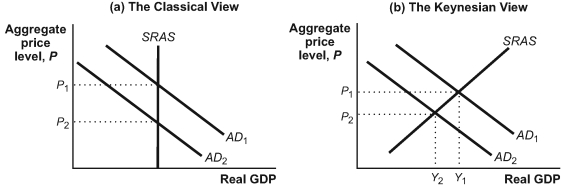 -(Figure: Classical Versus Keynesian Macroeconomics) Refer to Figure: Classical Versus Keynesian Macroeconomics. According to the Keynesian view, if this economy shifts from AD2 to AD1, perhaps because of a large increase in government spending, the price level will _____ and real GDP will _____.
 (Multiple Choice)
4.9/5 (74)
(74) 
Filters
- Essay(0)
- Multiple Choice(0)
- Short Answer(0)
- True False(0)
- Matching(0)