



 Chat with AI
Exam 17: Macroeconomics: Events and Ideas

Exam 1: First Principles183 Questions
Exam 2: Economic Models: Trade-Offs and Trade341 Questions
Exam 3: Supply and Demand230 Questions
Exam 4: Price Controls and Quotas: Meddling With Markets187 Questions
Exam 5: International Trade224 Questions
Exam 6: Macroeconomics: the Big Picture128 Questions
Exam 7: GDP and the CPI: Tracking the Macroeconomy213 Questions
Exam 8: Unemployment and Inflation300 Questions
Exam 9: Long-Run Economic Growth268 Questions
Exam 10: Savings, Investment Spending, and the Financial Syst355 Questions
Exam 11: Income and Expenditure114 Questions
Exam 12: Aggregate Demand and Aggregate Supply308 Questions
Exam 13: Fiscal Policy120 Questions
Exam 14: Money, Banking, and the Federal Reserve System135 Questions
Exam 15: Monetary Policy316 Questions
Exam 16: Inflation, Disinflation, and Deflation194 Questions
Exam 17: Macroeconomics: Events and Ideas283 Questions
Exam 18: International Macroeconomics411 Questions
Select questions type


Use the following to answer questions: 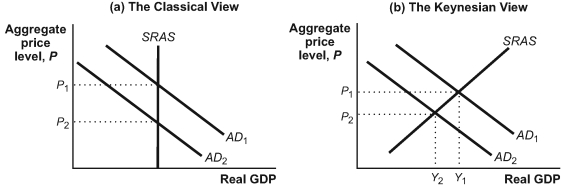 -(Figure: Classical Versus Keynesian Macroeconomics) Refer to Figure: Classical Versus Keynesian Macroeconomics. According to the classical view, if this economy shifts from AD1 to AD2, perhaps because of a large decline in investment spending by businesses, the price level will _____ and real GDP will _____.
 (Multiple Choice)
4.8/5  (83)
(83) Under rational expectations, government policy can be effective:
(Multiple Choice)
5.0/5 (66)
(66) Most economists believe that the budget should not be balanced annually but should be allowed to function as an automatic stabilizer.
(True/False)
4.8/5 (97)
(97) Most economists today believe that the appropriate monetary and/or fiscal policy can permanently reduce the unemployment rate below the natural rate.
(True/False)
4.7/5 (76)
(76) Keynesian economics emphasized that economic downturns could be due to:
(Multiple Choice)
4.8/5 (87)
(87) The historical validation of Keynes's theory came through the:
(Multiple Choice)
4.9/5 (84)
(84) _____ is the MOST likely to advocate the use of fiscal policy in fighting recessions.
(Multiple Choice)
4.8/5 (74)
(74) Nearly all economists agree that fiscal policy _____ keep the economy _____.
(Multiple Choice)
4.7/5 (82)
(82) The General Theory of Employment, Interest, and Money, written by _____ and published in _____, transformed the way economists thought about macroeconomics.
(Multiple Choice)
4.8/5 (71)
(71) If the money supply is growing at a constant rate of 2% and the economy undergoes a negative demand shock, the theory of monetarism recommends:
(Multiple Choice)
4.8/5 (86)
(86) Crowding out is MOST likely when expansionary fiscal policy is accompanied by:
(Multiple Choice)
4.9/5 (91)
(91) A policy of fiscal stimulus involves _____ taxes and _____ government spending.
(Multiple Choice)
4.8/5 (83)
(83) Which view of macroeconomics holds that a decrease in the money supply will reduce inflationary pressure?
(Multiple Choice)
4.7/5 (89)
(89) 
Filters
- Essay(0)
- Multiple Choice(0)
- Short Answer(0)
- True False(0)
- Matching(0)