



 Chat with AI
Exam 17: Macroeconomics: Events and Ideas

Exam 1: First Principles183 Questions
Exam 2: Economic Models: Trade-Offs and Trade341 Questions
Exam 3: Supply and Demand230 Questions
Exam 4: Price Controls and Quotas: Meddling With Markets187 Questions
Exam 5: International Trade224 Questions
Exam 6: Macroeconomics: the Big Picture128 Questions
Exam 7: GDP and the CPI: Tracking the Macroeconomy213 Questions
Exam 8: Unemployment and Inflation300 Questions
Exam 9: Long-Run Economic Growth268 Questions
Exam 10: Savings, Investment Spending, and the Financial Syst355 Questions
Exam 11: Income and Expenditure114 Questions
Exam 12: Aggregate Demand and Aggregate Supply308 Questions
Exam 13: Fiscal Policy120 Questions
Exam 14: Money, Banking, and the Federal Reserve System135 Questions
Exam 15: Monetary Policy316 Questions
Exam 16: Inflation, Disinflation, and Deflation194 Questions
Exam 17: Macroeconomics: Events and Ideas283 Questions
Exam 18: International Macroeconomics411 Questions
Select questions type


Which year is often described as the worst year of the Great Depression?
(Multiple Choice)
4.8/5  (69)
(69) Use the following to answer questions: 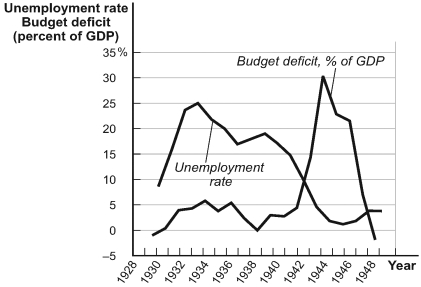 -(Figure: Fiscal Policy and the End of the Great Depression) Refer to Figure: Fiscal Policy and the End of the Great Depression. The period from 1933 through 1936 would seem to indicate that in the short run a moderate level of government deficit spending can _____ the unemployment rate.
 (Multiple Choice)
4.8/5 (64)
(64) According to the classical model of the price level, the short-run aggregate supply curve is:
(Multiple Choice)
4.7/5 (79)
(79) The recommendation that a decrease in taxes will alleviate a recessionary gap is consistent with _____ macroeconomics.
(Multiple Choice)
4.8/5 (65)
(65) Opponents of quantitative easing argued that the _____ monetary policy would cause _____.
(Multiple Choice)
4.7/5 (90)
(90) According to the theory of rational expectations, individuals will respond to expansionary monetary policy by predicting:
(Multiple Choice)
4.8/5 (89)
(89) Most economists today agree that the Federal Reserve should remain independent so that it is insulated from political pressure.
(True/False)
5.0/5 (67)
(67) Classical economics is based primarily on the works of John Maynard Keynes.
(True/False)
4.9/5 (78)
(78) Economists today generally believe that fiscal policy should be the primary tool for stabilizing the economy.
(True/False)
4.7/5 (81)
(81) During the Great Recession, policy makers were not as worried as usual about the lags associated with discretionary fiscal policy because:
(Multiple Choice)
4.8/5 (76)
(76) Use the following to answer questions:  -(Figure: Classical Versus Keynesian Macroeconomics) Refer to Figure: Classical Versus Keynesian Macroeconomics. According to the Keynesian view, if this economy shifts from AD1 to AD2 because of a large decline in investment spending by businesses, the price level will _____, and real GDP will _____.
 (Multiple Choice)
4.9/5 (82)
(82) The Great Moderation consensus among macroeconomists is that fiscal policy should be used sparingly because:
(Multiple Choice)
4.8/5 (70)
(70) The school of economics that predominated prior to the Great Depression was the:
(Multiple Choice)
4.9/5 (95)
(95) Which statement about new classical macroeconomics is FALSE?
(Multiple Choice)
4.9/5 (76)
(76) Keynesian theory argued that monetary policy could be very effective during a depression.
(True/False)
4.8/5 (86)
(86) 
Filters
- Essay(0)
- Multiple Choice(0)
- Short Answer(0)
- True False(0)
- Matching(0)