



 Chat with AI
Exam 11: The Muscular System

Exam 1: An Introduction to the Human Body78 Questions
Exam 2: Cells75 Questions
Exam 3: Tissues75 Questions
Exam 4: Development85 Questions
Exam 5: The Integumentary System75 Questions
Exam 6: Bone Tissue75 Questions
Exam 7: The Skeletal System: the Axial Skeleton75 Questions
Exam 8: The Skeletal System: the Appendicular Skeleton75 Questions
Exam 9: Joints75 Questions
Exam 10: Muscular Tissue75 Questions
Exam 11: The Muscular System75 Questions
Exam 12: The Cardiovascular System: Blood75 Questions
Exam 13: The Cardiovascular System: the Heart75 Questions
Exam 14: The Cardiovascular System: Blood Vessels75 Questions
Exam 15: The Lymphatic Lymphoid System and Immunity75 Questions
Exam 16: Nervous Tissue75 Questions
Exam 17: The Spinal Cord and the Spinal Nerves75 Questions
Exam 18: The Brain and the Cranial Nerves75 Questions
Exam 19: The Autonomic Nervous System75 Questions
Exam 20: Somatic Senses and Motor Control75 Questions
Exam 21: Special Senses75 Questions
Exam 22: The Endocrine System75 Questions
Exam 23: The Respiratory System87 Questions
Exam 24: The Digestive System75 Questions
Exam 25: The Urinary System100 Questions
Exam 26: The Reproductive Systems75 Questions
Exam 27: Surface Anatomy74 Questions
Select questions type


Muscles with either parallel or fusiform arrangements of fasciculi tend to have longer fibers than pennate muscles.
(True/False)
4.9/5  (86)
(86) The muscles of the posterior compartment of the thigh _____ the thigh and _____ the leg.
(Multiple Choice)
4.7/5 (66)
(66) The following muscles all have attachments to ribs or their costal cartilages. Which of them are NOT used to produce the movements of normal breathing?
1) external intercostals
2) internal intercostals
3) external obliques
4) internal obliques
5) diaphragm
(Multiple Choice)
4.9/5 (89)
(89) Which two muscles provide good examples for use of the term "synergists"?
(Multiple Choice)
4.9/5 (69)
(69) The rotator cuff muscles are _____, _____, _____, and _____. What vigorous movement of the shoulder most likely contributes to a rotator cuff injury?
(Essay)
4.9/5 (75)
(75) 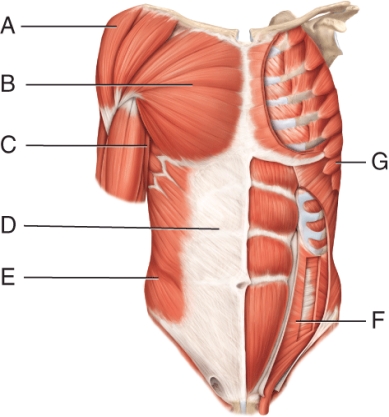
Of the muscles that move the forearm, two have points of origin on the scapula. They are the biceps brachii and the:
(Multiple Choice)
4.8/5 (79)
(79) The _____ muscle extends from the sternum to the thyroid cartilage and acts to depress the larynx.
(Multiple Choice)
4.7/5 (79)
(79) All muscles of facial expression are innervated by the _____ cranial nerve.
(Short Answer)
4.9/5 (86)
(86) The most common type of lever in the body is the first-class lever designated as EFL.
(True/False)
4.8/5 (76)
(76) The three intrinsic muscles of the hand that produce thumb movements are, as a group, called _____ muscles.
(Short Answer)
4.8/5 (90)
(90) Which two muscles provide a good example of an "antagonistic pair"?
(Multiple Choice)
4.9/5 (87)
(87) 
Filters
- Essay(0)
- Multiple Choice(0)
- Short Answer(0)
- True False(0)
- Matching(0)