



 Chat with AI
Exam 11: The Muscular System

Exam 1: An Introduction to the Human Body78 Questions
Exam 2: Cells75 Questions
Exam 3: Tissues75 Questions
Exam 4: Development85 Questions
Exam 5: The Integumentary System75 Questions
Exam 6: Bone Tissue75 Questions
Exam 7: The Skeletal System: the Axial Skeleton75 Questions
Exam 8: The Skeletal System: the Appendicular Skeleton75 Questions
Exam 9: Joints75 Questions
Exam 10: Muscular Tissue75 Questions
Exam 11: The Muscular System75 Questions
Exam 12: The Cardiovascular System: Blood75 Questions
Exam 13: The Cardiovascular System: the Heart75 Questions
Exam 14: The Cardiovascular System: Blood Vessels75 Questions
Exam 15: The Lymphatic Lymphoid System and Immunity75 Questions
Exam 16: Nervous Tissue75 Questions
Exam 17: The Spinal Cord and the Spinal Nerves75 Questions
Exam 18: The Brain and the Cranial Nerves75 Questions
Exam 19: The Autonomic Nervous System75 Questions
Exam 20: Somatic Senses and Motor Control75 Questions
Exam 21: Special Senses75 Questions
Exam 22: The Endocrine System75 Questions
Exam 23: The Respiratory System87 Questions
Exam 24: The Digestive System75 Questions
Exam 25: The Urinary System100 Questions
Exam 26: The Reproductive Systems75 Questions
Exam 27: Surface Anatomy74 Questions
Select questions type


Paralysis of the muscles of mastication may be an indication of damage to the trigeminal (V) cranial nerve.
(True/False)
4.8/5  (87)
(87) Which muscle originates from the medial epicondyle of the humerus AND turns the forearm (pronates) so that the palm faces posteriorly?
(Multiple Choice)
4.7/5 (79)
(79) What is the principal action of the muscle indicated by line B? 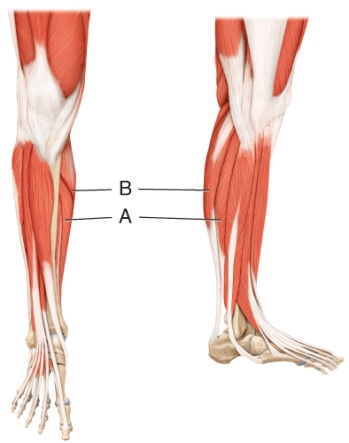
(Multiple Choice)
4.8/5 (84)
(84) Explain why an astronaut "must work hard to open their mouths" while in space but an elderly person asleep in a chair, for example, has their mouth open.
(Essay)
4.9/5 (87)
(87) The aponeurosis (sheet-like tendon) that unites the frontal belly (frontalis) and occipital belly (occipitalis) muscles is called the _____.
(Essay)
4.7/5 (80)
(80) The strength of movement produced by a muscle depends upon how close to the joint it is attached. A muscle attached farther away will produce a more powerful movement than one attached nearer the joint.
(Multiple Choice)
4.8/5 (82)
(82) 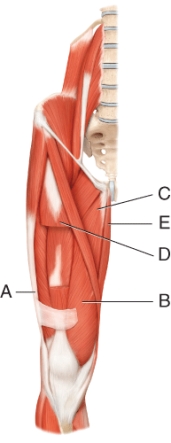
The diagastric, stylohyoid, mylohyoid, and geniohyoid muscles have which of the following in common?
(Multiple Choice)
4.9/5 (90)
(90) Regarding characteristics used to name muscles, which of the following is incorrectly matched?
(Multiple Choice)
4.8/5 (85)
(85) Medial epicondylitis which is often times seen in pianists, violinists, golfers and those who use computers is a condition which affects mainly the extensor muscles of the forearm.
(True/False)
4.8/5 (65)
(65) Which of the following pairs of terms is most closely matched?
(Multiple Choice)
4.8/5 (81)
(81) Name and describe the location of each of the muscles of the three compartments of the thigh: anterior, medial, and posterior.
(Essay)
4.8/5 (76)
(76) The genioglossus muscle could be considered a socially unacceptable muscle, since its action is to _____ the tongue.
(Short Answer)
4.9/5 (72)
(72) Branches of the _____ nerve are involved in the innervation of all perineal muscles.
(Short Answer)
5.0/5 (91)
(91) The scalenes originate on the first and second ribs and insert on the third through sixth thoracic vertebrae.
(True/False)
4.9/5 (75)
(75) Name three muscles that insert on the mastoid process. All three muscles move the head. Which one of these is antagonistic to the other two in the action of rotating the head?
(Essay)
4.8/5 (75)
(75) 
Filters
- Essay(0)
- Multiple Choice(0)
- Short Answer(0)
- True False(0)
- Matching(0)