



 Chat with AI
Exam 11: The Muscular System

Exam 1: An Introduction to the Human Body78 Questions
Exam 2: Cells75 Questions
Exam 3: Tissues75 Questions
Exam 4: Development85 Questions
Exam 5: The Integumentary System75 Questions
Exam 6: Bone Tissue75 Questions
Exam 7: The Skeletal System: the Axial Skeleton75 Questions
Exam 8: The Skeletal System: the Appendicular Skeleton75 Questions
Exam 9: Joints75 Questions
Exam 10: Muscular Tissue75 Questions
Exam 11: The Muscular System75 Questions
Exam 12: The Cardiovascular System: Blood75 Questions
Exam 13: The Cardiovascular System: the Heart75 Questions
Exam 14: The Cardiovascular System: Blood Vessels75 Questions
Exam 15: The Lymphatic Lymphoid System and Immunity75 Questions
Exam 16: Nervous Tissue75 Questions
Exam 17: The Spinal Cord and the Spinal Nerves75 Questions
Exam 18: The Brain and the Cranial Nerves75 Questions
Exam 19: The Autonomic Nervous System75 Questions
Exam 20: Somatic Senses and Motor Control75 Questions
Exam 21: Special Senses75 Questions
Exam 22: The Endocrine System75 Questions
Exam 23: The Respiratory System87 Questions
Exam 24: The Digestive System75 Questions
Exam 25: The Urinary System100 Questions
Exam 26: The Reproductive Systems75 Questions
Exam 27: Surface Anatomy74 Questions
Select questions type


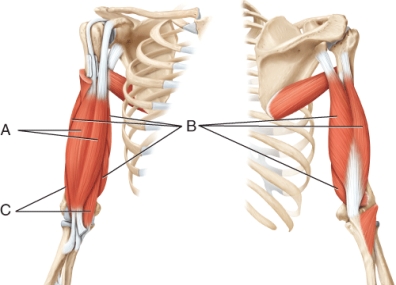

Muscles that insert via the calcaneal tendon do NOT include:
(Multiple Choice)
4.9/5  (75)
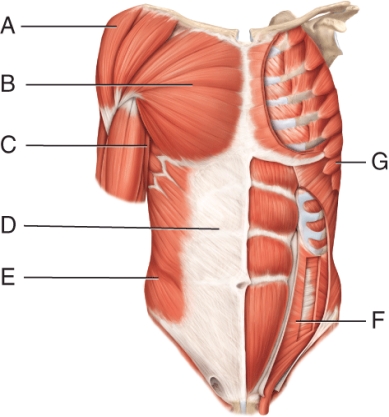
(75) 
Whereas superficial flexors in the anterior compartment of the forearm originate from the _____ epicondyle of the humerus, the superficial extensors in the posterior compartment of the forearm originate from the _____ epicondyle of the humerus.
(Multiple Choice)
4.9/5 (76)
(76) Tibialis anterior and tibialis posterior muscles both invert the foot.
(True/False)
4.9/5 (85)
(85) The extensor digitorum extends the phalanges. The extensor digiti minimi extends the distal phalanges only.
(Multiple Choice)
4.9/5 (84)
(84) Which of the muscles of the pelvic floor constricts the anus, urethra, and vagina?
(Multiple Choice)
4.9/5 (68)
(68) Muscles that extend the forearm are located on the _____ surface of the _____.
(Short Answer)
4.9/5 (71)
(71) Ordinarily, the insertion of a muscle:
1) in a limb is proximal to the origin.
2) does not move when the muscle contracts.
3) is the movable point of attachment of a muscle.
4) attaches a muscle to a bone or skin.
(Multiple Choice)
4.9/5 (80)
(80) The rectus sheath and linea alba are formed by the aponeuroses of the external obliques, internal obliques, and transversus abdominis muscles.
(True/False)
4.9/5 (75)
(75) Which of the following pairs of terms does not correctly match muscle with innervation?
(Multiple Choice)
4.8/5 (68)
(68) The _____ muscle of the larynx acts as a sphincter to control the size of the inlet of the larynx.
(Short Answer)
5.0/5 (79)
(79) The perineum consists of an anterior _____ triangle and a posterior _____ triangle.
(Multiple Choice)
4.8/5 (65)
(65) The greater tubercle of the humerus is the point of insertion of which of the following muscles?
(Multiple Choice)
4.8/5 (63)
(63) The fibers of the external oblique muscle are directed inferiorly and _____.
(Short Answer)
5.0/5 (78)
(78) List the muscles that act on the mandible to open the mouth and those that act on the mandible to close the mouth. Which set of muscles is more forceful? Why?
(Essay)
4.9/5 (90)
(90) The erector spinae is a group of muscles of the back, including which three of the following groups?
1) iliocostalis
2) spinalis
3) segmental
4) longissimus
5) scalene
(Multiple Choice)
4.8/5 (75)
(75) The central portion of the diaphragm is an aponeurosis that serves as the tendon of insertion for the diaphragm. The tendon is called:
(Multiple Choice)
4.7/5 (89)
(89) The muscle that acts on your left eyeball to move it as you read this line is the _____.
(Short Answer)
4.9/5 (81)
(81) 
Filters
- Essay(0)
- Multiple Choice(0)
- Short Answer(0)
- True False(0)
- Matching(0)