



 Chat with AI
Exam 24: The Digestive System

Exam 1: An Introduction to the Human Body78 Questions
Exam 2: Cells75 Questions
Exam 3: Tissues75 Questions
Exam 4: Development85 Questions
Exam 5: The Integumentary System75 Questions
Exam 6: Bone Tissue75 Questions
Exam 7: The Skeletal System: the Axial Skeleton75 Questions
Exam 8: The Skeletal System: the Appendicular Skeleton75 Questions
Exam 9: Joints75 Questions
Exam 10: Muscular Tissue75 Questions
Exam 11: The Muscular System75 Questions
Exam 12: The Cardiovascular System: Blood75 Questions
Exam 13: The Cardiovascular System: the Heart75 Questions
Exam 14: The Cardiovascular System: Blood Vessels75 Questions
Exam 15: The Lymphatic Lymphoid System and Immunity75 Questions
Exam 16: Nervous Tissue75 Questions
Exam 17: The Spinal Cord and the Spinal Nerves75 Questions
Exam 18: The Brain and the Cranial Nerves75 Questions
Exam 19: The Autonomic Nervous System75 Questions
Exam 20: Somatic Senses and Motor Control75 Questions
Exam 21: Special Senses75 Questions
Exam 22: The Endocrine System75 Questions
Exam 23: The Respiratory System87 Questions
Exam 24: The Digestive System75 Questions
Exam 25: The Urinary System100 Questions
Exam 26: The Reproductive Systems75 Questions
Exam 27: Surface Anatomy74 Questions
Select questions type


The hepatic veins deliver nutrient-rich blood to the sinusoids of the liver.

Free
(True/False)
4.8/5  (95)
(95) Correct Answer: Verified
False
The length of the GI tract is longer after death because of a lack of _____.
Free
(Short Answer)
4.8/5 (73)
(73) Correct Answer:Verified
Verifiedtonus
Describe the gross anatomy of the stomach. Illustrate your answer with a labeled diagram.
Free
(Essay)
4.9/5 (86)
(86) Correct Answer:Verified
VerifiedDescription and diagram should include the four regions of the stomach, the two regions of the pylorus, pyloric sphincter, rugae, and greater and lesser curvatures. See Fig. 24.10: External and Internal anatomy of the stomach.
The majority of nutrient digestion and absorption occurs in the small intestine.
(True/False)
4.8/5 (80)
(80) Trace the route most commonly traveled by pancreatic juice, from its production until it is in the lumen of the intestine.
(Essay)
4.8/5 (70)
(70) The four main regions of the stomach are cardia, fundus, cecum, and pylorus.
(True/False)
4.8/5 (83)
(83) Describe the structure of a tooth and illustrate your answer with a labeled diagram.
(Essay)
4.8/5 (79)
(79) The cecum directs waste into which structure of the large intestine?
(Multiple Choice)
4.8/5 (82)
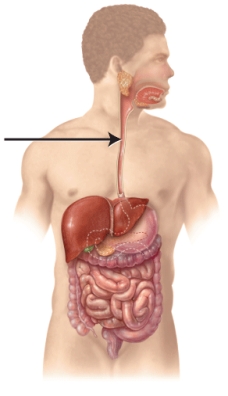
(82) 
Common changes in the digestive organs in the elderly include decreased mobility, increased mucosal secretions, and malabsoprtion.
(True/False)
4.9/5 (74)
(74) The type of epithelial tissue found in the mouth, pharynx, esophagus, and anal canal is keratinized stratified squamous epithelium.
(True/False)
4.8/5 (73)
(73) The muscularis layer of the esophagus contains skeletal muscle superiorly and changes to smooth muscle inferiorly.
(True/False)
4.7/5 (77)
(77) The gastrointestinal (GI) tract is found in the thoracic, abdominal and pelvic cavities.
(True/False)
4.9/5 (86)
(86) Which type of papillae of the tongue lack taste buds and are used to detect touch rather than taste?
(Multiple Choice)
4.8/5 (73)
(73) The _____ of the stomach is/are responsible for the production of gastric juice.
(Multiple Choice)
4.9/5 (91)
(91) Bile secreted from the gallbladder and pancreatic juice secreted from the pancreas enter which portion of the GI tract?
(Multiple Choice)
4.9/5 (92)
(92) The peritoneal fold situated as a "fatty apron" anterior to the small intestine is the _____.
(Multiple Choice)
4.9/5 (80)
(80) The greater omentum attaches to which two organs in the abdominopelvic cavity?
(Multiple Choice)
4.9/5 (88)
(88) Which of the following substances need to undergo digestion before being absorbed into the cells lining the alimentary canal?
(Multiple Choice)
4.8/5 (84)
(84) 
Filters
- Essay(0)
- Multiple Choice(0)
- Short Answer(0)
- True False(0)
- Matching(0)