



 Chat with AI
Exam 25: The Urinary System

Exam 1: An Introduction to the Human Body78 Questions
Exam 2: Cells75 Questions
Exam 3: Tissues75 Questions
Exam 4: Development85 Questions
Exam 5: The Integumentary System75 Questions
Exam 6: Bone Tissue75 Questions
Exam 7: The Skeletal System: the Axial Skeleton75 Questions
Exam 8: The Skeletal System: the Appendicular Skeleton75 Questions
Exam 9: Joints75 Questions
Exam 10: Muscular Tissue75 Questions
Exam 11: The Muscular System75 Questions
Exam 12: The Cardiovascular System: Blood75 Questions
Exam 13: The Cardiovascular System: the Heart75 Questions
Exam 14: The Cardiovascular System: Blood Vessels75 Questions
Exam 15: The Lymphatic Lymphoid System and Immunity75 Questions
Exam 16: Nervous Tissue75 Questions
Exam 17: The Spinal Cord and the Spinal Nerves75 Questions
Exam 18: The Brain and the Cranial Nerves75 Questions
Exam 19: The Autonomic Nervous System75 Questions
Exam 20: Somatic Senses and Motor Control75 Questions
Exam 21: Special Senses75 Questions
Exam 22: The Endocrine System75 Questions
Exam 23: The Respiratory System87 Questions
Exam 24: The Digestive System75 Questions
Exam 25: The Urinary System100 Questions
Exam 26: The Reproductive Systems75 Questions
Exam 27: Surface Anatomy74 Questions
Select questions type


The fetal kidneys begin excreting urine by the third month of development, thus contributing most of the volume of the amniotic fluid.
(True/False)
4.9/5  (78)
(78) What is the structure or area that the arrow is pointing to? 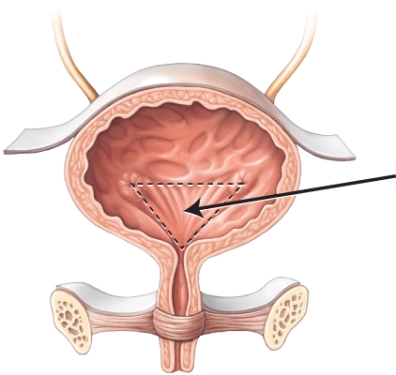
(Multiple Choice)
4.9/5 (78)
(78) The indentation on the concave border of each kidney is the renal _____.
(Short Answer)
4.7/5 (79)
(79) If red blood cells and proteins are detected in urine, it may indicate that
a. the filtration membrane in the glomerulus is not functioning properly.
b. the microvilli of the proximal convoluted tubules are not reabsorbing properly.
c. the collecting ducts are not secreting properly.
d. parietal cells are not responding to antidiuretic hormone.
(Essay)
4.8/5 (70)
(70) Which of the following structures would not be located entering/exiting the renal hilum?
(Multiple Choice)
4.8/5 (76)
(76) Trace the route of an oxygenated red blood cell from the time it passes into the kidney in a renal artery until it enters a venule as a deoxygenated red blood cell by placing the following vessels in their correct order:
1) segmental artery
2) arcuate artery
3) interlobar artery
4) peritubular capillary
5) afferent arteriole
6) peritubular venule
7) efferent arteriole
8) cortical radiate artery
9) glomerular capillaries
(Multiple Choice)
4.8/5 (93)
(93) The filtration membrane consists of the glomerular capillaries and the podocytes that surround the glomerulus.
(True/False)
4.7/5 (92)
(92) The process of tubular reabsorption rids the body of some materials such as hydrogen ions and ammonium ions and some drugs such as penicillin.
(True/False)
4.8/5 (80)
(80) Which sequence accurately describes the correct path of fluid flowing through the nephron?
(Multiple Choice)
5.0/5 (74)
(74) The portion of the renal cortex that extends between the renal pyramids are the
(Multiple Choice)
4.8/5 (63)
(63) ___are modified simple squamous cells that have pedicels and form the visceral layer of the glomerular capsule.
(Short Answer)
5.0/5 (83)
(83) Principal cells in the distal convoluted tubules contain receptors for antidiuretic hormone and
(Multiple Choice)
4.8/5 (75)
(75) Which of the following is least likely to affect filtration in the glomerulus?
(Multiple Choice)
4.7/5 (71)
(71) At the base of each renal pyramid, the interlobar arteries arch between the medulla and cortex to become the _____ arteries.
(Multiple Choice)
5.0/5 (80)
(80) The movement of substances through the epithelial cells and then into the peritubular capillaries is _____ reabsorption.
(Short Answer)
4.9/5 (87)
(87) All nephron loops (loops of Henle) receive their blood supply from the vasa recta.
(True/False)
4.9/5 (61)
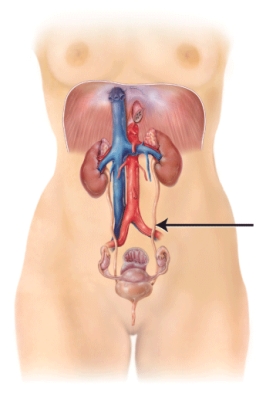
(61) 

Filters
- Essay(0)
- Multiple Choice(0)
- Short Answer(0)
- True False(0)
- Matching(0)