



 Chat with AI
Exam 25: The Urinary System

Exam 1: An Introduction to the Human Body78 Questions
Exam 2: Cells75 Questions
Exam 3: Tissues75 Questions
Exam 4: Development85 Questions
Exam 5: The Integumentary System75 Questions
Exam 6: Bone Tissue75 Questions
Exam 7: The Skeletal System: the Axial Skeleton75 Questions
Exam 8: The Skeletal System: the Appendicular Skeleton75 Questions
Exam 9: Joints75 Questions
Exam 10: Muscular Tissue75 Questions
Exam 11: The Muscular System75 Questions
Exam 12: The Cardiovascular System: Blood75 Questions
Exam 13: The Cardiovascular System: the Heart75 Questions
Exam 14: The Cardiovascular System: Blood Vessels75 Questions
Exam 15: The Lymphatic Lymphoid System and Immunity75 Questions
Exam 16: Nervous Tissue75 Questions
Exam 17: The Spinal Cord and the Spinal Nerves75 Questions
Exam 18: The Brain and the Cranial Nerves75 Questions
Exam 19: The Autonomic Nervous System75 Questions
Exam 20: Somatic Senses and Motor Control75 Questions
Exam 21: Special Senses75 Questions
Exam 22: The Endocrine System75 Questions
Exam 23: The Respiratory System87 Questions
Exam 24: The Digestive System75 Questions
Exam 25: The Urinary System100 Questions
Exam 26: The Reproductive Systems75 Questions
Exam 27: Surface Anatomy74 Questions
Select questions type


______ is defined by excess excretion of glucose in the urine.
(Short Answer)
4.9/5  (82)
(82) A renal papilla is located at the base (wider end) of each renal pyramid.
(True/False)
4.9/5 (76)
(76) The urinary system consists of two kidneys, two urethras, one urinary bladder, and one ureter.
(True/False)
5.0/5 (98)
(98) The renal corpuscle, proximal convoluted tubule, and distal convoluted tubule of a nephron are located within the renal cortex.
(True/False)
4.7/5 (79)
(79) The _____ _____ is a layer of material between the endothelium of the glomerulus and the podocytes. It contains a negatively charged glycoprotein matrix, which repels larger negatively charged proteins.
(Short Answer)
5.0/5 (78)
(78) 
Describe the three coats that make up the wall of the urinary bladder, from innermost (deepest) to outermost (most superficial).
(Essay)
4.8/5 (84)
(84) Which of the following structures is NOT a portion of a nephron?
(Multiple Choice)
4.9/5 (73)
(73) A patient who suffers from chronic bladder infections could eventually develop a more serious kidney infection. Which structure is responsible for the spread of the inflammation?
(Multiple Choice)
4.9/5 (76)
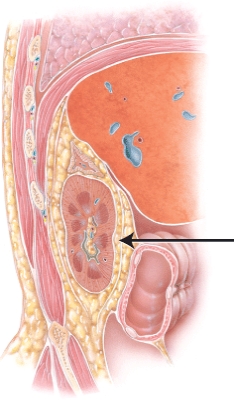
(76) Three layers of tissue surround each kidney. They are, in order from innermost (deepest) to outermost (most superficial):
1) renal capsule
2) visceral peritoneum (serosa)
3) adipose capsule
4) renal fascia
(Multiple Choice)
4.8/5 (88)
(88) Aldosterone and antidiuretic hormone target the principle cells of the proximal convoluted tubule?
(True/False)
4.8/5 (73)
(73) Which is a difference between the thin ascending limb and thick ascending limb in the juxtamedullary nephron loop?
(Multiple Choice)
4.8/5 (74)
(74) Which conclusion would be correct based on the observation that the number of nephrons in a 25 yr. old male is the same as when that individual was 5 years old?
a. the individual has had no kidney damage between 5 years and 25 years of age
b. the individual has had significant kidney damage at some point between 5 years and 25 years of age
c. the individual's kidneys are improving their function even as the kidney continues to age
d. the individual's kidneys are likely receiving reduced blow flow which prevents the nephrons from growing in number
(Essay)
4.9/5 (90)
(90) Which description is correct for cortical nephrons? Select all that apply.
(Multiple Choice)
4.9/5 (69)
(69) The urinary bladder is posterior to the pubic symphysis in males. In females, the urinary bladder is posterior to the vagina.
(Multiple Choice)
4.8/5 (82)
(82) The major blood vessel that supplies the kidney with blood from the heart is the renal artery.
(True/False)
4.8/5 (100)
(100) The distal (last) region of a ureter has only two layers of smooth muscle in the muscularis.
(True/False)
4.8/5 (65)
(65) 
Filters
- Essay(0)
- Multiple Choice(0)
- Short Answer(0)
- True False(0)
- Matching(0)