



 Chat with AI
Exam 11: Price-Searcher Markets With High Entry Barriers

Exam 1: The Economic Approach225 Questions
Exam 2: Some Tools of the Economist239 Questions
Exam 3: Demand, Supply, and the Market Process408 Questions
Exam 4: Supply and Demand: Applications and Extensions270 Questions
Exam 5: Difficult Cases for the Market, and the Role of Government184 Questions
Exam 6: The Economics of Political Action208 Questions
Exam 7: Consumer Choice and Elasticity229 Questions
Exam 8: Costs and the Supply of Goods222 Questions
Exam 9: Price Takers and the Competitive Process261 Questions
Exam 10: Price-Searcher Markets With Low Entry Barriers232 Questions
Exam 11: Price-Searcher Markets With High Entry Barriers260 Questions
Exam 12: The Supply of and Demand for Productive Resources154 Questions
Exam 13: Earnings, Productivity, and the Job Market91 Questions
Exam 14: Investment, the Capital Market, and the Wealth of Nations106 Questions
Exam 15: Income Inequality and Poverty105 Questions
Exam 16: Gaining From International Trade179 Questions
Select questions type


Which of the following explains why monopoly is uncommon in the real world?
(Multiple Choice)
4.9/5  (72)
(72) Use the figure to answer the following question(s).
Figure 11-12 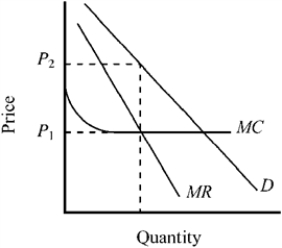 -Figure 11-12 indicates the industry cost and demand conditions for a product produced in an oligopolistic industry. The price of this product is most likely to be
 (Multiple Choice)
4.7/5 (76)
(76) Which of the following is a unique characteristic of the oligopolistic market structure?
(Multiple Choice)
4.8/5 (85)
(85) Consider the following demand and cost information for a monopoly.
Table 11-1
 -Refer to Table 11-1. The maximum profit this monopolist can earn is
 (Multiple Choice)
4.9/5 (81)
(81) When a park is funded by visitors, but not by taxpayers in general,
(Multiple Choice)
4.8/5 (77)
(77) A natural monopoly is defined as an industry in which one firm
(Multiple Choice)
4.7/5 (69)
(69) Use the figure to answer the following question(s).
Figure 11-8 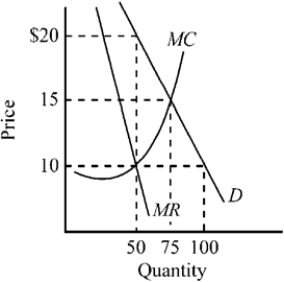 -The demand and cost conditions in an industry are as depicted in Figure 11-8. In the viewpoint of economic efficiency, what would the ideal price and output be?
 (Multiple Choice)
4.9/5 (84)
(84) When the federal government owns parks that are funded by tax dollars,
(Multiple Choice)
4.9/5 (62)
(62) Which of the following is the most efficient way to reduce pollution emissions?
(Multiple Choice)
4.8/5 (65)
(65) Which of the following is an effort to establish property rights and promote more efficient allocation of ocean fisheries?
(Multiple Choice)
4.7/5 (68)
(68) What problem does the government have that makes price regulation less than an ideal solution?
(Multiple Choice)
4.9/5 (74)
(74) In an oligopolistic market, if rival sellers act independently, each will have a strong incentive to
(Multiple Choice)
4.7/5 (69)
(69) A monopolist will earn economic profits as long as his price exceeds
(Multiple Choice)
5.0/5 (71)
(71) For a monopolist that does not price discriminate, economic profit is maximized in the short run at a price of $140. Marginal revenue at that output level is
(Multiple Choice)
4.8/5 (73)
(73) Figure 11-18  -The profit-maximizing output and price for the firm in Figure 11-18, which charges the same price to all customers, are
 (Multiple Choice)
4.9/5 (78)
(78) 
Filters
- Essay(0)
- Multiple Choice(0)
- Short Answer(0)
- True False(0)
- Matching(0)