



 Chat with AI
Exam 11: Price-Searcher Markets With High Entry Barriers

Exam 1: The Economic Approach225 Questions
Exam 2: Some Tools of the Economist239 Questions
Exam 3: Demand, Supply, and the Market Process408 Questions
Exam 4: Supply and Demand: Applications and Extensions270 Questions
Exam 5: Difficult Cases for the Market, and the Role of Government184 Questions
Exam 6: The Economics of Political Action208 Questions
Exam 7: Consumer Choice and Elasticity229 Questions
Exam 8: Costs and the Supply of Goods222 Questions
Exam 9: Price Takers and the Competitive Process261 Questions
Exam 10: Price-Searcher Markets With Low Entry Barriers232 Questions
Exam 11: Price-Searcher Markets With High Entry Barriers260 Questions
Exam 12: The Supply of and Demand for Productive Resources154 Questions
Exam 13: Earnings, Productivity, and the Job Market91 Questions
Exam 14: Investment, the Capital Market, and the Wealth of Nations106 Questions
Exam 15: Income Inequality and Poverty105 Questions
Exam 16: Gaining From International Trade179 Questions
Select questions type


Assuming that firms maximize profits, how will the price and output policy of an unregulated monopolist compare with ideal market efficiency?
(Multiple Choice)
4.9/5  (86)
(86) The prisoners' dilemma is used to illustrate the basic idea that
(Multiple Choice)
4.9/5 (81)
(81) Which of the following is true of marginal revenue for a monopolist that charges a single price?
(Multiple Choice)
4.8/5 (81)
(81) Figure 11-20  -The production level that will maximize the profit for the monopoly in Figure 11-20 is
 (Multiple Choice)
4.8/5 (86)
(86) The Redwood City Council has decided that there is an overallocation of resources in the lawn-care industry. Almost every homeowner owns a lawnmower, hose and sprinkler, seeder, spreader, etc., and these items are used, at most, once a week. The council will establish a legal monopoly and select a private firm that will be responsible for all lawn care in the city. What types of rent-seeking activities can be expected as a result of this action?
(Essay)
4.9/5 (83)
(83) Figure 11-4 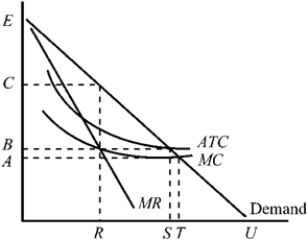 -What output would a monopolist with the demand and cost conditions depicted in Figure 11-4 produce if ordered by regulators to serve the entire market at average cost?
 (Multiple Choice)
5.0/5 (90)
(90) Which of the following is true about environmental regulation?
(Multiple Choice)
4.9/5 (86)
(86) At his current level of output, a monopolist has an MR of $10, an MC of $6, and an economic profit of zero. If the market demand curve is downward sloping and his marginal cost curve upward sloping, the monopolist
(Multiple Choice)
4.9/5 (71)
(71) At the long-run equilibrium level of output, the monopolist's marginal cost will
(Multiple Choice)
4.8/5 (80)
(80) For a privately owned business in a competitive market setting,
(Multiple Choice)
4.9/5 (67)
(67) Which of the following is an example of a deficiency caused by a regulatory approach to pollution?
(Multiple Choice)
4.8/5 (83)
(83) One key characteristic that is distinctive of an oligopoly market is that
(Multiple Choice)
4.9/5 (75)
(75) If zinc suppliers are successful in forming an international zinc cartel, they will
(Multiple Choice)
4.9/5 (83)
(83) Which of the following will reduce the likelihood of effective collusion among oligopolistic producers?
(Multiple Choice)
4.9/5 (79)
(79) A monopolist earning short-run economic profit determines that at its present level of output, marginal revenue is $23 and marginal cost is $30. Which of the following should the firm do to increase profit?
(Multiple Choice)
4.8/5 (77)
(77) Which of the following conditions would increase the likelihood of successful collusion among American automobile producers?
(Multiple Choice)
4.9/5 (72)
(72) Which of the following is true about environmental quality?
(Multiple Choice)
4.9/5 (71)
(71) Economists generally criticize high barriers to market entry because
(Multiple Choice)
4.9/5 (79)
(79) 
Filters
- Essay(0)
- Multiple Choice(0)
- Short Answer(0)
- True False(0)
- Matching(0)