



 Chat with AI
Exam 11: Price-Searcher Markets With High Entry Barriers

Exam 1: The Economic Approach225 Questions
Exam 2: Some Tools of the Economist239 Questions
Exam 3: Demand, Supply, and the Market Process408 Questions
Exam 4: Supply and Demand: Applications and Extensions270 Questions
Exam 5: Difficult Cases for the Market, and the Role of Government184 Questions
Exam 6: The Economics of Political Action208 Questions
Exam 7: Consumer Choice and Elasticity229 Questions
Exam 8: Costs and the Supply of Goods222 Questions
Exam 9: Price Takers and the Competitive Process261 Questions
Exam 10: Price-Searcher Markets With Low Entry Barriers232 Questions
Exam 11: Price-Searcher Markets With High Entry Barriers260 Questions
Exam 12: The Supply of and Demand for Productive Resources154 Questions
Exam 13: Earnings, Productivity, and the Job Market91 Questions
Exam 14: Investment, the Capital Market, and the Wealth of Nations106 Questions
Exam 15: Income Inequality and Poverty105 Questions
Exam 16: Gaining From International Trade179 Questions
Select questions type


Which of the following best explains why economists are generally critical of unregulated monopolists?
(Multiple Choice)
4.8/5  (74)
(74) Assuming that firms maximize profits, how will the price and output policy of an unregulated monopolist compare with ideal market efficiency?
(Multiple Choice)
4.8/5 (86)
(86) The difficulty in analyzing oligopolistic behavior arises from the
(Multiple Choice)
4.9/5 (74)
(74) If pizza used to be produced in a competitive price-taker market, and now the pizza market has become a monopoly, we can expect
(Multiple Choice)
4.9/5 (75)
(75) Which of the following provides the most secure protection for a firm with monopoly power?
(Multiple Choice)
4.8/5 (77)
(77) Under what conditions can a monopolist have potentially lower costs and possibly charge a lower price than would exist if the market were competitive?
(Multiple Choice)
4.8/5 (75)
(75) Regulating natural monopolies according to the "rate of return" criterion is likely to
(Multiple Choice)
4.7/5 (76)
(76) Which of the following is a problem that arises when regulations force "natural monopolies," like electric utilities, to charge a price that is equal to their marginal cost (MC)?
(Multiple Choice)
5.0/5 (70)
(70) Which of the following statements about monopoly is most accurate?
(Multiple Choice)
4.9/5 (65)
(65) Figure 11-20  -The profit-maximizing price the monopoly will charge in Figure 11-20 is
 (Multiple Choice)
4.9/5 (66)
(66) Use the figure to answer the following question(s).
Figure 11-1 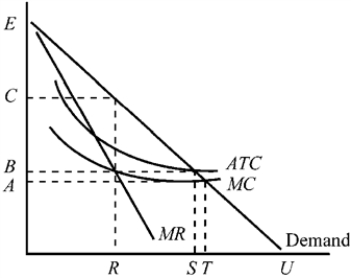 -What price and output in Figure 11-1 would an unregulated profit-maximizing monopolist choose?
 (Multiple Choice)
4.8/5 (91)
(91) Which of the following best explains why the monopolist's marginal revenue is less than the sales price?
(Multiple Choice)
4.9/5 (77)
(77) Consider the following demand and cost information for a monopoly.
Table 11-1
 -Refer to Table 11-1. The marginal revenue of the second unit is
 (Multiple Choice)
4.9/5 (70)
(70) New York City limits the number of taxi cabs that can legally operate in the city. The most likely result of this practice is that
(Multiple Choice)
4.9/5 (66)
(66) Pollution from a privately owned factory that seriously harms a privately owned forest will, if property rights are strongly protected,
(Multiple Choice)
4.9/5 (87)
(87) Concerning environmental regulation, which of the following is true?
(Multiple Choice)
4.8/5 (70)
(70) Under which of the following market conditions is it most difficult to maintain a cartel agreement?
(Multiple Choice)
4.9/5 (77)
(77) 
Filters
- Essay(0)
- Multiple Choice(0)
- Short Answer(0)
- True False(0)
- Matching(0)